Stan Weinstein Trading System – TC2000 PCF’s – TradeOn.com

Weinstein System: Weinstein Scan.

Done somewhat in the manner from Stan Weinstein’s excellent book
“How to Profit in Bull and Bear Markets”.

It is written to only look at stocks of $3 or more but you can change that.

. . . Relative Strength Indicator (RSI) higher than that from 5 days ago.
. . . Closing price is higher than the average in the past 30 days.
. . . Volume at least 120% of that from the last 2 months. (The 120% is arbitrary. I used it because it seems to work)
. . . Average volume for the last 2 months at least 100,000 shares (note that TC/2000 reports shares in hundreds).
. . . Price today higher than 30 day average
. . . Price today higher than in the last 3 weeks

((C >= 3) AND (RSI30.9 > RSI30.9.5) AND (C > AVGC30.1) AND (V >= (1.2 * AVGV42.1)) AND (AVGV42.1 >= 1000) AND (C > C1) AND (C2 < AVGC30.2) AND (C > MAXH14.3))

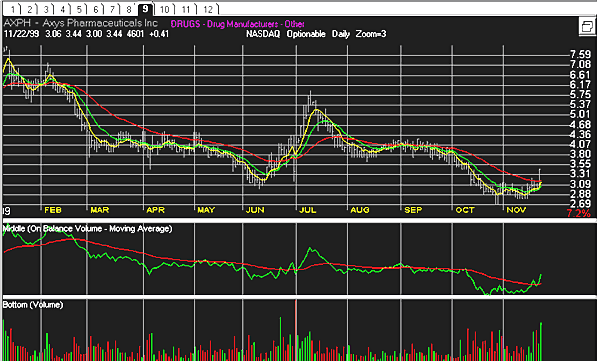
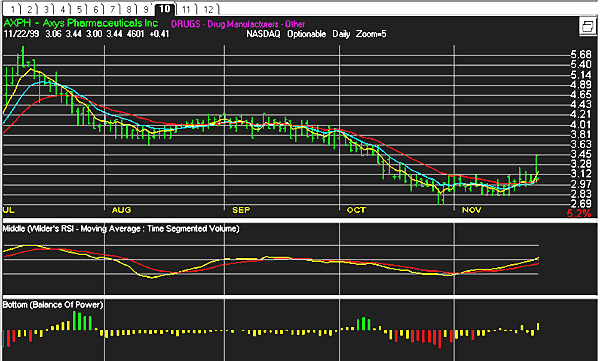
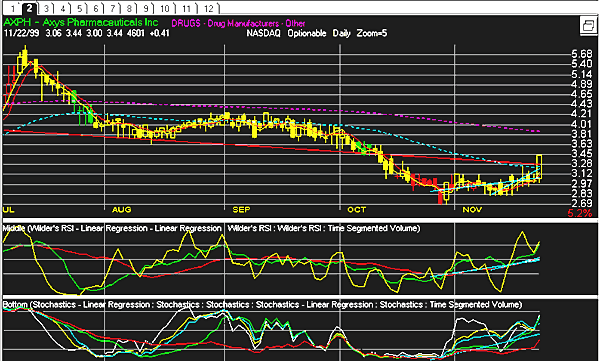
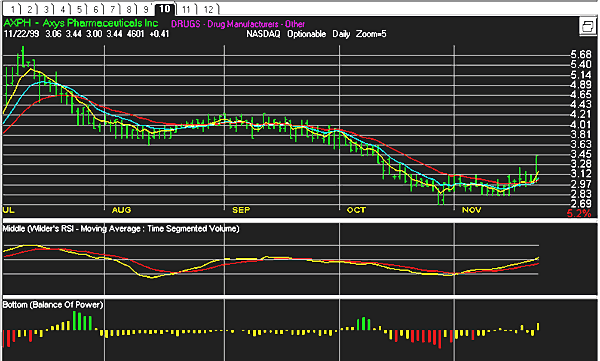
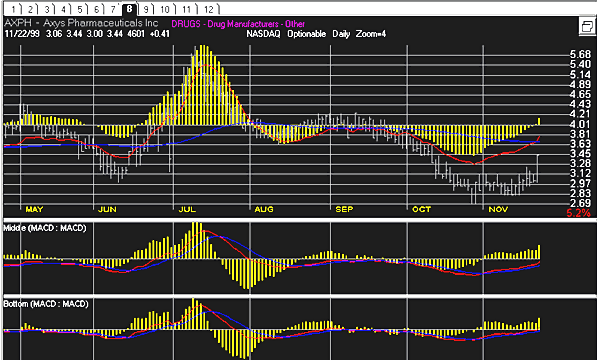
Example: (Found 11-22-1999 by scan)
Updaed: 11-17-01
message 18011 by jdh1344
Since you have read Stan Weinstein’s book “Secrets for Profiting in Bull and Bear Markets”. (it had a strong influence on me) you will be able to see how the following may be applied to his methodsFor 10 week and 30 week SMAs use 50 and 150 Day SMAs (50 up through 150)
PCF
AVGC50.1 < AVGC150.1 AND AVGC50 >= AVGC150
AND AVGC150 > AVGC150.1
(50 up through 150 in the last 5 days)
AVGC50.5 < AVGC150.5 AND AVGC50 > AVGC150
AND AVGC150 > AVGC150.1
(C xing 150):
C1 < AVGC150.1 AND C >= AVGC150

And (C xing 150 1 week ago):
C6 < AVGC150.6 AND C5 >= AVGC150.5

(Try the above see what works for you)

For those breaking above overhead resistance for the last I year period.
C >= MAXC250.1

For those breaking above overhead resistance for the last 3month period
C >= MAXC63.1

(From the two above you can see how to make one for any period you might want).

For volume at break out
V>2.5*AVGV21

For how to setup your chart tabs read that part of message #17954

For an Idea on how to find those in a stage 1 base see message #17811, which is in reference to #17802

All this should get you started in the right direction and give you plenty the study and try for a while. The overall market is in possible (worst case late stage 3 early stage 4) (more hopefully) late stage 4 with some making nice stage 1 bases now. Be patient and preserve you capital at this time I only play 35% of my trading capital. I have doubled that for a 100% return over the last 9 months in a bad market and I don?t play the short side. So the system
works if you quickly get out of those that don?t continue to act well and ride those that do, which is easier said than done. I don?t have the time to set in front of one, two, or three screens all day long as some do. I would not want to even if I did have the time. You need to find that style that fits your needs and philosophy. This is not so fast paced. I only play those that are making a strong move.

I usually start with 5 well chosen positions then get rid of those that are not acting well, to increase the position in those that are. This takes only daily maintenance in the evening of checking them against a trendline or in the beginning an MA, and scanning for new candidates, total 1 hour or two. Then in the AM an hour, moving stops up, adjusting positions &c. I don?t make it fast but I don?t loose it fast either. Those who day trade, or are purely indicator junkies can?t even see these opportunities the time frame of their indicators is too fast, they can?t
stand to hold that long. When the market goes to stage 1 there will be many more opportunities then. More opportunities than you can cover If you play now remember to find the leading sector and play the stronger ones You can scan using the TC2000 caned PCFs (price % change) for the day, week, and 30 days to see where they are.

= = = = =
From messages 19487-19488 by jdh1344
If you want to follow that discussion, go to: Discontinued: clubs.yahoo.com tc2000 usergroup
Read messages #121,#123,#125,#133

The following are pertinent excerpts:
From #123

>>>

Sir Four Phase (Feb. 9, 2001 Daily Worden reports) uses a 145 DMA others similarly use 200. I Prefer 150 (this is not too significant though) I’ll write his formulas as I interpret what I see given:

Phase II(A):

1. AVGC>AVGC145

2. AVGV2/AVGV126>2

3. C>MINC21*1.20 (note: this one is not clear and open to interpretation)

4. AVGC3.21<=AVGC145.21ANDAVGC3>AVGC145

Phase II(B)

1. AVGC>AVGC145

2. AVGV2/AVGV126>2

3. C>MINC21*1.35

4. C>MAXH250.1

5. AVGC145>AVGC145.126

Phase II(C)

1. AVGC>AVGC145

2. MAXC10>MAXC246.11

3. MAXC21.10<MAXC63.32

4. AVGC145>AVGC145.126

Qualifier or conditional scans

Aggressive:

AVGV63*AVGC63>200 MAXH500/MINL500>2

Conservative:

AVGV63*AVGC63>800

MAXH500/MINL500>1.5

From #133 on the auxiliary board

His qualifier or conditional scans are somewhat unique. The one he calls aggressive is the least limiting, so by aggressive I believe he is saying that with this he will look at more charts or consider more stocks as possible plays. I strung the statements together with AND statements Including the aggressive qualifier These have been converted to a 150 DMA so as to be more in agreement with Weinsteins book I have setup 3 columns on one of my sort tabs with the 3 PCFs as sorts. Now I can easily see when any single stock appears on all three sorts
They are:

Phase II (A)

AVGC > AVGC150 AND AVGV2 / AVGV126 > 2 AND C > MINC21

* 1.20 AND AVGC3.21 <= AVGC150.21 AND AVGC3 > AVGC150
AND AVGV63 * AVGC63 > 200 AND MAXH500 / MINL500 > 2

Phase II (B)

AVGC > AVGC150 AND AVGV2 / AVGV126 > 2 AND C > MINC21

* 1.35 AND C > MAXH250.1 AND AVGC150 > AVGC150.126 AND

AVGV63 * AVGC63 > 200 AND MAXH500 / MINL500 > 2

Phase II (C)

AVGC > AVGC150 AND MAXC10 > MAXC246.11 AND MAXC21.10 <

MAXC63.32 AND AVGC150 > AVGC150.126 AND AVGV63 *

AVGC63 > 200 AND MAXH500 / MINL500 > 2

I tend to like his qualifier or conditional PCF. It mostly gets rid of the junk but allows you to see even the low priced stacks
Triple Screen Trading System – TC2000 PCF’s – TradeOn.com

Triple Screen Trading System:
This is an adaptation of the trading system developed by Dr. Alexander Elder and explained in his book “Trading For A Living“. The original Triple Screen System applied three tests or screens to every trade. The system described here will apply tests consisting of scans made from PCFs and also use indicator screens to help locate stocks with a possible future move. Because TC2000 does not support exponential moving averages in PCFs I will be using simple instead. This set up is looking for stocks to go long on only.

PCFs:

1.) Dr. Elder uses the 13 day MA as his trend indicator.

#1-ELTR = AVGC13-AVGC13.4>0

2.) Elder-ray helps you see when bulls and bears become stronger or weaker.

#2-ELBP = (L-AVGC13)<0

#3-ELBP = (L1-AVGC13.1)<(L-AVGC13)

#4-ELBLP = (H-AVGC13)>(H1-AVGC13.1)

3.) Force Index is a highly sensitive indicator of the short-term force of bulls and bears. Buy when 2-day MA of Force Index turns negative during uptrends.

#5-ELFI = ((((V*(C-C1))+(V1*(C1-C2)))/2)<0) AND ((((V1*(C1-C2))+(V2*(C2-C3)))/2)>0)

You should place a buy order above the high price of that day. If the uptrend resumes and prices rally, you will be stopped in on the long side. If prices continue to decline, your order will not be executed.. Then lower your buy order to within one tick of the high of the latest bar. Once your buy stop is triggered, place a protective stop below the low of the trade day or the previous day, whichever is lower.

4) Volume PCF. I like to use a volume PCF to stay away from low volume stocks. If you have your own favorite PCF for this you can use it here.

#6-ELVOL = (AVGV126>1000) AND (V>AVGV63)


Create an EasyScan:

Hint:
This EasyScan may not produce any candidates until after you do a new end of day download.
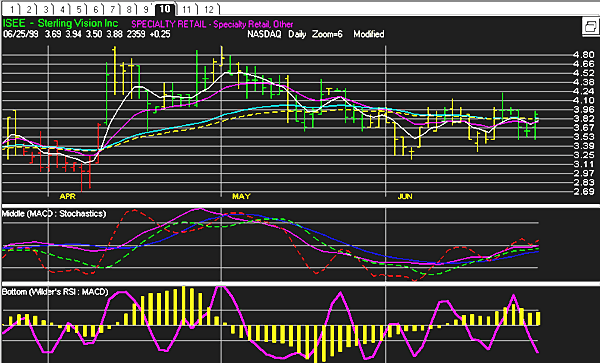
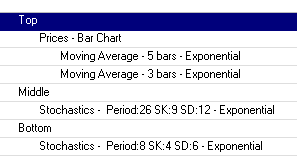
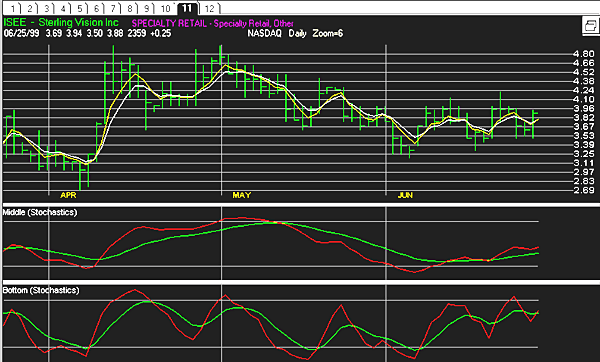
Tab settings: These are just examples, you can also pick your own settings Clearstation Tabs:ISEE was the only stock selected by this scan on 06-25-1999.K.I.S.S Tab Settings:

Stock Trading Experience – TC2000 PCF’s – TradeOn.com

Trading Experience (ejr39)

Many of the club members wish to see immediate results from a new strategy; unfortunately, the same individuals are being blind-sided by their lack of experience to make appropriate decisions for that strategy. Paper trading is FREE and allows you to say ‘been there, done that’.

Paper trade each strategy that you adopt; document EVERY paper trade: What went right! What went
wrong! What was the volume at the time you entered the trade! Does the time at which you enter or exit affect the strategy’s profitability! Be sure to include general market conditions in the documentation. Document any changes made to the

PCFs and EasyScans!

Ask the strategy?s sponsor what you are missing if the adopted strategy is less than 30%
successful during the first 5 days. The answer may be as simple as a PCF error. Or failure to identify the trend. Or an unquantifiable pattern – c&s, h&s.  Or the strategy’s default criteria doesn’t match your trading style. Or the strategy is incomplete. Or the strategy was an untested idea.

Paper trading is FREE and gives you the opportunity to determine if a strategy fits your style
i.e. as a CANSLIM investor are you adept enough for bottom fishing the under $3 stocks (not intended as a challenge but as an example).

For each strategy, paper trade at least 5 trades per day for 1 month (21 trading days). Until you have 100 documented paper trades for a strategy, don’t use green paper.

After 1 month or 100 trades, try green paper but continue with at least 5 trades (both white
and green paper) per day.

The additional trades help to refine YOUR strategy, to keep your attention focused on the strategy, AND to build the additional confidence necessary for successful Options trading.

Get good at one strategy; that strategy is your ‘bread and butter’ every trading day. Develop 2 or 3 additional strategies one for a custodial account (IRA, 401K, annuities); another for building a ‘blue chip’ portfolio; another for aggressive trading, etc.

Once you have established several solid strategies, additional strategies get easier and easier; you will understand the anatomy of the strategies that fit your style – because you have already been there and done that.

Invest well and prosper!

Clearstation Tab – TC2000 PCF’s – TradeOn.com


Clearstation Tab (mcsteiny) I set up a Tab that would best reflect Clearstations web page thusly;

If you read Clearstations education section, and what they are preaching, it seems
to make sense. Like the Dahl/DNS, they feel that money is to be made easier
in trending stocks. I found that after testing this TAB, I can use it
with Dahl/DNS, DNS short term, Tripple cross-over, and just about everything.
For the first time, I can really see what is going on, and feel confident
about what I am seeing! I use this TAB as my base, and check the others
as I’m going, depending on the stock. Much thanks to cpratsch for
his idea’s and input. By the way, cpratsch, you were right about
the Stoc12,4 indicating 2-3 days early against the MACD12,26,9. I tried
it, and changed it to what you use, the Stoc23,4,9… better. Even it
might be a day early.

Clearstation


DNS System – TC2000 PCF’s – TradeOn.com

DNS
System:
(Version 1)(These are the ideas of ejr39 adapted from the original by
Dave Evans)Dave Evans:
What I tried to do with DNS is put together most of the indicators I look at
in one place so I could buy directly from the scan results. I have come
very close BUT I still look at the charts before I buy..

I want ALL the indicators to give a buy signal because I am buying momentum..
I am looking for the big move and the big move can not come unless all
these indicators are positive.

If you look at any stock and pinpoint it’s break away you will see that
ALL the DNS indicators were positive within a week of the move. DNS will
not guarantee that each of it’s candidates will make a big move BUT it
will guarantee that the big move will not be made without a DNS signal…

Now on to the parameters…. Parabolic SAR is a very good indicator to
tell you when a move is starting. It is not very good by itself but when
you use it as part of a system it works fine. For a stock to move parabolic
SAR must be positive or the move is false…

Dahl’s Primary and On Balance Volume above it’s 40 MA are two of the best
indicators around. I ALWAYS look at them before I buy. When we talk about
Parabolic SAR we are talking short term. When we talk about Dahl and OBV
above it’s 40 MA we are talking longer term. I like to mix the times together
to eliminate some of the whipsaws.

ROC, MACD and the Volume indicators are there to make sure the trend is
real. I want Volume building and in my favor. The parameters for MACD
were taken out of one of the books I was reading at the time and they
seem to work.

The whole idea of DNS is twofold. Find a big move and stay away from whipsaws.
That’s why I’ve mixed price and Volume and long term and short term. For
every big move I’ve looked at ALL of these indicators were positive so
why not put them together and scan for them??? The mix was the results
of a lot of chart watching and substitution until I found the 8 indicators
I liked the best. Some of them are not as reliable alone but as a unit
they work well..

Ejr39:
Use
DNS to scan your basic stock list (one that includes your personal limitations).
Put the DNS 7+ stocks into a bulleted WatchList. The stocks in the bulleted
WatchList are then scanned each day with your choice of criteria from
InSync and the StocRSI’s.

PCF
1:
if (5 day simple mov avg is greater than the
13 day simple mov avg), assign value of 1 +…
AVGC5
> AVGC13

PCF
2:
if (13 day simple mov avg
is greater than the 40 day simple mov avg), assign value of 1 +…
AVGC13
> AVGC40

PCF
3:
if (8 day simple mov avg – 17 day simple mov
avg) is greater than the 9 day simple mov avg of (8 day simple mov avg –
17 day simple mov avg) assign value of 1 +…
(AVGC8
– AVGC17) > (AVG(AVGC8,9) – AVG(AVGC17,9))

PCF
4:
if (55 day simple mov avg of the close – 55 day
simple mov avg of the close 15 DAYS AGO is greater than 0), assign a value
of 1 +…
(AVGC55
– AVGC55.15) > 0

PCF
5:
if (12 period percent rate of change is greater
than 0), assign a value of 1 +…
((C
/ C13) * 100)>0

PCF
6:
if (volume is greater than the 120 day simple
mov avg of volume), assign a value of 1+
V
> AVGV120

PCF
7:
Work with a bulleted WatchList i.e. a target
list – IBD’s YFR or an EasyScan that fulfills your personal criteria or
use the “Smart Scan” PCF (aka Richard’s BUY, BUY, BUY Scan). I have put
this scan right into the EasyScan. You can use it to create a separate Watchlist
if you like and then scan it with the DNS PCF’s.
(AVGV126
> 1000) AND (C > (MAXC252.1) * .85) AND (V >= AVGV63) AND (C >
(MINC5) * 1.05)

00:
if on balance volume is greater than the 40 day simple mov avg of on balance
volume, assign a value of 1 +…
07
OBV > 40 dma requires visual confirmation

Extra
check if available:
if parabolic sar .02,.2 is less
than the close, assign a value of 1 +…
The
parabolic SAR isn’t available in TC2000 version 4; for those who use DNS+8,
it’s a look up – its available through more advanced charting software or
through one of the free Internet sites. Parabolic SAR is ignored if one
is using DNS+7.

EasyScan:


Tab#1:
Top:
Prices
are bar charted; color gray (your not interested in price on this Tab#)

Overlay with MACD 13.34.89 exponential (check histogram)

Overlay with MACD 13.34.89 exponential (lines)

. . . long term; use as entry signal when moves above signal line.

Middle:
MACD 13.26.9 exponential (check histogram)

MACD 13.26.9 exponential (lines)

. . . intermediate term; aggressive traders can use as an entry signal
when moves above signal line; conservative individuals can use as an exit
when moves below signal line.

Bottom:MACD
8.17.9 exponential (check histogram)

MACD 8.17.9 exponential (lines)

. . . short term; exit when moves below signal line

Example:
(PLCM
was found with above EasyScan)


Tab#2:
Top:
Prices
(use whatever you’re comfortable with)

…Moving Average 5 bar exponential

…Moving Average 13 bar exponential

…Moving Average 40 bar exponential

. . . Use simple or exponential moving averages whichever you prefer; be
sure the moving averages stack left to right 5 > 13 > 40 (conservative
individuals can add > 200); the 5 dma is a whipsaw indicator.

. . . Visually check charts for the most recent crossover of the 3 averages.
If the 3 averages crossed UP together within the past 3-5 days, it’s the
beginning of the move. If the 5 dma is “whipping” around an 8 or 9 dma or
the 13 dma, avoid the trade until the 5 dma calms and remains above the
8, 9, or 13 dma.

Middle:
OBV (On Balance Volume)

…Moving Average 40 bar (simple or exponential, whichever fits your style)

. . . This is the last step and is VISUAL; the OBV MUST be above the 40
dma.

Bottom:
. . . Any indicators you prefer.


Tip:
Using
the bulleted Watchlist, use the Slide Show from the Tools drop down menu;
(F)lag and remove stocks with an OBV less than it’s 40 dma, utilities,
or any other stocks that you dislike).

Yes, now for the MACD’s. You are looking for the crossovers i.e. in the
histogram, the bars cross upward over the mid or -0- line; in the two
line MACD look for the “MACD Color” to cross upward through the “Avg Color”.
(This isn’t rocket science so don’t try to optimize the crossover points.)
If you like, remove EITHER the two line MACD OR the MACD histogram; both
the MACDs are giving you the same crossover points – use whichever provides
you with the clearest image of the crossover. Try enlarging the crossover
by increasing the Zoom to 7 or 8.

The MACD13.34.89 (Top Window) is long term – conservative; use the upward
crossover as the buy signal.

The MACD13.26.9 (Middle Window) is intermediate term; aggressive individuals
might use the upward crossover as the buy signal; conservative individuals
might use the downward crossover as the sell signal.

The MACD8.17.9 (Lower Window) is short term; the downward crossover is
the sell signal.

Look at any chart; look for the crossovers – both up and down.

01 parabolic SAR helps you identify exit points. Especially useful for
setting DAILY stops.

Example:
(SNE
is a little more aggressive buy, also found with above EasyScan)


DNS System: (Version
2)(By ejr39)

This scan is looking for stocks in a “knock your socks” off
up trend.

PCF
1 StackEm1:

((AVGC34 > AVGC55) AND (AVGC55
> AVGC89))

PCF 2 StackEm2:
(L > AVGC34)

PCF 3 AVGC13>AVGC34:
(AVGC13 > AVGC34)

PCF 4 AVGC5>AVGC13:
(AVGC5 > AVGC13)

PCF 5 Dahl(13):
(AVGC13 – AVGC13.5 > 0)

PCF 6 Dahl(55):
((AVGC55 – AVGC55.15) > 0)

PCF 7 Dahl(89):
((AVGC89 – AVGC89.27) > 0)

PCF 8 DNS ROC(10):
((C / C10) * 100) > 100

PCF 9 DNS Vol:
(V > AVGV120) AND (V >
9000)


EasyScan:


Example: (CSCO,
a little aggressive, top window MACD has not crossed up yet)


Example:
(RFMD,
MACD in top window has just crossed up)
 

Useful DNS additions and modifications:
(ejr39)

Chan’s DNS Partner (is NOT a modifier, but a companion formula to go along
with DNS)
(AVGC5-AVGC13)
– (AVG(AVGC5,34) – AVG(AVGC13,34))

DNS:
MACD12,24 before crossing zero:
(mcsteiny)

Playing around with my DNS, and I took out the item MACD8,17, and replaced
it with a “MACD12,24 just before crossing zero” scan. I got one hit…
CETV. I haven’t checked the SAR yet, but it passed the OBV with flying
colors. But… it is just a little early, and it is supposed to be, which
is O.K., I don’t mind watching it for 2 or 3 days. Then I used the “Combined”
DNS written by I believe Norf, and got 465 hits with my Sales Price criteria
(8-14). I then sorted those with the MACD12,24 before zero, and got about
18-20 True hits. Next, I want to re-write Norfs combined DNS, and drop
the MACD8,17, and replace it with the new MACD12,24 before zero, and see
what happens.

Here is the PCF I used:
((AVGC12-AVGC24)>(-((AVGC12-AVGC24)-(AVGC12.1-AVGC24.1))/1)AND(AVGC12.1-AVGC24.1)<(-((AVGC12-AVGC24)-(AVGC12.1-AVGC24.1))/1))


StochRSI
and DNS:
(ejr39)

PCF’s used to screen bulleted WatchLists containing DNS or Dahl only stocks.
StochRSI14:
((RSI14
– MIN(RSI14,14)) /((MAX(RSI14,14) – MIN(RSI14,14))+.001) * 100) > 30
StochRSI14.2:
((RSI14.2
– MIN(RSI14.2,14)) / ((MAX(RSI14.2,14) – MIN(RSI14.2,14))+.001) * 100)
< 30
StochRSI8.5:
((RSI8
– MIN(RSI8,5)) / ((MAX(RSI8,5) – MIN(RSI8,5))+.001) * 100) > 20

StochRSI(14) should be crossing UP THROUGH 30

StochRSI(8.5) should be crossing UP THROUGH 20 and may even be crossing
up through 80

Additional
Conditions:

(your preferences)

Optionable

Capitalization…value > 149(000,000)

Volume 1-Day-H…………………..Value > 1000(00)

Volume 90-Day…rank > 74

Price Per Share – H………………..Value < 30.00

Volume (Dollars) 5-Day-H…………Rank > 74

WatchList to Scan…All Items In System

Save. Scan.

Divergence Trading System – TC2000 PCFs – TradeOn.com

Divergence Trading System:
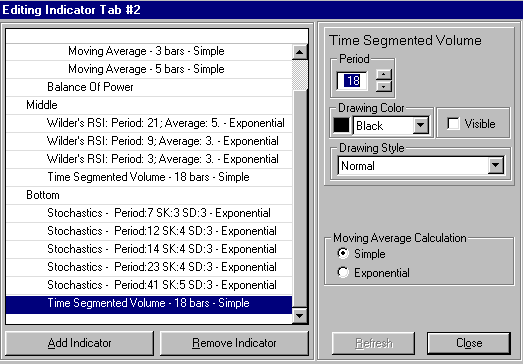
What will be shown here is an experiment using some of the ideas presented in the “Supplemental Users Guide”.  This is only an example what can be done using a simple trading system involving only a “1” indicator PCF. In no way am I suggesting that you use this sytem to trade with without fully understanding what is taking place here. The examples shown were found by back-dating the PCF to a prior date.Below is a window of the Tab settings used. These are just for reference. Use what ever you are familiar with for tab settings.
PCFs:(Positive Divergence)

#1: (TSV18>=(MAX(TSV18,10)))AND(C<=MINC10)

#2: AVGV21 > 1000

The second PCF is to look at stocks that have an average 21 day volume of greater than 100,000. These “2” PCFs were than put into an EasyScan. Two stocks were found on August 13, 1999. HBCCA and VRTX. Their charts are below. As you can see they turned out to be good picks. There were actually three stocks found on that day by the PCF but the third “MMGR” wasn’t trading.


(Negative Divergence)#1:
(TSV18<=MIN(TSV18,10)))AND(C>=MAXC10)#2: AVGV21 > 1000This time we are going to look for stocks with negative divergence in the TSV. This is what we I found on July 16, 1999. AMB, DBD, EVF, GTSG, MVSN, NA, NOK, SKYT, XLK. From these I picked NA and XLK because of the other indicators on the chart and also because the following day they both showed a “Bearish Engulfing” candlestick pattern.
 You can look at the other stocks. They are not all good selections, thats why you should use other confirming indicators. OK, so you say we got lucky, well what would the picks have been if the dates are reversed. So I did a Positive Divergence test on July 16, 1999 and got no hits. I then did a Negative Divergence test on August 13, 1999 and got (2) hits. NNS and WYN. WYN wasn’t trading so that left just NNS which is shown below. As you can see this one took a couple days to confirm its downward movement.
This one didn’t produce as much gain as the others, but if you look at the S&P-500 on the dates these picks were made you may see why they say to go with the market trend.MACD Divergence Trading System:PCFs:

(Positive Divergence)

#1:
(AVGC12-AVGC26)-(AVG(AVGC12,9)-AVG(AVGC26,9))>0AND(AVGC12-AVGC26)-(AVG(AVGC12,9)-AVG

(AVGC26,9))<(AVGC12.10-AVGC26.10)-(AVG(AVGC12.10,9)-AVG(AVGC26.10,9))AND(C<=MINC10)

#2: AVGV21 > 1000

On September 14, 1999 an EasyScan using both these PCFs found 70 stocks, so to narrow down the list I ran the TSV positive divergence PCF on this list of 70 and ended up with just (2) picks. CIV and SWK. Their charts are below.


(Negative Divergence)#1:
(AVGC12-AVGC26)-(AVG(AVGC12,9)-AVG(AVGC26,9))<0AND(AVGC12-AVGC26)-(AVG(AVGC12,9)-AVG(AVGC26,9))>(AVGC12.10-AVGC26.10)-(AVG(AVGC12.10,9)-AVG(AVGC26.10,9))AND(C>=MAXC10)#2:
AVGV21 > 1000

On September 14, 1999 these (2) PCFs picked RKY, USON, AVT, EKO, ELF, NTN, PR, TSEMF, UMR, USTB and ARDT. No confirmation from negative TSV divergence. Below is the chart of ELF which may be ready for a little pull back.

Remember: Everything shown here is for teaching purposes only and should not be used as a means to trade but only as a means to develop your own trading system.

Exits

Exits: (ejr39)
As for when to sell: KNOW YOUR EXIT BEFORE ENTERING THE TRADE!! Each trader/investor has to choose their own comfort level.. . . . In general, Why are you entering the trade?
. . . If you enter a trade using MACD13.34.89 crossing above it’s 10 dma than sell when MACD8.17.9 crosses down through it’s 10dma.
. . . If you are a ma trend trader, exit when the short term ma crosses down through it’s companion ma (i.e. 5 dma crosses down through 13 dma).
. . . If you enter a trade based on DNS, try using the parabolic SAR for an exit signal.
. . . If you trade for a 10% profit, sell when you have the profit.
. . . If you trade another’s recommendation, what is the individual’s exit strategy?
Personally, I use the PCFs and EasyScans to keep the selection process mechanical and my exit strategies are determined by the stronger PCF readings. NEVER, NEVER hold a loosing trade. Again choose your own comfort level – as a rule of thumb, exit the trade if the loss is more than 8%.
* * * KNOW YOUR EXIT BEFORE ENTERING THE TRADE. * * *

Exits: (cpratsch)
 If you use stoc7.3 and RSI3.3 on the way up why don’t you use the same indicators on their way down? Whenever they turn down –or whenever their MA is going OVER their signal line –or whenever stoc7.3 and/or RSI3.3 go through the middle line-sell—
or, whenever price goes down through YOUR selected MA (I use MA 20 as absolute boundary). Or you set a price percentage limit. Or, if you are a longer-than-a-few-days-holder, use MACD 12-26-9 (or a shorter one) or RSI21.5–as long as the RSI 21.5 indicator signals stay above the middle line you are OK, because RSI reflects U/D (average up prices over average down prices), and at the middle line they are equal = no change in up or down movements over the length of your time window, here 21 market days= about 1 month. Or, sell as soon as price dips. But don’t cry if price goes right back up again.
Exits: (howie99)
I have a rule for anything that can happen, when something happens that I don’t have a rule for I Sell.. My rule for a stock that does not move for a period of 5 days is sell.. I find that if I have to think about what to do I’m in trouble.. Mechanical is the only way to be, for me.
Exits: (jcmorrill)
Ken, a stop strategy you may want to think about is as follows:
. . . Figure 2% of total portfolio, divide by number of positions you are holding, use this number to determine first stop by subtracting the number from cost of position and dividing by number of shares. For example your portfolio is worth $10,000, 2%(I know it doesn’t sound like much) is $200. Your stock pick is 12.50 per share and you buy 100 shares, cost $1250 plus commission(times 2 if you want to consider the round trip cost). (1250 +30) – 200 = 1080, 1080 / 100 = $10.80, $10.80 (or 10 3/4 if you like
fractions better) is where you set first stop. Analyze your position each day, when stock goes up, figure the average of the low for the day and the prior stop, that will be your stop for the next day. If stock doesn’t go up do not adjust stop. You can ride a stock to very near its peak with this method and if you get stopped out right away you have only lost 2% of portfolio giving you several chances to get it right. As soon as you are ‘in the money’ in a position you can use this method again in another trade.
Exits: (jnorfy)
 From Clearstation: (paraphrased) If a stock fails to move on Stoc26.9 going from below 20 to above 80, exit the position. I realize that you are not necessarily using stoc26.9, but the same holds true. If you buy a stock based on some indicator, new, fundy, etc; and it doesn’t materialize, get out and don’t look back. Put the capital to work somewhere else. The stock may shoot up, it may tank. If it rises, get in the next time your signals say buy. It is always easier to get back in to a stock going (albeit later) your way, then get out (or hold) one that went against you.
Exits: (cpratsch)
I just saw a description of a neat MA trick:
. . . Place the moving averages (MA) 4-9-18 on an upper chart with price;
. . . 1) when MA 4 AND 9 both cross MA18 upwards – buy;
. . . 2) when MA 4 crosses MA 9 downward-sell.
The reason this is good is, of course, that this gives a little bit longer after a price upturn to consider buying (MA 9 overMA18), so the trend is better defined and under way. And on the way down MA 4 under MA 9 is early and should keep losses at 0-?5%, this depending on the speed of the price dip. I am sure that a combination MA 5-10-20 gives similar results and sounds better. But somebody must have run a back test and found/published the combination 4-9-18.

EdMulroy Scans

Ed Mulroy Stock Screening Scans

Scans #1 For KCDick (edMulroy)

My scans change as I go and I do not remember what ones I posted here before so am posting most of what I look at now. Yahoo cut off the end of one of my previous messages so I’m breaking this up into several messages.

This is Long $3-$8. You can modify it for any price range. I do $3-$8, $8-$20 and >$20. This is NOT a GBS long scan.

Remember that the results of the scan are the START. You then must look at the charts and filter out what you don’t like.

————————–

(C1 – C) * ((C >= 2) AND (C < 8) AND (V >= (1.5 * AVGV15.1)) AND (AVGV15.1 > 500) AND (C1 < MAXC30.1) AND (C >= MAXC30.1) AND (MINV21.1 >= 250))

–Report amount the stock rose today
–Price $2 to $7.99
–Volume at least 50% higher than monthly average
–Yesterday’s close less than max 30 day price
–Today’s close equal or higher than max 30 day price
–Minimum daily volume in last month 25,000 shares

————————–

Scans #2 for KCDick(edMulroy)

I use this as a GBS long

—————-

(C >= 20) AND (C > (C1 + 1)) AND (V >= (1.5 * AVGV50.1)) AND (V > V1) AND (C >= MAXC50.1) AND(AVGV50.1 >= 500)

–Price at least $20
–Rose at least $1
–Volume at least 50% higher than 50 day average
–Volume higher than yesterday
–Closed at or above 50 day high
–Average volume 50 days at least 50,000 shares

—————-

Scans #3 for KCDick(edMulroy)

Weinstein scan, evolved from what Stan Weinstein wrote in his book.

——————-

((C >= 3) AND (RSI30.9 > RSI30.9.5) AND (C > AVGC30.1) AND (V >= (1.2 * AVGV42.1)) AND (AVGV42.1 >= 1000) AND (C > C1) AND (C2 < AVGC30.2) AND (C > MAXH14.3))

–Price at least $3
–Relative strength increasing
–Price greater than 30 day average
–Volume at least 20% above 2 month average
–Volume 2 month daily average at least 100,000
–Price day before yesterday was below 30 day average
–Price is a 14 day high

——————-

Scans #4
for KCDick
(edMulroy)

30 MA Breakout $2-$8 Reports rise for selected stocks, zero for others. The (C1 – C) part looks backwards. It is that way because of a quirk in how Visual Basic treats logical tests (TC/2000 is done with Visual Basic) This one is new and a little choppy. I am playing with it and you may want to also.

—————-

((C1 – C) * ((C >= 2) AND (C < 8) AND (V >= (1.5 * AVGV15.1)) AND (AVGV15.1 >= 500) AND (MAXC5.1 < C) AND (AVGC30.1 > C1) AND (AVGC31.1 < C) AND (MINV21.1 >= 250)))

–Price from $2 to $7.99
–Volume at least 50% greater than 15 day average
–15 day average daily volume at least 50,000
–Price is higher than last 5 days
–Yesterday’s price is less than 30 day average
–Today’s price is higher than 30 day average
–Minimum volume in last month is 25,000 shares

—————-

edMulroy-Scan#4 reworked (KCDick 98)

Ed: Here’s a rework of your Scan#4. It spits out 6 candidates, ENDO looks the best.

Line1:15MA-V > 50K

2: 18MA > 40MA > 30W MA

3:30WMA increasing

4:C> 30WMA

5: C> high in last 5 days

6: Price= lo

7: Vol + 50% of 15MA

1) AVGV 15.2 > 500

2) (AVGC18>AVGC40) AND (AVGC18 > AVGC 18.3) AND (AVGC40 > AVGC40.3) AND

((AVGC18>AVGC150) OR (AVGC40 > AVGC 150))

3) AVGC150>AVGC150.3

4) C>AVGC150

5) C>MAXC5.1

6) C>1.25 AND C<7.5 —

7) V>(1.5*AVGV15.1)

Scans #5 for KCDick (edMulroy)

Volatility scan. Reports stocks that have a swing of at least $5 in a day (of interest for day trading). It turned out to essentially be a reporter of what Internet stocks are moving.

————————–

((AVGV21.1 >= 10000) AND (MINV22 >= 3000) AND (C >= 30) AND (C <= 120) AND ((H – L) >= 5) AND ((H1 – L1) >= 5) AND ((H2 – L2) >= 5) AND ((H3 – L3) >= 5) AND ((H4 – L4) >= 5) AND (MINV21.1 >= 250))

–Average daily volume in last month at least 1,000,000
–Minimum daily volume in last month at least 300,000
–Price from $30 to $120
–High
– Low each of last 5 days at least $5

————————–

Scans #6 for KCDick (edMulroy)

GERN ENZN style surge.

Mimics the action that made me money when Geron and Enzon prices did “moon shots”. Has proved interesting and useful but only by selecting a number of stocks that you then have to heavily filter.

———————-

(C < 25) AND (C > O) AND ((2 * (C – O)) >= (H – L)) AND ((C >= (1.06 * C1)) AND (V >= 2000) AND (V >= (1.05 * V1)) AND (AVGV21.3 < 1000)) OR ((C >= (1.17 * C1)) AND (V >= 6240) AND (V >= (7.8 * V1)) AND (AVGV21.3 < 1000)))

———————-

KCDick: re: your scan#4 comment (edMulroy)

When Visual Basic makes a logical test, the result is zero for FALSE or all 1’s (0xFFFF or &HFFFF) for TRUE. Interpreted as a number the all 1’s value becomes minus one and that is why I multiplied by a value which is minus that which you would logically think is correct. Mine does not return all stocks. Values of zero or of blank are those which were not selected by the scan.

DNS + Big Dog Bounce Stock Trading Scan- TC2000 PCFs – TradeOn.com

DNS + Big Dog Bounce:
(This is a combination of the DNS system PCFs and the Big Dog Bounce PCFs)

PCFs:

  • #1-DNS
    (AVGC5>AVGC13)
  • #2-DNS
    (AVGC13>AVGC34)
  • #3-DNS
    (AVGC8-AVGC17)>(AVG(AVGC8,9)-AVG(AVGC17,9))
  • #4-DNS
    (AVGC55-AVGC55.15>0)
  • #5-DNS
    (C-C12)>0
  • #6-DNS
    (V>AVGV120)
  • #6-Big-Dog-Bounce
    (MAXH5.1>C*1.1)
    AND (STOC7.3<50) AND (STOC28.3>50) AND (C>AVGC21)
  • #24-Risk-Reward
    ((MAXC21-AVGC21)/AVGC21)*100


EasyScan:
#1-DNS+Big-Dog-Bounce

Note:
Volume 5-Day-H is under “Technicals” and is a value setting. It is set at roughly
>100K.

You can use what ever you feel comfortable with in your trading style.

Tabs:
(These are just a suggestion. Use what you feel comfortable with)

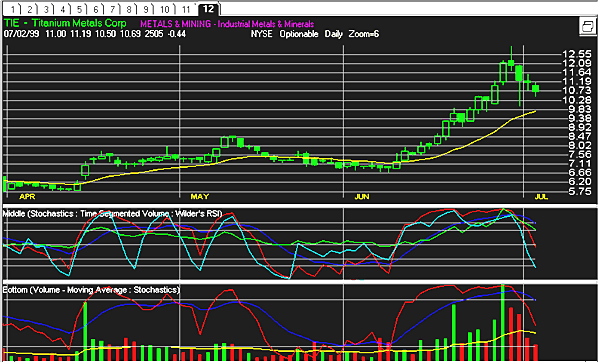
Examples:

These were picked by the system after close on July 2, 1999. They were sorted using the #24-Risk-Reward PCF.

CNV Has already started back up from the 21 dma.


TJCO is just starting its turn back up.


TIE is a little early yet. Wait for the bounce off the 21 dma.

Also watch for the signals from your tabs, they haven’t turned yet.

These are only examples and are for training purposes only.

Clearstation Trading System – TC2000 PCFs

Clearstation
Tab setup close to clearstation(mcsteiny)

I set up a Tab that would best reflect Clearstations webpage thusly:

TOP: Bar chart 5 ma
exp. white
13 ma exp. magenta
40 ma exp. cyan
50 ma exp. yellow dashed
or dotted

BOP

Middle: MACD12,26,9 magenta
fast/blue slow – wide – simple

Stoc23,4,9 red
fast/green slow – dots – simple

Bottom: MACD12,26,9
yellow – histogram – simple

RSI13,3

magenta – wide – simple

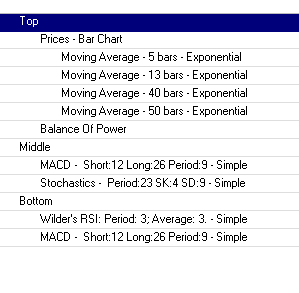
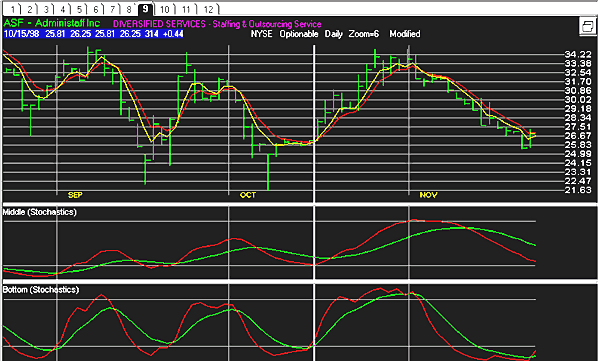
If you read Clearstations education section, and what they are preaching, it seems to make sense. Like the Dahl/DNS, they feel that money is to be made easier in trending stocks. I found that after testing this TAB, I can use it with Dahl/DNS, DNS short term, Tripple cross-over, and just about everything. For the first time, I can really see what is going on, and feel confident about what I am seeing! I use this TAB as my base, and check the others as I’m going, depending on the stock.

Much thanks to cpratsch for his idea’s and input. By the way, cpratsch, you were right about the Stoc12,4 indicating 2-3 days early against the MACD12,26,9. I tried it, and changed it to what you use, the Stoc23,4,9… better. Even it might be a day early.

Exiting a good trade(jnorfy)

From Clearstation: (paraphrased) If a stock fails to move on Stoc26.9 going from below 20 to above 80, exit the position.

I realize that you are not necessarily using stoc26.9, but the same holds true. If you buy a stock based on some indicator, new, fundy, etc; and it doesn’t materialize, get out and don’t look back. Put the capital to work somewhere else. The stock may shoot up, it may tank. If it rises, get in the next time your signals say buy. It is always easier to get back in to a stock going (albeit later) your way, then get out (or hold) one that went against you.


Added 02-02-01 (message 13890 by Dietrich_67)
However, I do not agree with what is written … as they add indicators not appearing on the ClearStation charts and they have the time periods “wrong”. Here’s what I would use, noting it takes two tabs:

Tab #1 -Top window-
Bar chart of prices
13-day moving average (exponential)
50-day moving average (exponential)

-Middle window-
MACD with short=12, long=26, and period 5
set to exponential

-Bottom Window-
Stochastic period=5, SK Period=5, SD Period=3
and I have it set to exponential but it may be simple on the ClearStation site.

Tab #2 -Top window-
Same as above

-Middle window-
Volume bars with 30-day moving average (simple)

-Bottom Window-
Same as the middle window above but plotted as a histogram instead

(via the check box at the bottom)

I’ve grouped them in this fashion, which slightly differs from the way they appear on the ClearStation page, because of the system described by Kensey (Doug) and the gang over there.

Their primary indicator is MACD, so it makes sense it needs to be the first indicator listed. Stochastic is their primary confirming indicator, which they only say provides an long entry indication if the MACD is in an uptrend. In other words, one or the other alone does not an entry make. To me, that means those two indicators must be on the same Tab

The second set of tabs places the volume indicator first because that’s an underlying assumed indication. If the volume/price relationship is not sound, then that kibashes the whole thing.

You would get no arguement from me if you swapped the histogram of the MACD to Tab 1 and the actual MACD chart back to Tab 2. I know lots of people who prefer the histogram, I just don’t happen to be one of them.