Time Segmented Volume (TSV) and Balance of Power (BOP) – TC2000 PCF’s – TradeOn.com

INDICATOR INTERPRETATION LESSONS

This special segment on indicator interpretation will be featured periodically as a part of the Daily Electronic Worden Report. In this segment we will feature specific individual stocks along with specific indicator parameters. We will predominantly be using our Time Segmented Volume (TSV) and Balance of Power (BOP), but at times we will also try to incorporate other indicators into the mix, such as MACD and stochastics.

Utilizing the TeleChart program, we will essentially take you ‘back in time’. This will enable you to see exactly how the charts and indicators appeared just prior to significant price moves in the stock

The stock we are going to start working with today is Digital Equipment (DEC). This company was bought out by Compaq Computer so is no longer listed but it is used here as an example only.

Let’s begin by pulling up a daily chart of DEC and clipping it all the way back to 12/3/90. Now let’s take a moment and set-up a few indicator modules that we intend to use with this chart. For the purpose of these examples, we will suggest specific colors for each indicator parameter.

Indicator Module #1) – On a daily chart with a zoom=4, calculate a MACD of 9 & 21 (YELLOW LINE) with a moving average of 10 (HI RED DOTS). Moving Average Type = Exponential.

Indicator Module #2) – On a daily chart with a zoom=4, calculate a Time Segmented Volume (TSV) of 18 (HI RED) with a moving average of 10 (YELLOW DOTS). Next calculate a price moving average of 30 (HI WHITE DOTS). Moving Average Types = Simple.

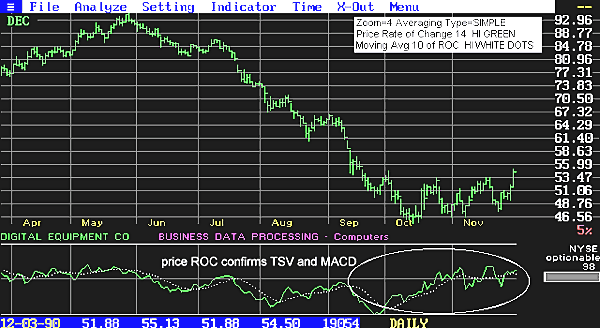
Indicator Module #3) – On a 2-day chart with a zoom=4, calculate a price rate of change of 14 (HI GREEN) with a moving average of 10 (HI WHITE DOTS). Moving Average Type = Simple.

There is one more rather interesting, but somewhat complicated indicator module that we would like to share with you since it seems to work well with this particular stock as well as others. However, in the interest of time and space, we will have to save it for our next installment.

Now let’s get to the business at hand. Pull up your daily chart of DEC with indicator module #1. Remember, the ending date on your chart should be 12/3/90. There are three things to look at when using this indicator. First, the relationship between MACD (yellow) and its moving average (hi red dots). Secondly, the relationship of both MACD and its moving average to the zero-line. And last, but certainly not least, look for contradictions between price and the indicator. In other words, look for simple positive and negative divergences between MACD and price.
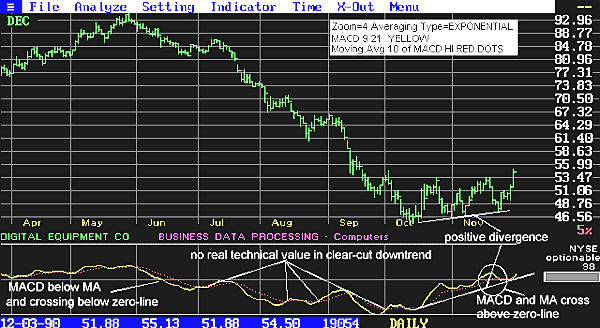
Notice that back in mid-June of 1990 as price had already begun to top out, MACD is below its moving average and breaking down below the zero-line. Just days later, MACD’s moving average (hi red dots) also breaks below the zero-line. Now granted, this occurs with the stock selling at about 85, when just a month before DEC was trading up around 95. Which is to say that MACD is more of a lagging indicator, as opposed to one that typically leads price.

As price declines through July, August, and September, MACD (yellow) actually crosses up through its moving average (hi red dots) on a couple of occasions. However, these crossovers are of no real technical value, when one considers they are occurring within the context of a clear-cut downtrend. In fact, MACD and its moving average do not finally hit their ultimate lows until late September. If you were to use this chart exclusively to determine a potential bottom, the first real signs of any positive technicals do not really start popping up until mid- November. It is at this point that positive divergences of some real substance begin to form. It is also at this point that MACD and its moving average break up through the zero-line for the first time in five months.

In Friday’s report we were working with a daily chart of Digital Equipment (DEC) clipped back to 12/3/90. You will recall that we outlined three different indicator modules for the purpose of this example. We’ve just about covered everything pertinent to Module #1, so let’s move on to Indicator Module #2.
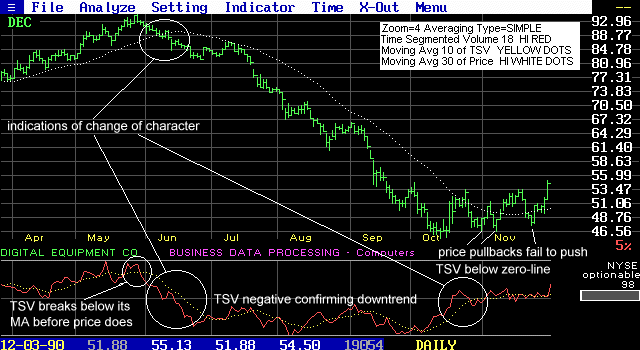
The interpretation of Time Segmented Volume (TSV) is similar to the MACD discussed in our previous report. As is the case with MACD, we are looking for zero-line crossovers combined with either positive or negative divergences between price and TSV.

On our daily chart of DEC, you will notice that price dropped below its 30-day moving average (HI WHITE DOTS) during the middle part of June — right around the same time TSV and its moving average broke down below the zero-line. Both are indications of a change taking place in the character of the trend. As a result, DEC’s price declines from around 85 to a low of about 45 over the following four months. During which time, TSV remained well into negative territory, flatly refusing to contradict the action in price. This is to say that during this period from June through October, TSV did nothing more than simply confirm the downtrend intact. It is not until the later part of October before TSV (HI RED) crosses back above the zero-line into positive territory. This is an early sign of a change in character. Just as TSV alerted us to technical deterioration taking place back in June (1990), by 12/3/90, TSV was signaling that a short to intermediate term bottom was likely forming. Both of the latest two price pullbacks, coming in early and late November, failed to push TSV below the zero-line. The backing-and-filling action during October and November was accompanied by a TSV showing first, a pronounced dry-up in selling pressure and second, an actual changeover to accumulation.

Now let’s look at Indicator Module #3 on both a daily and 2-day chart of DEC. We threw in this rather simple measure of price rate of change (ROC) because we feel its one more pretty good thing to use in order to gain confirmation on conclusions already drawn from the use of other technical indicators. On both the daily and the 2-day chart of DEC, the ROC merely confirms our TSV and MACD indicators.
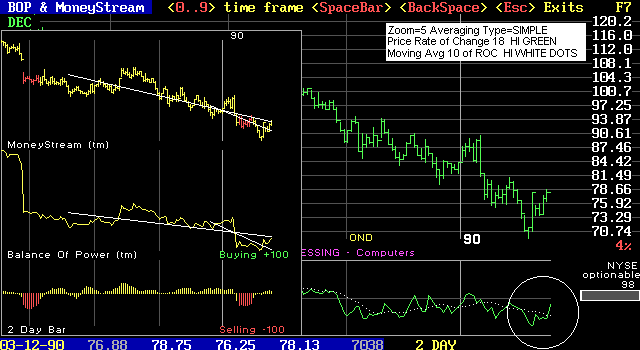
Using shorter term time frames (i.e. daily and 2-day charts), one is able to detect changes in trends sooner. However, since short-term indicators also tend to produce far more whipsaws, 3-day and weekly charts are vital in determining the direction and the overall health of the primary trend. The primary trend is really nothing more than a stock’s intermediate term bias.

We were last working with a chart of Digital Equipment (DEC), updated through 12/3/90. In this example, we are going to demonstrate an easy-to-interpret, short term trading method using only two different indicators. Now remember, these indicator parameters and this specific method of application is not going to work for every stock in every situation. Furthermore, we are out to capture short term, short-lived price swings, with little or no regard to the stock’s primary trend. This typically means there will be a greater tendency for whip-saws…so be careful.

Pull up a daily chart of DEC and clip-back the ending date to 2/23/90. Now let’s create two different indicator modules to be used in conjunction with each other. For the first one, set-up a daily chart with a zoom=5. Calculate a Time Segmented Volume (TSV) of 21 (HI RED) with a moving average of 10 (HI WHITE DOTS). Average Type = Simple.

Construct a second indicator module on a 2-day chart with a zoom=5. Calculate a Price Rate of Change (ROC) of 18 (HI GREEN) with a moving average of 10 (HI WHITE DOTS). Average Type = Simple

The object here is to buy long and cover shorts when both the TSV (HI RED) and the ROC (HI GREEN) are simultaneously above their respective moving averages (HI WHITE DOTS) and conversely, closeout longs and establish shorts when both indicators are below their respective moving averages.

To start, let’s pull up our first indicator module (TSV on a daily chart). Now we’re going to scroll ahead, one day at a time using our right bracket key <]>. Each time we advance one single trading day, we are going to check our TSV for a crossover of its moving average. A legitimate crossover would prompt us to check our second indicator module (Rate of Change on a 2-day chart) for a confirmation.
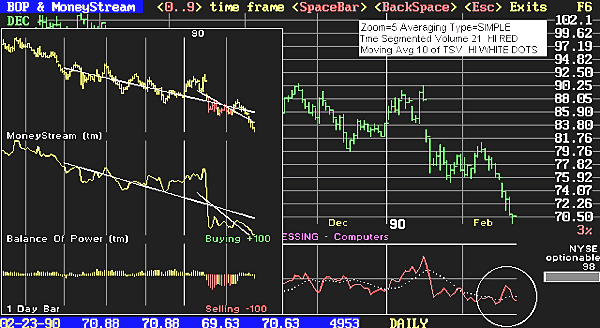
Scrolling ahead just two days to 2/27/90 produces a positive crossover in module 1, but NOT in module 2. Therefore a buy signal does not yet exist. In fact, our first buy signal is not generated until 3/12/90 at 78 1/8. Why on this particular day? Because our TSV and ROC are both trading above their respective moving averages. Now let’s slowly scroll forward, one day at a time, closely watching for crossovers in the other direction.
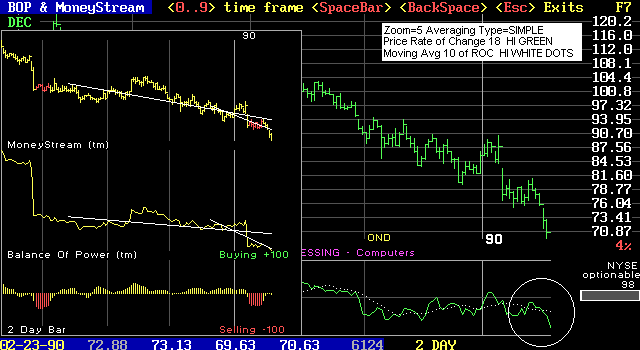
On 3/29/90, module 1 falls below its moving average, but just barely. Checking module 2, we see that no violation has occured. The following day on 3/30/90, both module 1 and 2 are dangerously close to negative crossovers, but are simply not decisive enough to constitute a sell signal. Moving ahead one more day we see that on 4/2, module 1 is just below its MA, but module 2 is at best, ambiguous. Still no sell signal. On 4/6, TSV again breaks below its MA, but module 2 still fails to confirm the negative. On 4/17 and 4/18, module 1 again indicates a negative condition, but module 2 again fails to confirm. The buy signal generated on 3/12/90 at 78 1/8 still remains in force.
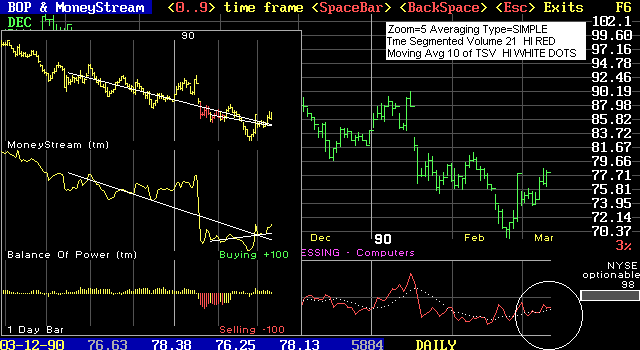
Finally on 6/1/90, both indicator modules confirm a negative crossover, thereby triggering a sell signal at 91 3/4. This means we would closeout our long position and take profits right here, while also establishing a new short position.
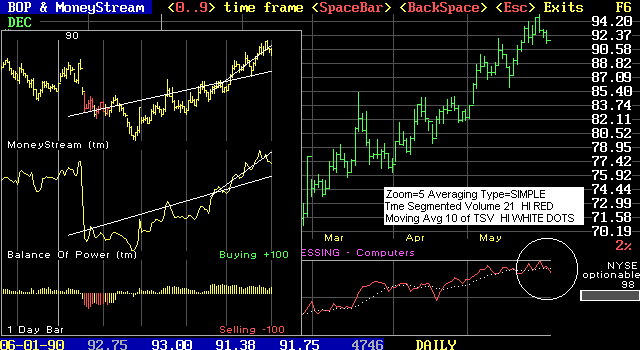
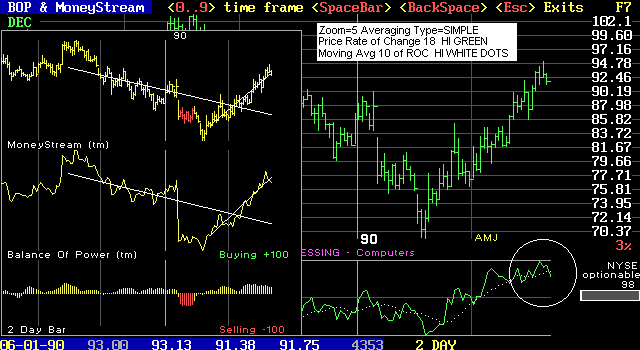
 

On 7/9/90, almost six weeks into our short trade, module 1 registers a negative crossover, but module 2 fails to confirm. Continuing to scroll forward one day at a time, we see DEC’s stock price plunge to a low of 67 3/8 by early August. Scrolling ahead further to 8/20/90, we see that module 1 is turning positive, but module 2 still indicates a sell. In fact, over the course of the next three weeks module 1 continues to trade above its moving average, but module 2 stubbornly fails to confirm this positive action. We continue to hold our short position. By the end of September, DEC has fallen to a price low af about 50. Remember, we established a short position at 91 3/4 back on June 1, and we’re still in the trade
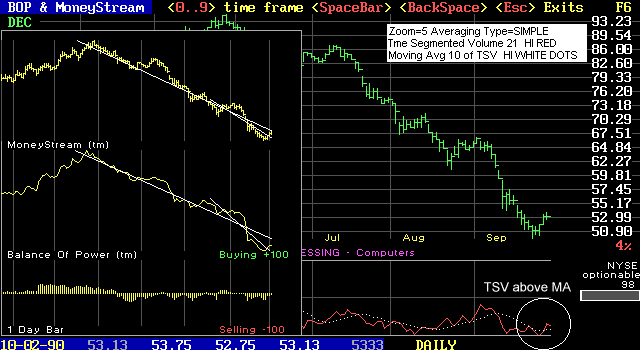
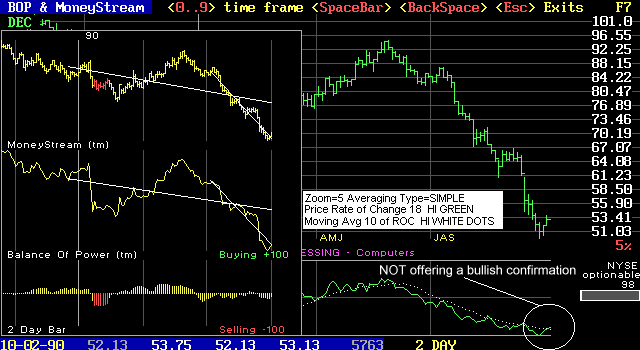
 

Pull-up a daily chart of DEC with indicator module number 1. Clip it back to 10/2/90. You will recall we are still in a hypothetical short trade, which we entered four months earlier on 6/1/90.
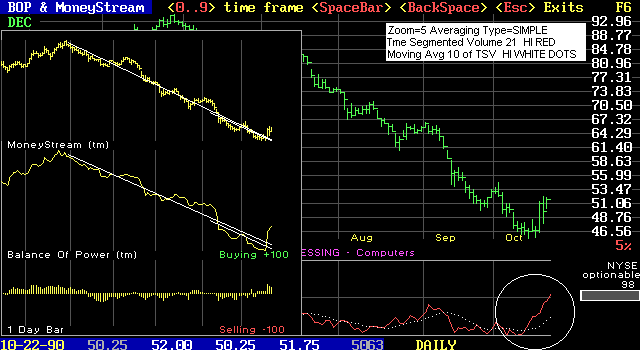
 

Looking at module 1 on our chart through 10/2/90 we see that TSV has again crossed up through its moving average. However, a quick glance at indicator module 2 shows us that our rate of change indicator is NOT offering a bullish confirmation. Therefore, our short trade remains in force. Scrolling ahead one day at a time, we see that by 10/15, DEC has fallen to a low of
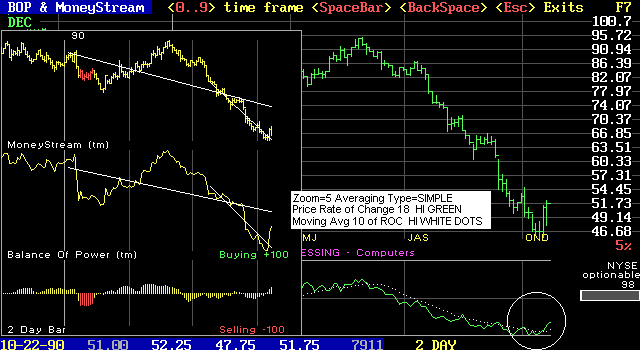
45 1/2. If we scroll ahead just a bit further to 10/22/90, we get our first real look at definitive crossovers by both modules 1 & 2. Since initiating the short trade on 6/1/90, this is the first time that the indicators in both modules are trading decisively above their respective moving averages, simultaneously. In fact, the TSV of 21 in module 1 is actually crossing into positive territory for the first time since June. Based on the rules we have established for using our two indicator modules, it is at this point we would closeout our short trade and establish a long position.

Alright, so we’re long DEC as of 10/22/90 at a price of 51 3/4. Now let’s scroll ahead several days to 10/31/90. DEC is at 47 1/2 and module 1 has completed a negative crossover, but in checking module 2 we find no clear-cut confirmation. If you scroll ahead through the next couple of days, you will find that module 1 continues to flash a sell, but module 2 fails to confirm. As a result, we hold our long position.
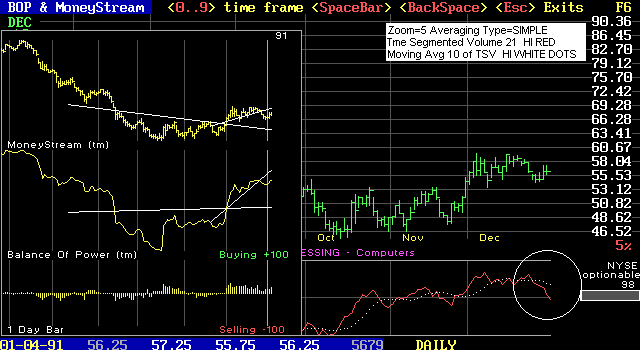
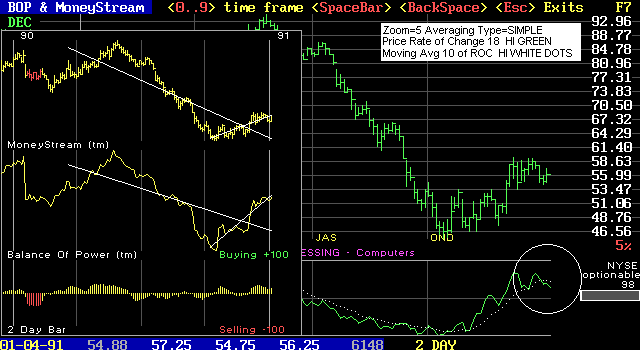
 

Module 1 alerts us to another possible sell signal on 11/21/90, but like before, a quick check of module 2 fails to confirm the weakness. By 11/26/90, DEC is at $48 a share, module 1 is clearly flashing sell, but the ROC indicator in module 2 remains comfortably above its moving average. Still no change in our position. As we scroll forward from this point, we see that DEC finally begins to move higher, closing at a high of 59 1/4 on 12/18/90. Our sell signal occurs some two weeks later on 1/4/91 at 56 1/4.
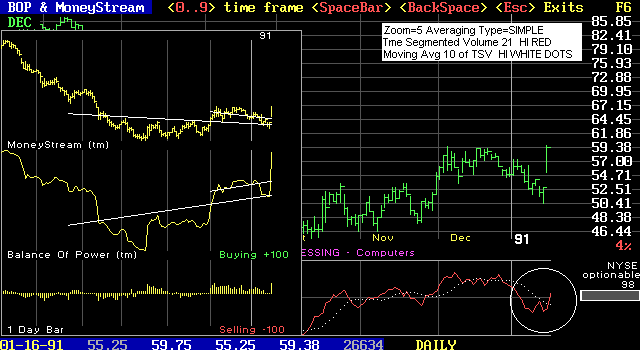
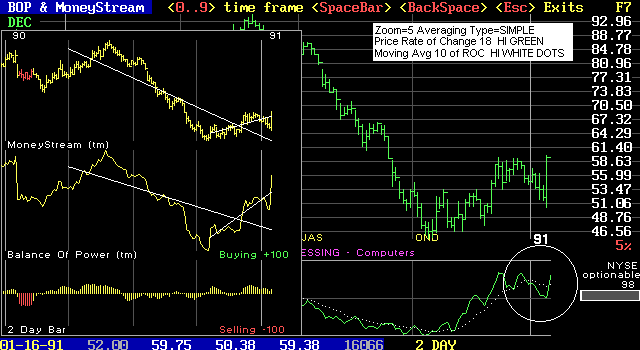
Again, based on our established rules, we closeout our long position at 56 1/4 and we go short. As you will see in just a moment, this particular trade is a good example of the dreaded whip-saw we warned you against in a previous installment. On 1/16/91, before we are able to reverse our position, DEC pops to the upside, closing the session at 59 3/8. The result is a confirmed buy signal by modules 1 & 2. This prompts us to closeout our short trade and go long the stock at 59 3/8. We obviously would have been far better off simply riding out our original long position, established back on 10/22/90 at 51 3/4, but such is the nature of a whip-saw.

You will recall that in our last installment, our chart of DEC is updated through 1/16/91 and we have just initiated a LONG position at 59 3/8. Now let’s slowly scroll forward one day at a time and watch the results of our trade unfold. Check each indicator module frequently for a possible closeout signal. Stop when you get to 2/15/91. Notice the TSV in ‘module 1’ has crossed decisively down through its moving average. Now let’s check our indicator ‘module 2’ for confirmation. Module 2 fails to show similar action, having not violated its moving average. According to our rules, we must continue to hold our long position in DEC. Now, pull-up ‘module 1’ again and resume scrolling forward through time. A sell signal is finally rendered on 3/15/91 with DEC trading at 74 3/4. This is our cue to closeout our long position, which was originally established on 1/16/91 at 59 3/8 and open a new short position right here at 74 3/4.
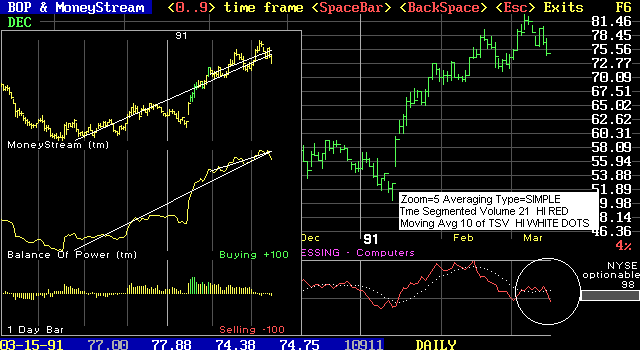
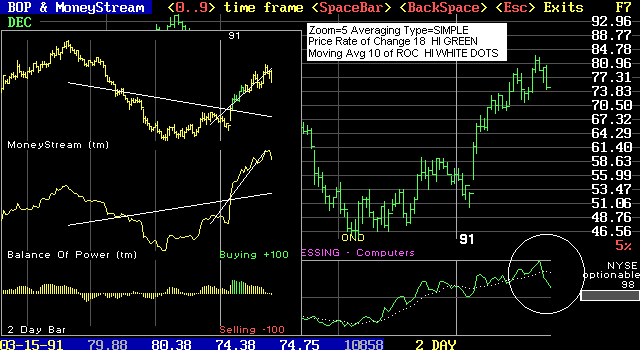
In Friday’s installment, we were working with a past chart of Digital Equipment (DEC). When we last left off, our ending chart date was 3/15/91. You will recall that we were long DEC from 1/16/91 (59 3/8) until 3/15/91 (74 3/4). Both modules 1 & 2 show that the indicators in each module are decisively crossing down through their respective moving averages. This renders a sell signal on 3/15/91, forcing us out of our long trade and into a short position.

Now let’s slowly scroll forward on a daily chart and see how our short trade unfolds. The stock hits a low of 62 3/4 on 4/5/91 and then drifts essentially sideways for the next half-a-dozen sessions. On 4/17/91, module 1 has completed a positive crossover and module 2 has all but confirmed the buy signal. With the stock trading down some eights points (from our entry price) and with the indicator modules within a hair of issuing a signal, one might be inclined to exit the trade right here and take profits. But, for the purpose of our trading examples, our predetermined rules are not flexible, so we must stick with the position. The next day on 4/18, DEC pops sharply to the upside, closing at 70 3/8. As a result of the positive action in price, module 2 completes the positive crossover, thereby confirming a trade reversal. This means our short position established on 3/15/91 at 74 3/4 is closed out here (4/18/91) at 70 3/8 and a new long position is taken. Although this most recent short trade was profitable, we ended up giving back the bulk of our profits. We established the short position at 74 3/4 on 3/15/91. Approximately three weeks later, DEC was trading at about $63 a share. However, by the time we closed out our position on 4/18/91, DEC had already rallied back to 70 3/8. As you can see, knowing when to sell is even more difficult than knowing when to buy. What could we have done differently to better protect our profits? We could have implemented a simple strategy of a trailing loss-cut. In many instances, a trailing loss-cut can create a completely objective way of deciding when to take at least partial profits in a successful trade. We’ll get more into loss-cuts at a later date.
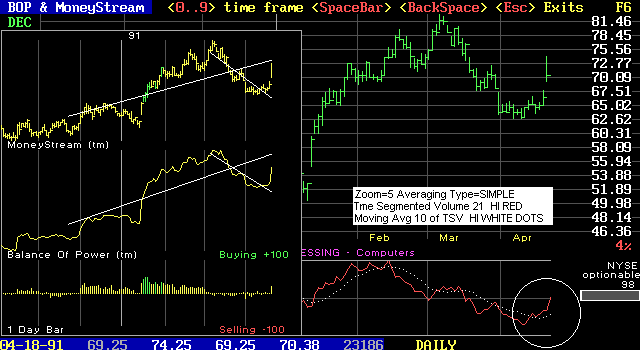
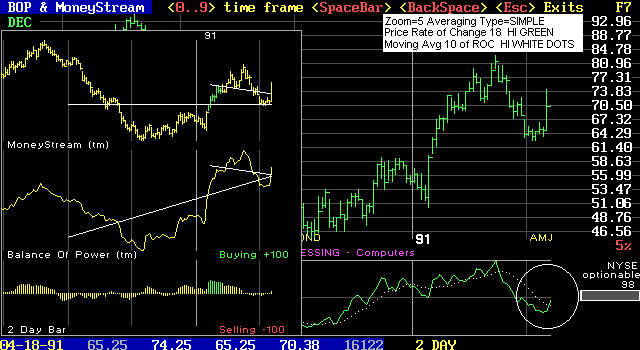
Now let’s get back to the trade at hand. You will recall, based on our simple rules of interpretation we are now long shares of DEC as of 4/18/91. So clip-back your daily chart of DEC to this date and let’s begin. We’re going to continue to work with the same two individual indicator modules 1 & 2. However, as you will see in a few minutes, this simple canned approach is less likely to produce the same favorable results in a trading range environment. Far more whip-saws tend to occur.

Start scrolling forward day by day using your right bracket key <]>. Check your indicator modules for the next reversal signal. On 6/10/91, with DEC trading at 66 3/8, our indicator modules signal us to closeout our long position and initiate a short position. This represents a loss of about six percent (excluding commissions) on our long trade. Remember, we went long DEC on 4/18/91 at 70 3/8. By 5/21/91, DEC had traded down to a low of 61 5/8. If we had employed a predetermined loss-cut when we first initiated the trade, we would have been stopped-out in early May with a five to ten percent loss. Instead, we were forced to hold our position until 6/10/91, while still incurring roughly the same percentage loss.
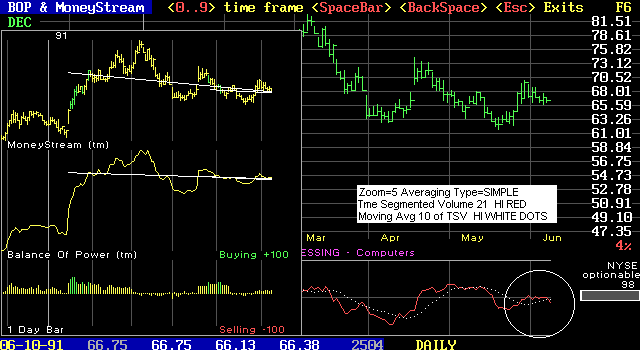
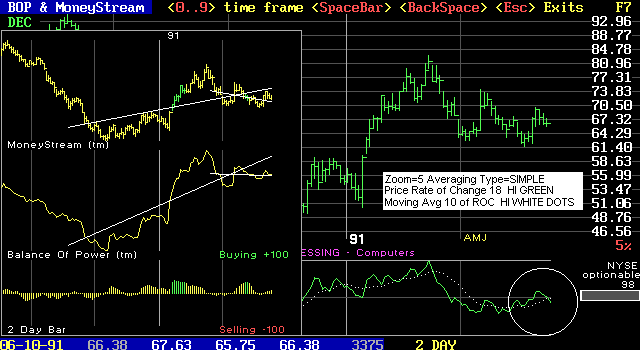
Religious followers of our indicator interpretation lessons are quite familiar with our short term trade scenarios using Digital Equipment (DEC) and our two indicator modules. We introduced these two indicator modules in our report dated, December 8, for the purpose of trying to deliver a totally objective means by which one could arrive at buy and sell signals. And since we did this as a kind of starting place for users interested in getting a better handle on what the technicals are saying, we felt we had to keep our approach as straight-forward and uncomplicated as possible. Please understand, we are not big believers in a purely automated approach to technical analysis, but since this approach is completely free of subjective interpretation, it is a logical starting point, a foundation if you will, for those wanting to develop and/or improve their indicator interpretation skills.

As we have said previously, these two indicator modules used in conjunction with one another are certainly not going to work effectively on all stocks in all situations, but they sure have worked remarkably well with DEC. For lack of a better word, this ‘system’ or purely objective approach, produced seven complete trades (opened and closed) from the period 3/12/90 through 6/10/91. Five of the seven trades were profitable, producing an average gain of 20.3%. Even more remarkable was the fact that the two losing trades were only down 5.6% and 5.7%, respectively. This means the average gain on all seven trades (losses included) was 12.9%.

It is our intention to continue working with DEC and these two indicator modules in order to see if this approach continues to work with the same effectiveness. This approach (as is the case with many technical trading methods) typically works better in a trending environment than it does in a trading range. However, based on our trade scenarios to this point, our whip-saws have been limited not only in number, but in the magnitude of losses as well. Most will agree that a couple of 6% losing trades due to whip-saws are certainly tolerable if it means being around to participate when that 44% move comes along.

Using both indicator modules and going back in time once again to the summer of 1991, we see that we are short Digital Equipment (DEC) as of the date 6/10/91 at a price of 66.38. Less than one month later, on 7/8/91, DEC pops to the upside, closing at 63.25, thereby triggering crossovers in both our indicator modules. This forces us to reverse our position from short to long. The short position netted us just over three points on the trade.
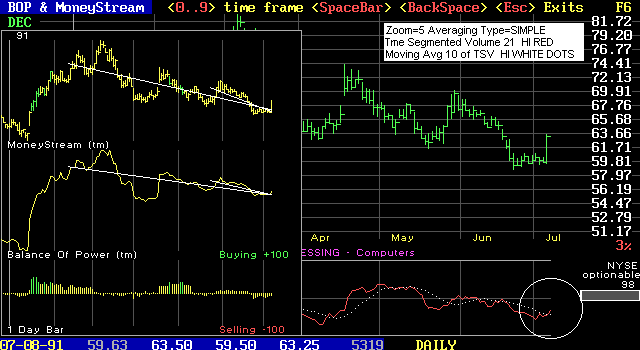
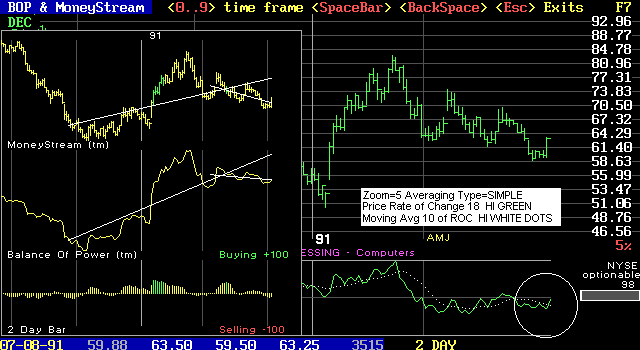
On 8/6/91, our first indicator module (daily chart with a TSV of 21 and a moving average of 10) completes a negative crossover. A check of the second module (2-day chart with an ROC of 18 and a moving average of 10) shows the indicator on the absolute verge of a negative crossover. However, since our rules are not the least bit flexible, “on the absolute verge” of a crossover is not a crossover. Of course, one day later on 8/7/91, both modules complete crossovers, signalling another reversal point. Our gain on the trade is a very nominal 2.68 points.
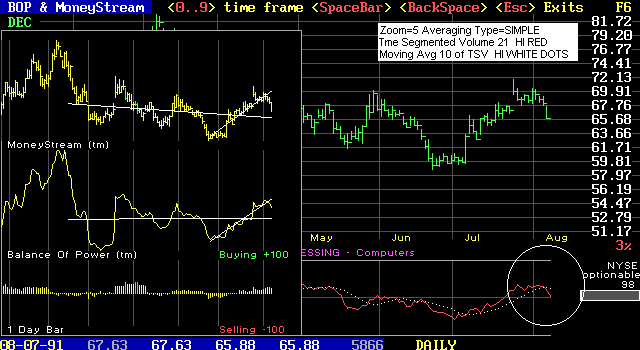
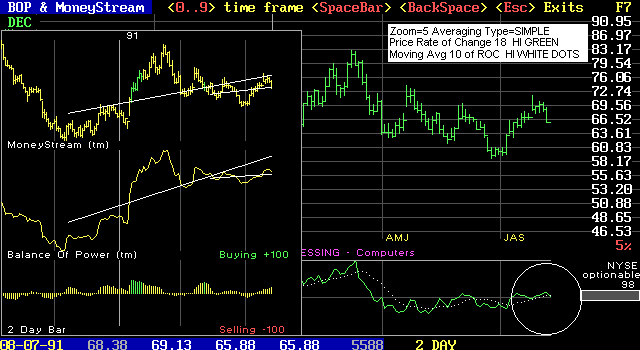
We are now short DEC as of 8/7/91, at a price of 65.88. On 8/29/91, our first indicator module shows a positive crossover, but our second module fails to confirm the signal. Some days later on 9/6/91 and again on 9/18/91, the first module completes positive crossovers, but in neither instance does the second module confirm the buy signal. DEC now stands at 55.25, more than ten full points below where we entered our short trade just five weeks before. As you scroll through this final week of September, you will see that DEC’s price begins to stabilize and there are several points at which the TSV indicator module signals a buy. However, at no point does the second indicator module give us the necessary confirmation to reverse our short position. Finally on 10/4/91, both modules confirm a buy signal at 53.75. This prompts us to closeout our short position and open a new long position. The net result of our short trade is a 12 point profit or a gain of 18.4% over an eight week period.
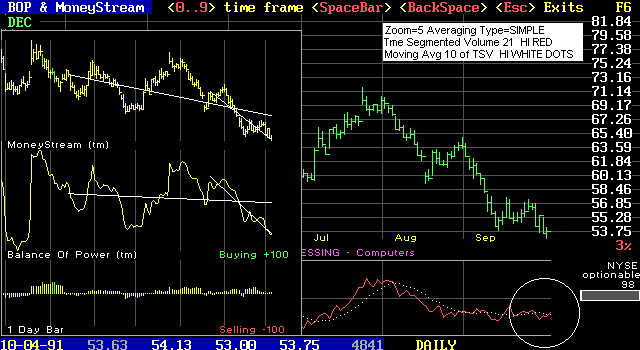
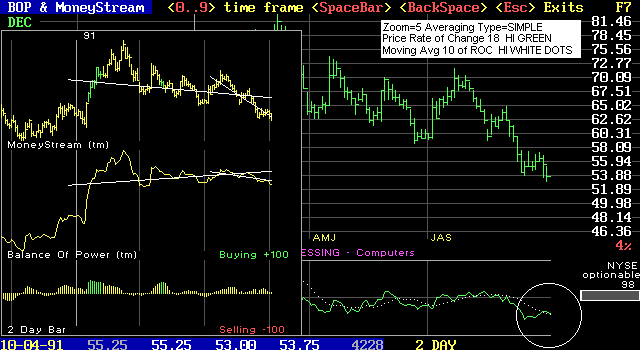
You will recall, at the end of yesterday’s segment, we initiated a long position in Digital Equipment (DEC) on 10/4/91 at 53.75. Now, let’s scroll forward one day at a time and see how this latest trade plays out.
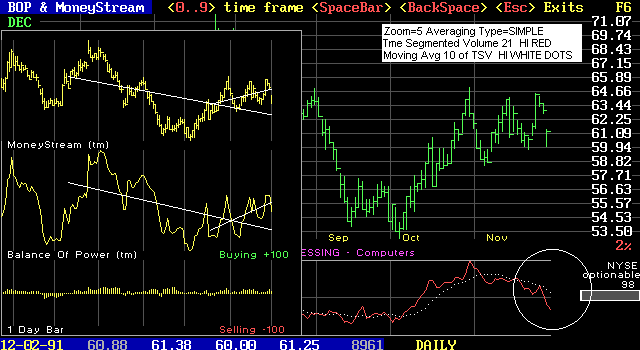
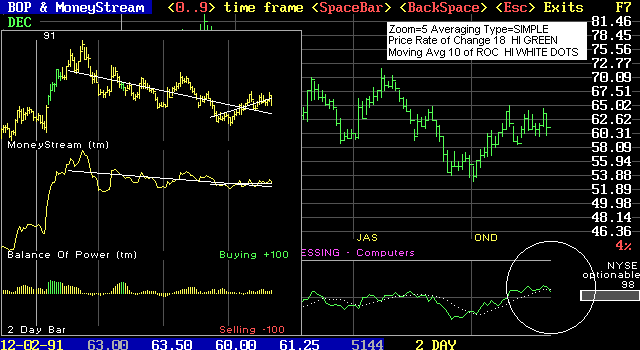
Following the buy signal, DEC rallies impressively to a high of $65 a share by the end of October. However, during the first days of November, DEC pulls back rather sharply from an overbought condition. On 11/5/91, with DEC now trading at 59, our first indicator module (daily chart with TSV) registers a negative crossover. But a quick check of our second indicator module fails to confirm, therefore we have no valid sell signal, as yet.

Scrolling ahead a few more days, we find that by 11/8/91, the short term correction in price appears to have run its course. Our first indicator module remains in a negative mode, but the second module still fails to confirm, keeping the current buy signal in force. By 11/14/91, DEC has rallied back up to a high of 64, but both modules still continue to contradict one another. Scrolling ahead now to 11/22/91, we continue to see much the same action. Price is in a consolidation mode; our first indicator module is in a sell mode; and our second module is in a buy mode. Remember, both indicator modules must be in agreement before we can reverse our current long position. On 11/29/91, with DEC trading at 63 and indicator module number one thoroughly entrenched in a bearish mode, indicator module number two is just a hair away from a confirming bearish crossover. The following day (12/2/91), DEC gaps down to 61.25 and as a result, we get our official sell signal. To review the trade, we went long DEC on 10/4/91 at 53.75. The stock hit a high of 65 on 10/31/91. And a sell signal was finally rendered on 12/2/91 at 61.25. This means we took about 7 1/2 points out of the stock in about two months time and we are now short DEC at a price of 61.25.

You will recall, in our last installment we initiated a short position in Digital Equipment (DEC) on 12/2/91 at a price of 61.25. Now, let’s scroll forward on a daily chart using our first indicator module (TSV 21 with a MA 10) to help us detect a reversal point. Less than three weeks after the short signal, DEC hits a low of 48.5 on 12/20/91. However, scrolling ahead further we see that it is not until 12/30/91 that both modules reveal a positive crossover, thereby signalling a reversal of our position. Unfortunately, by this point DEC has traded back up to a price of 56.25, leaving us only a five point profit instead of twelve.
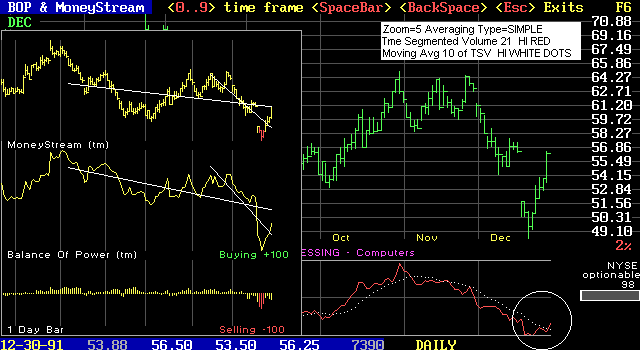
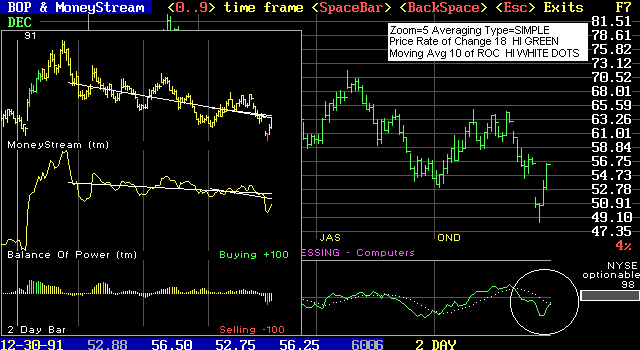
Obviously, this is a case where our entry worked much better than our exit, but the bottom line is we still made a profit on the trade. In fact, since we started running these trade scenarios on DEC using our two indicator modules (sometimes referred to as the Micro Timing Technique), our results have been quite remarkable. Nevertheless, in the coming weeks and months we plan to introduce a few new indicator modules that should help us to better identify a stock’s underlying bias. Additional indicator module configurations used in conjunction with our Micro Timing Technique, may actually enhance the accuracy of our overall timing and ultimately translate into bigger profits on fewer trades.

Introduction to WBMF System – TC2000 PCF’s – TradeOn.com

The WBMF system shown here is a PCF version of the system being used by Antonio the original author. There has been some discussion of it on the Yahoo CANSLIM board and also on the TC2000 board by several people. The PCFs have been added by Seller9 to try and implement the process into TC2000. This is not a finished TC2000 system yet, so use it as such. Please post any improvements to the system on the TC2000 Yahoo club site. You may want to go over to the CANSLIM board and check out some of the posts on it. They start around #635. Good Luck

An Introduction to WBMF System
( Where The Big Money Flows )

I’m going to explain the WBMF system that I stumbled upon out of frustration with my own inability to distinguish “sound” bases from faulty ones. The setup and pre-requisites work extremely well with O’Neil’s way of buying stocks from “sound” bases. So, first let’s define what WBMF means.
WBMF means Where the Big Money Flows and it was taken from IBD’s special section on stocks showing volume increases. This is the MAIN indicator in the system. It is described with the following criteria.1) Today’s gain or loss is at least ½ a point.
#1-WBMF: C >= C1 + .5
2) 50-day EXPONENTIAL volume average ( “Avg Vol” column) must be greater than 70,000 shares. We look for stocks with a constant flow of buyers/sellers. I prefer at least 100K.
#2-WBMF: ((AVGV50.2 * .961) + (V1 * .0392)) > 1000
3) Today’s volume must be greater than YESTERDAY’s 50-day EXPONENTIAL volume average by at least 40% (“V v A” column.) I personally look for 100% and higher. Anything above 200% is excellent.
#3-WBMF: (V * 1.4) > ((AVGV50.2 * .961) + (V1 * .0392))
So, now we have the main indicator that can be negative (“W-” column) or positive (“W+” column). This is a sign to hold above the stock that says “Hey, look at me today!” Obviously, when entering the trade we look for WBMF-Gainers (+1/2) but the WBMF Losers come in handy AFTER entering the trade. We’ll talk about WBMF Losers later on.
Now, let’s explain the setup of the days prior to the “W+” column turning ON. I call this part “the tail.”1) The 10-day to 50-day volume oscillator (“VO” column) must be negative for the last 10 days. During this period one can have from one to three positive values but that’s it. Positive values in this column tend to turn the breakout into a mere top. Study the tables and you’ll see what I’m talking about.
This is a look at the graph.
2) There cannot be a WBMF Loser (“W-” column) within the last 10 days. We are looking for the next leg UP not a recovery from a prior low. In other words, we’re not interested in “cratered” price patterns but in flat ones.
#4-WBMF: ((C1 + .5) >= C2) AND ((C2 + .5) >= C3) AND ((C3 + .5) >= C4) AND ((C4 + .5) >= C5) AND ((C5 + .5) >= C6) AND ((C6 + .5) >= C7) AND ((C7 + .5) >= C8) AND ((C8 + .5) >= C9) AND ((C9 + .5) >= C10) AND ((C10 + .5) >= C11)
3) The 10-day EXPONENTIAL ATR (“ATR” column) cannot be greater than 3.00. This indicates the volatility of the stock for the last 10 days. Internet stocks are the exception to this rule. Sorry, but I haven’t studied the Internet stocks in my tables to determine an equivalent value. Good values are less than 2.00. The closer they get to three the riskier the entry is on the following day. Of the hundreds of entries that I’ve studied I have only seen two or three (non-internet) with ATRs greater than 3.0 that successfully climbed up the chart.
#5-WBMF: (((AVGH10.1 * .818) + (H * .21)) – ((AVGL10.1 * .818) + (L * .21))) < 3
These three pre-requisites describe how calm the stock is prior to lift off. Inscribe them on your forehead because they form the base to a successful move up.
We have described the “tail” now let’s discuss the “head”. What happens on the breakout day.1) The breakout day’s HIGH must be a 10-day high.
#6-WBMF: H > MAXH10.1
2) Today’s gain (in dollars) must be 20% or greater than the 10-day EXPONENTIAL ATR (“ATR” column ). Now, this is critical. Don’t settle for less than 20%. The only exception to this rule is when the breakout day causes a gap up in the price pattern. I have seen winners that break this rule but ONLY on a gap.
#7-WBMF: (((((C – C1) / (((AVGH10.1 * .818) + (H * .1818)) – ((AVGL10.1 * .818) + (L * .1818)))) – 1) * 100)) > 19
3) The volume on the breakout day must be at least 100% greater than the day before( “V v Y” column.) Moreover, this percentage must be greater than the value in the “V v A” column. If it’s not, the move may lack force to propel it to higher territory.
#8-WBMF: V > 2 * V1
#9-WBMF: ((V – ((AVGV50.2 * .961) + (V1 * .0392))) / ((AVGV50.2 * .962) + (V1 * .0392))) < ((V – V1) / V1) 4) The 10-day volume oscillator must turn positive.
This indicates a radical change in volume for the last ten days. Some moves become succesful even if this column is negative or zero. Failure to turn positive does not indicate that the breakout is not good. It just doesn’t have enough market confirmation. That’s all. #10-WBMF: (V – ((AVGV10.2 * .818) + (V1 * .1818)) > 0) AND ((V1 – ((AVGV10.3 * .818) + (V2 * .1818))) <= 0)
Now that we have the defined the entire system, let’s talk about the stock’s graph. It needs to be flat for the last 10 days. This is all the charting knowledge that you need to know. I usually look at the Time Segmented Volume and the Money Stream (TC2000 stuff) to be above their averages AND above the zero line. That’s it. If you have other indicators that meet YOUR psychology of trading, please use them. If you use the oversold/overbought indicator to trade, you will not trade well with this system. Why? Because the entry points of the system coincide with this indicator being near or at overbought territory.
#11-WBMF: (TSV > 0) AND TSV > (((AVG(TSV10,2)) * .818) + ((TSV10.1) * .1818))
One last thing to add. Don’t trade stocks with EPS rating less than 80, accumulation/distribution rating less than “C”, and Group strength rating less than 70. You may want to check IBD’s paper from the week before to make sure that the stock’s accumulation rating has not been downgraded.
ENTERING THE TRADE

DO NOT enter trades on confirmed news that a takeover is in the horizon.
You enter on the next day at the opening. You want to get on the train ASAP. Practice sound money management at this point. Now, the market has confirmed the direction of the movement. Put a stop at ¼ below the low of the breakout day. This is the base for the upcoming move. This stop gets you out ASAP if the stock retraces its steps back to the base. Some people like Ryan (O’Neil’s partner) sales half of its shares when the stock retraces back to the breakout day’s range. I suppose he dumps the rest when it breaks below the breakout day. Think of the breakout day as a healthy step up a ladder. If the stock retraces, the leg (breakout day) is not strong enough to support the next leg up. Move your stops following your own methods. I’ve only seen one stock that stopped me ¼ below the low and then immediately proceeded to move up.
Some people have suggested to wait for a confirmation of the move by entering the trade in the afternoon rather than placing a market order at the opening. This is a good advice when you’re first learning the system. Look for the stock to be closing above the prior close AND its high to be a 10-day high before deciding to enter the trade.
EXITING THE TRADE, abruptly.- If a WBMF Loser (“W+” column) shows up within five days of the breakout day, the move is going to retrace or is about to go sideways. I leave it to your discretion to exit or stay with the trade.

FORMULAS
Exponential avg = (SIMPLE average from yesterday up to 9 days)*(1-weight)+today’s value*weight weight = 2/(days+1)

CONCLUSION
The system works well for stocks making new highs or about to make bold upward moves from sound bases.
The
system dumps the losers quickly, as given advice by O’Neil,and watches the winners closely.
 /Antonio

Candlestick Charting PCF’s for TC2000 TCNet- Candlestick formulas for – TC2000 PCFs – TradeOn.com

Candlesticks For PCFs and charts of similar Candlestick formulas: Go to “CANDLES”
CANDLESTICK LINES

Doji
(O=C)

Doji AND Almost or Near Doji
(ABS(O-C)<=((H-L)*0.1))

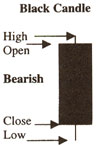
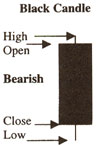
Black Candle
(O>C)

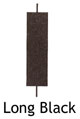
Long Black Candle
((O>C)AND((O-C)/(.001+H-L)>.6))

Small Black Candle
((O>C)AND((H-L)>(3*(O-C))))

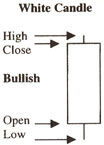
White Candle
(C>O)

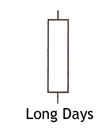
Long White Candle
((C>O)AND((C-O)/(.001+H-L)>.6))

Small White Candle
((C>O)AND((H-L)>(3*(C-O))))

MARUBOZU or Bald Lines:

Black Marubozu
((O>C)AND(H=O)AND(C=L))

White Marubozu
((C>O)AND(H=C)AND(O=L))

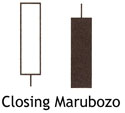
Black Closing Marubozu
((O>C)AND(C=L))

White Closing Marubozu
((C>O)AND(C=H))

Black Opening Marubozu
((O>C)AND(O=H))

White Opening Marubozu
((C>O)AND(O=L))


PAPER UMBRELLAS ?
have strong reversal implications:

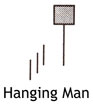
Hanging Man
(((H-L)>4*(O-C))AND((C-L)/(.001+H-L)>=0.75)AND((O-L)/(.001+H-L)>=0.75))

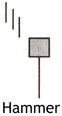
Hammer
(((H-L)>3*(O-C))AND((C-L)/(.001+H-L)>0.6)AND((O-L)/(.001+H-L)>0.6))

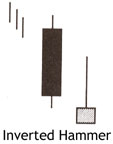
Inverted Hammer
(((H-L)>3*(O-C))AND((H-C)/(.001+H-L)>0.6)AND((H-O)/(.001+H-L)>0.6))

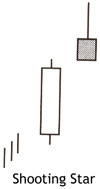
Shooting Star
(((H-L)>4*(O-C))AND((H-C)/(.001+H-L)>= 0.75)AND((H-O)/(.001+H-L)>=0.75))

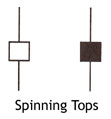
SPINNING TOPS:

Black Spinning Top
((O>C)AND((H-L)>(3*(O-C)))AND(((H-O)/(.001+H-L))<.4)AND(((C-L)/(.001+H-L))<.4))

White Spinning Top
((C>O)AND((H-L)>(3*(C-O)))AND(((H-C)/(.001+H-L))<.4)AND(((O-L)/(.001+H-L))<.4))

PATTERNS USING CANDLESTICK LINES
BEAR PATTERNS:

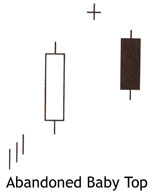
Bearish Abandoned Baby ? very rare
((C1=O1)AND(C2>O2)AND(O>C)AND(L1>H2)AND(L1>H))

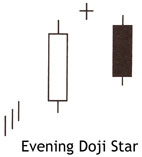
Bearish Evening Star or Bearish Evening Doji Star
((C2>O2)AND((C2-O2)/(.001+H2-L2)>.6)AND(C2<O1)AND(C1>O1)AND((H1-L1)>(3*(C1-O1)))AND(O>C)AND(O<O1))

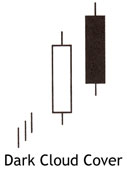
Dark Cloud Cover
((C1>O1)AND(((C1+O1)/2)>C)AND(O>C)AND(O>C1)AND(C>O1)AND((O-C)/(.001+(H-L))>0.6))

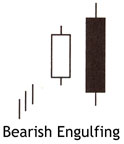
Bearish Engulfing
((C1>O1)AND(O>C)AND(O>=C1)AND(O1>=C)AND((O-C)>(C1-O1)))

Equis Bearish Engulfing

(C1>O1)AND(O>C)AND(O>=C1)AND(O1>=C)AND((O-C)>(C1 O1))AND(STOC9.1>90
OR
STOC9.1.1>90ORSTOC9.1.2>90)AND(V>AVGV70)AND((C-C60)>15)

CONFIRMS yesterdays Bearish Engulfing Pattern:
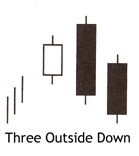
Three Outside Down Pattern
((C2>O2)AND(O1>C1)AND(O1>=C2)AND(O2>=C1)AND((O1-C1)>(C2-O2))AND(O>C)AND (C<C1))

BULL PATTERNS:

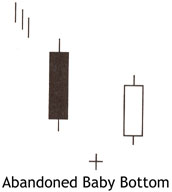
Bullish Abandoned Baby ? very rare
((C1=O1)AND(O2>C2)AND(C>O)AND(L2>H1)AND(L>H1))

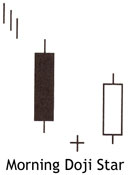
Bullish Morning Star or Bullish Morning Doji Star
((O2>C2)AND((O2-C2)/(.001+H2-L2)>.6)AND(C2>O1)AND(O1>C1)AND((H1-L1)>(3*(C1-O1)))AND(C>O)AND(O>O1))

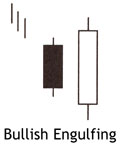
Bullish Engulfing
((O1>C1)AND(C>O)AND(C>=O1)AND(C1>=O)AND((C-O)>(O1-C1)))

Equis Bullish Engulfing
((O1>C1)AND(C>O)AND(C>=O1)AND(C1>=O)AND((C-O)>(O1-C1)))AND(STOC9.1<10
OR
STOC9.1.1<10ORSTOC9.1.2<10)AND(V >AVGV70)AND((C-C60)<(-15))

CONFIRMS yesterday?s Bullish Engulfing Pattern:
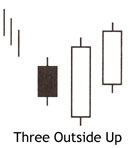
Three Outside Up Pattern
((O2>C2)AND(C1>O1)AND(C1>=O2)AND(C2>=O1)AND((C1-O1)>(O2-C2))AND (C>O)AND (C>C1))

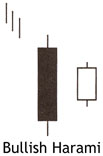
Bullish Harami:
((O1>C1)AND(C>O)AND(C<=O1)AND(C1<=O)AND((C-O)<(O1-C1)))

CONFIRMS yesterday?s Bullish Harami Pattern:
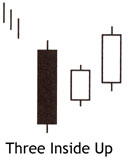
Three Inside Up Pattern
((O2>C2)AND(C1>O1)AND(C1<=O2)AND(C2<=O1)AND
((C1-O1)<(O2-C2))AND(C>O)AND(C>C1)AND(O>O1))

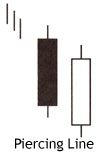
Piercing Line:
((C1<O1)AND(((O1+C1)/2)<C)AND(O<C)AND(O<C1)AND(C<O1)AND((C-O)/(.001+(H-L))>0.6))

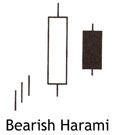
Bearish Harami:
((C1>O1)AND(O>C)AND(O<=C1)AND(O1<=C)AND((O-C)<(C1-O1)))

CONFIRMS yesterday?s Bearish Harami Pattern:

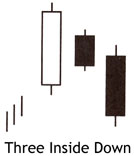
Three Inside Down Pattern
((C2>O2)AND(O1>C1)AND(O1<=C2)AND(O2<=C1)AND
((O1-C1)<(C2-O2))AND(O>C)AND(C<C1)AND(O<O1))

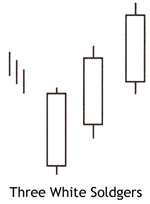
Three White Soldiers
? Bullish Reversal Pattern

Identifying the Pattern
1. Three consecutive long white lines occur, each with a higher close
Today: (C>O*1.01) AND (C>C1)
Yesterday: (C1>O1*1.01) AND (C1>C2)
Day before Yesterday: (C2>O2*1.01)

2. Each opens within the body of the previous day
(O<C1) AND (O>O1)
(O1<C2) AND (O1>O2)

3. Each should close at or near the high for the day
(((H – C) / (H – L)) > .2)
(((H1 – C1) / H1 – L1)) >.2)
(((H2 – C2) / (H2 – L2)) >.2)

Three White Soldiers PCF
(C>O*1.01) AND(C1>O1*1.01) AND(C2>O2*1.01) AND(C>C1) AND
(C1>C2) AND(O<C1ANDO>O1) AND(O1<C2ANDO1>O2) AND
(((H-C)/(H-L))<.2) AND(((H1-C1)/(H1-L1))<.2)AND(((H2-C2)/(H2-L2))<.2)

Pattern Breakdown
The Three White Soldiers pattern on a daily chart reduces to a long white candlestick on a 3 Days/Bar chart

Dark Cloud Cover

Identifying the Pattern
1. (Yesterday) The first day is a long white day that is continuing the uptrend
(C1>O1*1.01)

Dahl Trend Indicator
(AVGC13-AVGC13.4)>0

Candlestick Trading

2. (Today) The second day is a black body day with the open above the previous day’s HIGH

(O>C)
(O>H1)

3. (Today) The second (black) day closes within and below the midpoint of the previous white body.
(C>O1)
(((C1+O1)/2)>C)

Dark Cloud Cover PCF
(C1>O1*1.01) AND(O>C) AND(O>H1) AND(C>O1) AND(((C1+O1)/2)>C)AND(C>O1) AND((AVGC13-AVGC13.4)>0)


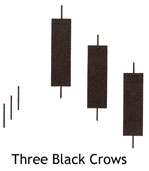
Three Black Crows
? Bearish Reversal Pattern

Identifying the Pattern
1. Three consecutive long black days
Today: O>C*1.01
Yesterday: O1>C1*1.01
Day before Yesterday: O2>C2*1.01

2. Each day closes at a new low
(C<C1)
(C1<C2)

3. Each day opens within the body of the previous day
(O>C1 AND O<O1)
(O1>C2 AND O1<O2)

4. Each day closes at or near its low

(((C – L) / (H – L)) < .2)
(((C1 – L1) / H1 – L1)) < .2)
(((C2 – L2) / (H2 – L2)) < .2)

Three Black Crows PCF

(O > C * 1.01) AND (O1 > C1 * 1.01) AND (O2 > C2 *

1.01) AND (C < C1) AND (C1 < C2) AND (O > C1) AND (O < O1) AND

(O1 > C2) AND (O1 < O2) AND (((C – L) / (H – L)) < .2) AND

(((C1 – L1) / (H1 – L1)) < .2) AND (((C2 – L2) / (H2 – L2)) < .2)

Pattern Breakdown
The Three Black Crows pattern on a daily chart reduces to a long Black candlestick on a 3 Days/Bar chart


Candlestick Recommended Books for the serious:
Candlestick Charting Basics, Author: Steve Nison
Beyond Candlesticks: New Japanese Charting Techniques Revealed

Candlestick Charting Explained: Timeless Techniques for Trading Stocks and Futures


Active OnLine Candlestick tutorials:


Additional Sources:
. . . Candlestick Techniques Training File
. . . Trading Techniques Training File


Insider TA Demo:
. . .includes Candlestick format

Once you’re “hooked” on candlesticks, read Japanese Candlestick Charting Techniques
by Steve Nison Candlestick Charting Explained by Gregory L Morris

CandleStick Forcaster (CSF) Demo:
For a workable current data file; see message 5862 below:

MESSAGE #5862
To create the file (or a better file) for the CSF Demo:

On the disk that has the TCMSDATA and TCV3DATA folders, add <new> <folder> rename the new folder TCTXDATA.

From the TC2000 menu bar, select <Databank>.
Select <Export to Text>

List to Export: For the first time, choose a list with 4 or 5 stocks
<Add> the Available Data Fields in this order to the Export Fields window:

DateMM/DD/YYYY

Open

High

Low

Close

Exchange

Exchange

Data Delimiter: Comma

Click Multiple Files (named with symbol)

Number of Days to Export: 250 (about 1 year)

Export Path:

. C: (or the disk containing the TCTXDATA folder)

. . .TCTXDATA

Click Descending

Click Export

Go to the TCTXDATA Folder and open the folder

Double click the first file in the folder; use WORDPAD or any other simple word processor with a REPLACE function

In each stock folder, insert a top line:

MM/DD/YY,OPEN,HIGH,LOW,CLOSE,VOLUME,OPEN INT

Replace All: 1999 with 99

Replace All: 1998 with 98

Replace All: ,Exchange with ,0 (yes ?comma zero?)

Sample contents for S (Sears) data file (TCTXDATA folder):

MM/DD/YY,OPEN,HIGH,LOW,CLOSE,VOLUME,OPEN INT

06/18/99,49.69,49.88,48.25,48.63,0,0

06/17/99,49,49.06,47.75,48.94,0,0

06/16/99,49.5,49.81,48.38,49.25,0,0

06/15/99,50.19,50.44,49.25,49.5,0,0

06/14/99,49.38,50.69,49.38,50.06,0,0

06/11/99,49.19,49.81,48.63,49.13,0,0

In the CSF Demo,

Click <Chart>;
from the dropdown menu, select <Get?>
Choose File Type: 3
Click <SetUp>
type the TC2000 Export path: C:TCTXDATA
The Databank Smart Export to MS tends to scramble the some of the data.


Stochastics – TC2000 PCF’s – TradeOn.com

Stoc: Stochastics
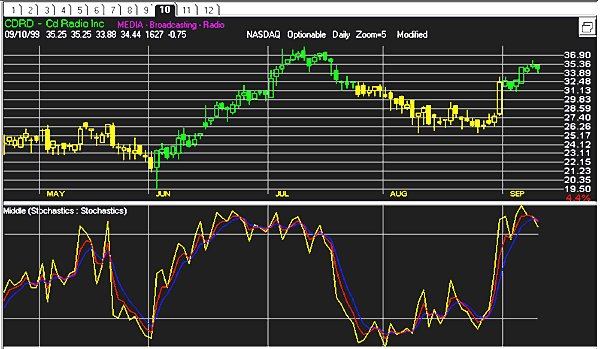
For this example, Chart Editing Indicator Tab# Stochastics’ setting . .Stochastics – Period:13 SK:8 SD7 – Exponential Personal Criteria Formula Editing Window setting . .Period 13, SK 8, as of: . . . (No SD)

Stochastic %K (SK) (STOC13.8)
. . . . . . . Today (STOC13.8.1)
. . . . . . Yesterday (STOC13.8.5)
. . . . . . 5 trading days ago

Stochastic %D (SD) . .Note: “comma” between the 8 and 7; 7 is %D value (AVG(STOC13.8,7))
. . . . Today
(AVG(STOC13.8.1,7))
. . . Yesterday
(AVG(STOC13.8.5,7))
. . . 5 trading days ago
STOCHASTIC MOVEMENT SK less than 20 (Chart’s lower Stochastic reference line)
(STOC13.8<20)
. . . . . Today
(STOC13.8.1<20)
. . . . Yesterday
(STOC13.8.5<20)
. . . . 5 trading days ago
SK greater than 80 (Chart’s upper Stochastic reference line)
(STOC13.8>80)
. . . . . Today
(STOC13.8.1>80)
. . . . Yesterday
(STOC13.8.5>80)
. . . . 5 trading days ago
SK crossing SD
. Fast Stochastic (SK) crossing UP through Slow Stochastic(SD)
. Buy Signal?
(STOC13.8.1)<(AVG(STOC13.8.1,7)) AND
. . . Yesterday: SK below SD
(STOC13.8)>(AVG(STOC13.8,7))
. . . Today: SK above SD
. Fast Stochastic (SK) crossing DOWN through Slow Stochastic(SD) . Sell Signal?
(STOC13.8.1)>(AVG(STOC13.8.1,7)) AND
. . . Yesterday: SK above SD
(STOC13.8)<(AVG(STOC13.8,7))
. . . Today: SK below SD
StochRSI (from InSync Index)
((RSI8-MIN(RSI8,5))/((MAX(RSI8,5)-MIN(RSI8,5))+.001)*100)

For additional information, a few book suggestions:
Stochastic RSI . . . PCFs: Stochastic . . . PCFs: StochRSI . . . Trading Systems: InSync
Technical trading Tips and Tricks
High frequency trading
Trading with the stochastic oscillator
High frequency trading programming

. . . 3 line stochastics –
message 4482
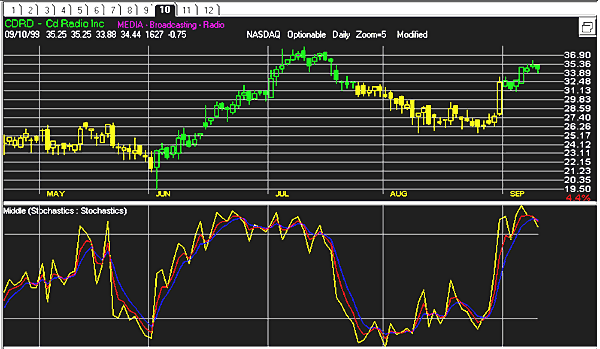
Select a Tab#, in the Editing Indicator Tab# window, Middle ..<Add indicator> Select Stochastics ….Period 14 ….%K 1 (draw color yellow) ….%D 3 (draw color red) ..<Add indicator> Select Stochastics ….Period 14 ….%K 3 (draw color red) ….%D 3 (draw color blue) <Refresh> <Close>


In Stochastic14.1.3, 14.1 is raw data with no smoothing; the 3 is the first smoothing. In Stochastic14.3.3, the 14.3 is the first smoothing repeated – %K; the last 3 is the second smoothing -%D.
See, also: TeleChart 2000 Help Topics TeleChart 2000 User’s Guide

Volatility Ratio – TC2000 PCFs – TradeOn.com

Historical Volatility & Volatility Ratio

Message 14941 by tedclimo
Need help with TC2000 Historic Volatility formula
(described as follows):

1) Divide todays close by yesterdays close.

2) Take natural log of #1

3) Take the standard deviation of #2 for 50 days

4) Multiply #3 by 100

5) Multiply #4 by the square root of the # of trading days in a year (256).
Message 14974  Calculating Historical Volatility

Let Length = length of volatility to be calculated

ln = natural logarithm

Historical Volatility(length) = standard deviation
(ln(close/yesterdays close),length) * 100 * square root (256)


HISTORICAL VOLATILITY PCFs

Suggestions:
COPY and PASTE the formulas.

For testing, remove ALL spaces including carriage returns.
During the FIRST [Update All Criteria], let the PCF editor insert spaces into the “spaceless” PCF (reduces logic errors).

6-day Historical Volatility PCF
(((SQR((6*((LOG(C/C1))*(LOG(C/C1))+(LOG(C1/C2))*
(LOG(C1/C2))+(LOG(C2/C3))*(LOG(C2/C3))+(LOG(C3/C4))*
(LOG(C3/C4))+(LOG(C4/C5))*(LOG(C4/C5))+(LOG(C5/C6))*
(LOG(C5/C6)))-((LOG(C/C1))+(LOG(C1/C2))+(LOG(C2/C3))+
(LOG(C3/C4))+(LOG(C4/C5))+(LOG(C5/C6)))*((LOG(C/C1))+
(LOG(C1/C2))+(LOG(C2/C3))+(LOG(C3/C4))+(LOG(C4/C5))+
(LOG(C5/C6))))/(6*6))))*100*16.1245)


Message 15042 by sammy_4_1
10-day Historical Volatility PCF
(((SQR((10*((LOG(C/C1))*(LOG(C/C1))+(LOG(C1/C2))*
(LOG(C1/C2))+(LOG(C2/C3))*(LOG(C2/C3))+(LOG(C3/C4))*
(LOG(C3/C4))+(LOG(C4/C5))*(LOG(C4/C5))+(LOG(C5/C6))*
(LOG(C5/C6))+(LOG(C6/C7))*(LOG(C6/C7))+(LOG(C7/C8))*
(LOG(C7/C8))+(LOG(C8/C9))*(LOG(C8/C9))+(LOG(C9/C10))*
(LOG(C9/C10)))-((LOG(C/C1))+(LOG(C1/C2))+(LOG(C2/C3))+
(LOG(C3/C4))+(LOG(C4/C5))+(LOG(C5/C6))+(LOG(C6/C7))+
(LOG(C7/C8))+(LOG(C8/C9))+(LOG(C9/C10)))*((LOG(C/C1))+
(LOG(C1/C2))+(LOG(C2/C3))+(LOG(C3/C4))+(LOG(C4/C5))+
(LOG(C5/C6))+(LOG(C6/C7))+(LOG(C7/C8))+(LOG(C8/C9))+
(LOG(C9/C10))))/(10*10))))*100*16.1245)


50-day Historical Volatility PCF
(((SQR((50*((LOG(C/C1))*(LOG(C/C1))+(LOG(C1/C2))*
(LOG(C1/C2))+(LOG(C2/C3))*(LOG(C2/C3))+(LOG(C3/C4))*
(LOG(C3/C4))+(LOG(C4/C5))*(LOG(C4/C5))+(LOG(C5/C6))*
(LOG(C5/C6))+(LOG(C6/C7))*(LOG(C6/C7))+(LOG(C7/C8))*
(LOG(C7/C8))+(LOG(C8/C9))*(LOG(C8/C9))+(LOG(C9/C10))*
(LOG(C9/C10))+(LOG(C10/C11))*(LOG(C10/C11))+(LOG(C11/C12))*
(LOG(C11/C12))+(LOG(C12/C13))*(LOG(C12/C13))+(LOG(C13/C14))*
(LOG(C13/C14))+(LOG(C14/C15))*(LOG(C14/C15))+(LOG(C15/C16))*
(LOG(C15/C16))+(LOG(C16/C17))*(LOG(C16/C17))+(LOG(C17/C18))*
(LOG(C17/C18))+(LOG(C18/C19))*(LOG(C18/C19))+(LOG(C19/C20))*
(LOG(C19/C20))+(LOG(C20/C21))*(LOG(C20/C21))+(LOG(C21/C22))*
(LOG(C21/C22))+(LOG(C22/C23))*(LOG(C22/C23))+(LOG(C23/C24))*
(LOG(C23/C24))+(LOG(C24/C25))*(LOG(C24/C25))+(LOG(C25/C26))*
(LOG(C25/C26))+(LOG(C26/C27))*(LOG(C26/C27))+(LOG(C27/C28))*
(LOG(C27/C28))+(LOG(C28/C29))*(LOG(C28/C29))+(LOG(C29/C30))*
(LOG(C29/C30))+(LOG(C30/C31))*(LOG(C30/C31))+(LOG(C31/C32))*
(LOG(C31/C32))+(LOG(C32/C33))*(LOG(C32/C33))+(LOG(C33/C34))*
(LOG(C33/C34))+(LOG(C34/C35))*(LOG(C34/C35))+(LOG(C35/C36))*
(LOG(C35/C36))+(LOG(C36/C37))*(LOG(C36/C37))+(LOG(C37/C38))*
(LOG(C37/C38))+(LOG(C38/C39))*(LOG(C38/C39))+(LOG(C39/C40))*
(LOG(C39/C40))+(LOG(C40/C41))*(LOG(C40/C41))+(LOG(C41/C42))*
(LOG(C41/C42))+(LOG(C42/C43))*(LOG(C42/C43))+(LOG(C43/C44))*
(LOG(C43/C44))+(LOG(C44/C45))*(LOG(C44/C45))+(LOG(C45/C46))*
(LOG(C45/C46))+(LOG(C46/C47))*(LOG(C46/C47))+(LOG(C47/C48))*
(LOG(C47/C48))+(LOG(C48/C49))*(LOG(C48/C49))+(LOG(C49/C50))*
(LOG(C49/C50)))-((LOG(C/C1))+(LOG(C1/C2))+(LOG(C2/C3))+
(LOG(C3/C4))+(LOG(C4/C5))+(LOG(C5/C6))+(LOG(C6/C7))+(LOG(C7/C8))+
(LOG(C8/C9))+(LOG(C9/C10))+(LOG(C10/C11))+(LOG(C11/C12))+
(LOG(C12/C13))+(LOG(C13/C14))+(LOG(C14/C15))+(LOG(C15/C16))+
(LOG(C16/C17))+(LOG(C17/C18))+(LOG(C18/C19))+(LOG(C19/C20))+
(LOG(C20/C21))+(LOG(C21/C22))+(LOG(C22/C23))+(LOG(C23/C24))+
(LOG(C24/C25))+(LOG(C25/C26))+(LOG(C26/C27))+(LOG(C27/C28))+
(LOG(C28/C29))+(LOG(C29/C30))+(LOG(C30/C31))+(LOG(C31/C32))+
(LOG(C32/C33))+(LOG(C33/C34))+(LOG(C34/C35))+(LOG(C35/C36))+
(LOG(C36/C37))+(LOG(C37/C38))+(LOG(C38/C39))+(LOG(C39/C40))+
(LOG(C40/C41))+(LOG(C41/C42))+(LOG(C42/C43))+(LOG(C43/C44))+
(LOG(C44/C45))+(LOG(C45/C46))+(LOG(C46/C47))+(LOG(C47/C48))+
(LOG(C48/C49))+(LOG(C49/C50)))*((LOG(C/C1))+(LOG(C1/C2))+
(LOG(C2/C3))+(LOG(C3/C4))+(LOG(C4/C5))+(LOG(C5/C6))+
(LOG(C6/C7))+(LOG(C7/C8))+(LOG(C8/C9))+(LOG(C9/C10))+
(LOG(C10/C11))+(LOG(C11/C12))+(LOG(C12/C13))+(LOG(C13/C14))+
(LOG(C14/C15))+(LOG(C15/C16))+(LOG(C16/C17))+(LOG(C17/C18))+
(LOG(C18/C19))+(LOG(C19/C20))+(LOG(C20/C21))+(LOG(C21/C22))+
(LOG(C22/C23))+(LOG(C23/C24))+(LOG(C24/C25))+(LOG(C25/C26))+
(LOG(C26/C27))+(LOG(C27/C28))+(LOG(C28/C29))+(LOG(C29/C30))+
(LOG(C30/C31))+(LOG(C31/C32))+(LOG(C32/C33))+(LOG(C33/C34))+
(LOG(C34/C35))+(LOG(C35/C36))+(LOG(C36/C37))+(LOG(C37/C38))+
(LOG(C38/C39))+(LOG(C39/C40))+(LOG(C40/C41))+(LOG(C41/C42))+
(LOG(C42/C43))+(LOG(C43/C44))+(LOG(C44/C45))+(LOG(C45/C46))+
(LOG(C46/C47))+(LOG(C47/C48))+(LOG(C48/C49))+(LOG(C49/C50))))/
(50*50))))*100*16.1245)


100-day Historical Volatility PCF
(((SQR((100*((LOG(C/C1))*(LOG(C/C1))+(LOG(C1/C2))*
(LOG(C1/C2))+(LOG(C2/C3))*(LOG(C2/C3))+(LOG(C3/C4))*
(LOG(C3/C4))+(LOG(C4/C5))*(LOG(C4/C5))+(LOG(C5/C6))*
(LOG(C5/C6))+(LOG(C6/C7))*(LOG(C6/C7))+(LOG(C7/C8))*
(LOG(C7/C8))+(LOG(C8/C9))*(LOG(C8/C9))+(LOG(C9/C10))*
(LOG(C9/C10))+(LOG(C10/C11))*(LOG(C10/C11))+(LOG(C11/C12))*
(LOG(C11/C12))+(LOG(C12/C13))*(LOG(C12/C13))+(LOG(C13/C14))*
(LOG(C13/C14))+(LOG(C14/C15))*(LOG(C14/C15))+(LOG(C15/C16))*
(LOG(C15/C16))+(LOG(C16/C17))*(LOG(C16/C17))+(LOG(C17/C18))*
(LOG(C17/C18))+(LOG(C18/C19))*(LOG(C18/C19))+(LOG(C19/C20))*
(LOG(C19/C20))+(LOG(C20/C21))*(LOG(C20/C21))+(LOG(C21/C22))*
(LOG(C21/C22))+(LOG(C22/C23))*(LOG(C22/C23))+(LOG(C23/C24))*
(LOG(C23/C24))+(LOG(C24/C25))*(LOG(C24/C25))+(LOG(C25/C26))*
(LOG(C25/C26))+(LOG(C26/C27))*(LOG(C26/C27))+(LOG(C27/C28))*
(LOG(C27/C28))+(LOG(C28/C29))*(LOG(C28/C29))+(LOG(C29/C30))*
(LOG(C29/C30))+(LOG(C30/C31))*(LOG(C30/C31))+(LOG(C31/C32))*
(LOG(C31/C32))+(LOG(C32/C33))*(LOG(C32/C33))+(LOG(C33/C34))*
(LOG(C33/C34))+(LOG(C34/C35))*(LOG(C34/C35))+(LOG(C35/C36))*
(LOG(C35/C36))+(LOG(C36/C37))*(LOG(C36/C37))+(LOG(C37/C38))*
(LOG(C37/C38))+(LOG(C38/C39))*(LOG(C38/C39))+(LOG(C39/C40))*
(LOG(C39/C40))+(LOG(C40/C41))*(LOG(C40/C41))+(LOG(C41/C42))*
(LOG(C41/C42))+(LOG(C42/C43))*(LOG(C42/C43))+(LOG(C43/C44))*
(LOG(C43/C44))+(LOG(C44/C45))*(LOG(C44/C45))+(LOG(C45/C46))*
(LOG(C45/C46))+(LOG(C46/C47))*(LOG(C46/C47))+(LOG(C47/C48))*
(LOG(C47/C48))+(LOG(C48/C49))*(LOG(C48/C49))+(LOG(C49/C50))*
(LOG(C49/C50))+(LOG(C50/C51))*(LOG(C50/C51))+(LOG(C51/C52))*
(LOG(C51/C52))+(LOG(C52/C53))*(LOG(C52/C53))+(LOG(C53/C54))*
(LOG(C53/C54))+(LOG(C54/C55))*(LOG(C54/C55))+(LOG(C55/C56))*
(LOG(C55/C56))+(LOG(C56/C57))*(LOG(C56/C57))+(LOG(C57/C58))*
(LOG(C57/C58))+(LOG(C58/C59))*(LOG(C58/C59))+(LOG(C59/C60))*
(LOG(C59/C60))+(LOG(C60/C61))*(LOG(C60/C61))+(LOG(C61/C62))*
(LOG(C61/C62))+(LOG(C62/C63))*(LOG(C62/C63))+(LOG(C63/C64))*
(LOG(C63/C64))+(LOG(C64/C65))*(LOG(C64/C65))+(LOG(C65/C66))*
(LOG(C65/C66))+(LOG(C66/C67))*(LOG(C66/C67))+(LOG(C67/C68))*
(LOG(C67/C68))+(LOG(C68/C69))*(LOG(C68/C69))+(LOG(C69/C70))*
(LOG(C69/C70))+(LOG(C70/C71))*(LOG(C70/C71))+(LOG(C71/C72))*
(LOG(C71/C72))+(LOG(C72/C73))*(LOG(C72/C73))+(LOG(C73/C74))*
(LOG(C73/C74))+(LOG(C74/C75))*(LOG(C74/C75))+(LOG(C75/C76))*
(LOG(C75/C76))+(LOG(C76/C77))*(LOG(C76/C77))+(LOG(C77/C78))*
(LOG(C77/C78))+(LOG(C78/C79))*(LOG(C78/C79))+(LOG(C79/C80))*
(LOG(C79/C80))+(LOG(C80/C81))*(LOG(C80/C81))+(LOG(C81/C82))*
(LOG(C81/C82))+(LOG(C82/C83))*(LOG(C82/C83))+(LOG(C83/C84))*
(LOG(C83/C84))+(LOG(C84/C85))*(LOG(C84/C85))+(LOG(C85/C86))*
(LOG(C85/C86))+(LOG(C86/C87))*(LOG(C86/C87))+(LOG(C87/C88))*
(LOG(C87/C88))+(LOG(C88/C89))*(LOG(C88/C89))+(LOG(C89/C90))*
(LOG(C89/C90))+(LOG(C90/C91))*(LOG(C90/C91))+(LOG(C91/C92))*
(LOG(C91/C92))+(LOG(C92/C93))*(LOG(C92/C93))+(LOG(C93/C94))*
(LOG(C93/C94))+(LOG(C94/C95))*(LOG(C94/C95))+(LOG(C95/C96))*
(LOG(C95/C96))+(LOG(C96/C97))*(LOG(C96/C97))+(LOG(C97/C98))*
(LOG(C97/C98))+(LOG(C98/C99))*(LOG(C98/C99))+(LOG(C99/C100))*
(LOG(C99/C100)))-((LOG(C/C1))+(LOG(C1/C2))+(LOG(C2/C3))+
(LOG(C3/C4))+(LOG(C4/C5))+(LOG(C5/C6))+(LOG(C6/C7))+
(LOG(C7/C8))+(LOG(C8/C9))+(LOG(C9/C10))+(LOG(C10/C11))+
(LOG(C11/C12))+(LOG(C12/C13))+(LOG(C13/C14))+(LOG(C14/C15))+
(LOG(C15/C16))+(LOG(C16/C17))+(LOG(C17/C18))+(LOG(C18/C19))+
(LOG(C19/C20))+(LOG(C20/C21))+(LOG(C21/C22))+(LOG(C22/C23))+
(LOG(C23/C24))+(LOG(C24/C25))+(LOG(C25/C26))+(LOG(C26/C27))+
(LOG(C27/C28))+(LOG(C28/C29))+(LOG(C29/C30))+(LOG(C30/C31))+
(LOG(C31/C32))+(LOG(C32/C33))+(LOG(C33/C34))+(LOG(C34/C35))+
(LOG(C35/C36))+(LOG(C36/C37))+(LOG(C37/C38))+(LOG(C38/C39))+
(LOG(C39/C40))+(LOG(C40/C41))+(LOG(C41/C42))+(LOG(C42/C43))+
(LOG(C43/C44))+(LOG(C44/C45))+(LOG(C45/C46))+(LOG(C46/C47))+
(LOG(C47/C48))+(LOG(C48/C49))+(LOG(C49/C50))+(LOG(C50/C51))+
(LOG(C51/C52))+(LOG(C52/C53))+(LOG(C53/C54))+(LOG(C54/C55))+
(LOG(C55/C56))+(LOG(C56/C57))+(LOG(C57/C58))+(LOG(C58/C59))+
(LOG(C59/C60))+(LOG(C60/C61))+(LOG(C61/C62))+(LOG(C62/C63))+
(LOG(C63/C64))+(LOG(C64/C65))+(LOG(C65/C66))+(LOG(C66/C67))+
(LOG(C67/C68))+(LOG(C68/C69))+(LOG(C69/C70))+(LOG(C70/C71))+
(LOG(C71/C72))+(LOG(C72/C73))+(LOG(C73/C74))+(LOG(C74/C75))+
(LOG(C75/C76))+(LOG(C76/C77))+(LOG(C77/C78))+(LOG(C78/C79))+
(LOG(C79/C80))+(LOG(C80/C81))+(LOG(C81/C82))+(LOG(C82/C83))+
(LOG(C83/C84))+(LOG(C84/C85))+(LOG(C85/C86))+(LOG(C86/C87))+
(LOG(C87/C88))+(LOG(C88/C89))+(LOG(C89/C90))+(LOG(C90/C91))+
(LOG(C91/C92))+(LOG(C92/C93))+(LOG(C93/C94))+(LOG(C94/C95))+
(LOG(C95/C96))+(LOG(C96/C97))+(LOG(C97/C98))+(LOG(C98/C99))+
(LOG(C99/C100)))*((LOG(C/C1))+(LOG(C1/C2))+(LOG(C2/C3))+
(LOG(C3/C4))+(LOG(C4/C5))+(LOG(C5/C6))+(LOG(C6/C7))+
(LOG(C7/C8))+(LOG(C8/C9))+(LOG(C9/C10))+(LOG(C10/C11))+
(LOG(C11/C12))+(LOG(C12/C13))+(LOG(C13/C14))+(LOG(C14/C15))+
(LOG(C15/C16))+(LOG(C16/C17))+(LOG(C17/C18))+(LOG(C18/C19))+
(LOG(C19/C20))+(LOG(C20/C21))+(LOG(C21/C22))+(LOG(C22/C23))+
(LOG(C23/C24))+(LOG(C24/C25))+(LOG(C25/C26))+(LOG(C26/C27))+
(LOG(C27/C28))+(LOG(C28/C29))+(LOG(C29/C30))+(LOG(C30/C31))+
(LOG(C31/C32))+(LOG(C32/C33))+(LOG(C33/C34))+(LOG(C34/C35))+
(LOG(C35/C36))+(LOG(C36/C37))+(LOG(C37/C38))+(LOG(C38/C39))+
(LOG(C39/C40))+(LOG(C40/C41))+(LOG(C41/C42))+(LOG(C42/C43))+
(LOG(C43/C44))+(LOG(C44/C45))+(LOG(C45/C46))+(LOG(C46/C47))+
(LOG(C47/C48))+(LOG(C48/C49))+(LOG(C49/C50))+(LOG(C50/C51))+
(LOG(C51/C52))+(LOG(C52/C53))+(LOG(C53/C54))+(LOG(C54/C55))+
(LOG(C55/C56))+(LOG(C56/C57))+(LOG(C57/C58))+(LOG(C58/C59))+
(LOG(C59/C60))+(LOG(C60/C61))+(LOG(C61/C62))+(LOG(C62/C63))+
(LOG(C63/C64))+(LOG(C64/C65))+(LOG(C65/C66))+(LOG(C66/C67))+
(LOG(C67/C68))+(LOG(C68/C69))+(LOG(C69/C70))+(LOG(C70/C71))+
(LOG(C71/C72))+(LOG(C72/C73))+(LOG(C73/C74))+(LOG(C74/C75))+
(LOG(C75/C76))+(LOG(C76/C77))+(LOG(C77/C78))+(LOG(C78/C79))+
(LOG(C79/C80))+(LOG(C80/C81))+(LOG(C81/C82))+(LOG(C82/C83))+
(LOG(C83/C84))+(LOG(C84/C85))+(LOG(C85/C86))+(LOG(C86/C87))+
(LOG(C87/C88))+(LOG(C88/C89))+(LOG(C89/C90))+(LOG(C90/C91))+
(LOG(C91/C92))+(LOG(C92/C93))+(LOG(C93/C94))+(LOG(C94/C95))+
(LOG(C95/C96))+(LOG(C96/C97))+(LOG(C97/C98))+(LOG(C98/C99))+
(LOG(C99/C100))))/(100*100))))*100*16.1245)


HISTORICAL VOLATILITY RATIO PCFS
From an Educational article, Volatility in Action by

Author: Dave Landry – Trading Stocks

Divide the short-term volatility reading by the long-term reading i.e. for stocks: (6 HV PCF/100 HV PCF)

Email 4/29/01

One certainly can use one or either part of this Pcf (i.e. 6/100 or 10/100).
I use these with NR4 & ID pcfs for HV breakout systems. I am enclosing it as this will also be useful to a lot of people.

Regards
Sammy_4_1


HV Ratio (6/100 & 10/100 )

(((SQR((10*((LOG(C/C1))*(LOG(C/C1))+
(LOG(C1/C2))*(LOG(C1/C2))+(LOG(C2/C3))*
(LOG(C2/C3))+(LOG(C3/C4))*(LOG(C3/C4))+
(LOG(C4/C5))*(LOG(C4/C5))+(LOG(C5/C6))*
(LOG(C5/C6))+(LOG(C6/C7))*(LOG(C6/C7))+
(LOG(C7/C8))*(LOG(C7/C8))+(LOG(C8/C9))*
(LOG(C8/C9))+(LOG(C9/C10))*(LOG(C9/C10)))-
((LOG(C/C1))+(LOG(C1/C2))+(LOG(C2/C3))+
(LOG(C3/C4))+(LOG(C4/C5))+(LOG(C5/C6))+
(LOG(C6/C7))+(LOG(C7/C8))+(LOG(C8/C9))+
(LOG(C9/C10)))*((LOG(C/C1))+(LOG(C1/C2))+
(LOG(C2/C3))+(LOG(C3/C4))+(LOG(C4/C5))+
(LOG(C5/C6))+(LOG(C6/C7))+(LOG(C7/C8))+
(LOG(C8/C9))+(LOG(C9/C10))))/(10*10))))
*100*16.1245)<=(((((SQR((100*((LOG(C/C1))
*(LOG(C/C1))+(LOG(C1/C2))*(LOG(C1/C2))+
(LOG(C2/C3))*(LOG(C2/C3))+(LOG(C3/C4))*
(LOG(C3/C4))+(LOG(C4/C5))*(LOG(C4/C5))+
(LOG(C5/C6))*(LOG(C5/C6))+(LOG(C6/C7))*
(LOG(C6/C7))+(LOG(C7/C8))*(LOG(C7/C8))+
(LOG(C8/C9))*(LOG(C8/C9))+(LOG(C9/C10))*
(LOG(C9/C10))+(LOG(C10/C11))*(LOG(C10/C11))+
(LOG(C11/C12))*(LOG(C11/C12))+(LOG(C12/C13))*(LOG(C12/C13))+
(LOG(C13/C14))*(LOG(C13/C14))+(LOG(C14/C15))*(LOG(C14/C15))+
(LOG(C15/C16))*(LOG(C15/C16))+(LOG(C16/C17))*(LOG(C16/C17))+
(LOG(C17/C18))*(LOG(C17/C18))+(LOG(C18/C19))*(LOG(C18/C19))+
(LOG(C19/C20))*(LOG(C19/C20))+(LOG(C20/C21))*(LOG(C20/C21))+
(LOG(C21/C22))*(LOG(C21/C22))+(LOG(C22/C23))*(LOG(C22/C23))+
(LOG(C23/C24))*(LOG(C23/C24))+(LOG(C24/C25))*(LOG(C24/C25))+
(LOG(C25/C26))*(LOG(C25/C26))+(LOG(C26/C27))*(LOG(C26/C27))+
(LOG(C27/C28))*(LOG(C27/C28))+(LOG(C28/C29))*(LOG(C28/C29))+
(LOG(C29/C30))*(LOG(C29/C30))+(LOG(C30/C31))*(LOG(C30/C31))+
(LOG(C31/C32))*(LOG(C31/C32))+(LOG(C32/C33))*(LOG(C32/C33))+
(LOG(C33/C34))*(LOG(C33/C34))+(LOG(C34/C35))*(LOG(C34/C35))+
(LOG(C35/C36))*(LOG(C35/C36))+(LOG(C36/C37))*(LOG(C36/C37))+
(LOG(C37/C38))*(LOG(C37/C38))+(LOG(C38/C39))*(LOG(C38/C39))+
(LOG(C39/C40))*(LOG(C39/C40))+(LOG(C40/C41))*(LOG(C40/C41))+
(LOG(C41/C42))*(LOG(C41/C42))+(LOG(C42/C43))*(LOG(C42/C43))+
(LOG(C43/C44))*(LOG(C43/C44))+(LOG(C44/C45))*(LOG(C44/C45))+
(LOG(C45/C46))*(LOG(C45/C46))+(LOG(C46/C47))*(LOG(C46/C47))+
(LOG(C47/C48))*(LOG(C47/C48))+(LOG(C48/C49))*(LOG(C48/C49))+
(LOG(C49/C50))*(LOG(C49/C50))+(LOG(C50/C51))*(LOG(C50/C51))+
(LOG(C51/C52))*(LOG(C51/C52))+(LOG(C52/C53))*(LOG(C52/C53))+
(LOG(C53/C54))*(LOG(C53/C54))+(LOG(C54/C55))*(LOG(C54/C55))+
(LOG(C55/C56))*(LOG(C55/C56))+(LOG(C56/C57))*(LOG(C56/C57))+
(LOG(C57/C58))*(LOG(C57/C58))+(LOG(C58/C59))*(LOG(C58/C59))+
(LOG(C59/C60))*(LOG(C59/C60))+(LOG(C60/C61))*(LOG(C60/C61))+
(LOG(C61/C62))*(LOG(C61/C62))+(LOG(C62/C63))*(LOG(C62/C63))+
(LOG(C63/C64))*(LOG(C63/C64))+(LOG(C64/C65))*(LOG(C64/C65))+
(LOG(C65/C66))*(LOG(C65/C66))+(LOG(C66/C67))*(LOG(C66/C67))+
(LOG(C67/C68))*(LOG(C67/C68))+(LOG(C68/C69))*(LOG(C68/C69))+
(LOG(C69/C70))*(LOG(C69/C70))+(LOG(C70/C71))*(LOG(C70/C71))+
(LOG(C71/C72))*(LOG(C71/C72))+(LOG(C72/C73))*(LOG(C72/C73))+
(LOG(C73/C74))*(LOG(C73/C74))+(LOG(C74/C75))*(LOG(C74/C75))+
(LOG(C75/C76))*(LOG(C75/C76))+(LOG(C76/C77))*(LOG(C76/C77))+
(LOG(C77/C78))*(LOG(C77/C78))+(LOG(C78/C79))*(LOG(C78/C79))+
(LOG(C79/C80))*(LOG(C79/C80))+(LOG(C80/C81))*(LOG(C80/C81))+
(LOG(C81/C82))*(LOG(C81/C82))+(LOG(C82/C83))*(LOG(C82/C83))+
(LOG(C83/C84))*(LOG(C83/C84))+(LOG(C84/C85))*(LOG(C84/C85))+
(LOG(C85/C86))*(LOG(C85/C86))+(LOG(C86/C87))*(LOG(C86/C87))+
(LOG(C87/C88))*(LOG(C87/C88))+(LOG(C88/C89))*(LOG(C88/C89))+
(LOG(C89/C90))*(LOG(C89/C90))+(LOG(C90/C91))*(LOG(C90/C91))+
(LOG(C91/C92))*(LOG(C91/C92))+(LOG(C92/C93))*(LOG(C92/C93))+
(LOG(C93/C94))*(LOG(C93/C94))+(LOG(C94/C95))*(LOG(C94/C95))+
(LOG(C95/C96))*(LOG(C95/C96))+(LOG(C96/C97))*(LOG(C96/C97))+
(LOG(C97/C98))*(LOG(C97/C98))+(LOG(C98/C99))*(LOG(C98/C99))+
(LOG(C99/C100))*(LOG(C99/C100)))-((LOG(C/C1))+(LOG(C1/C2))+(LOG(C2/C3))+(LOG(C3/C4))+(LOG(C4/C5))+
(LOG(C5/C6))+(LOG(C6/C7))+(LOG(C7/C8))+(LOG(C8/C9))+(LOG(C9/C10))+
(LOG(C10/C11))+(LOG(C11/C12))+(LOG(C12/C13))+(LOG(C13/C14))+
(LOG(C14/C15))+(LOG(C15/C16))+(LOG(C16/C17))+(LOG(C17/C18))+
(LOG(C18/C19))+(LOG(C19/C20))+(LOG(C20/C21))+(LOG(C21/C22))+
(LOG(C22/C23))+(LOG(C23/C24))+(LOG(C24/C25))+(LOG(C25/C26))+
(LOG(C26/C27))+(LOG(C27/C28))+(LOG(C28/C29))+(LOG(C29/C30))+
(LOG(C30/C31))+(LOG(C31/C32))+(LOG(C32/C33))+(LOG(C33/C34))+
(LOG(C34/C35))+(LOG(C35/C36))+(LOG(C36/C37))+(LOG(C37/C38))+
(LOG(C38/C39))+(LOG(C39/C40))+(LOG(C40/C41))+(LOG(C41/C42))+
(LOG(C42/C43))+(LOG(C43/C44))+(LOG(C44/C45))+(LOG(C45/C46))+
(LOG(C46/C47))+(LOG(C47/C48))+(LOG(C48/C49))+(LOG(C49/C50))+
(LOG(C50/C51))+(LOG(C51/C52))+(LOG(C52/C53))+(LOG(C53/C54))+
(LOG(C54/C55))+(LOG(C55/C56))+(LOG(C56/C57))+(LOG(C57/C58))+
(LOG(C58/C59))+(LOG(C59/C60))+(LOG(C60/C61))+(LOG(C61/C62))+
(LOG(C62/C63))+(LOG(C63/C64))+(LOG(C64/C65))+(LOG(C65/C66))+
(LOG(C66/C67))+(LOG(C67/C68))+(LOG(C68/C69))+(LOG(C69/C70))+
(LOG(C70/C71))+(LOG(C71/C72))+(LOG(C72/C73))+(LOG(C73/C74))+
(LOG(C74/C75))+(LOG(C75/C76))+(LOG(C76/C77))+(LOG(C77/C78))+
(LOG(C78/C79))+(LOG(C79/C80))+(LOG(C80/C81))+(LOG(C81/C82))+
(LOG(C82/C83))+(LOG(C83/C84))+(LOG(C84/C85))+(LOG(C85/C86))+
(LOG(C86/C87))+(LOG(C87/C88))+(LOG(C88/C89))+(LOG(C89/C90))+
(LOG(C90/C91))+(LOG(C91/C92))+(LOG(C92/C93))+(LOG(C93/C94))+
(LOG(C94/C95))+(LOG(C95/C96))+(LOG(C96/C97))+(LOG(C97/C98))+
(LOG(C98/C99))+(LOG(C99/C100)))*
((LOG(C/C1))+(LOG(C1/C2))+(LOG(C2/C3))+(LOG(C3/C4))+(LOG(C4/C5))+
(LOG(C5/C6))+(LOG(C6/C7))+(LOG(C7/C8))+(LOG(C8/C9))+(LOG(C9/C10))+
(LOG(C10/C11))+(LOG(C11/C12))+(LOG(C12/C13))+(LOG(C13/C14))+
(LOG(C14/C15))+(LOG(C15/C16))+(LOG(C16/C17))+(LOG(C17/C18))+
(LOG(C18/C19))+(LOG(C19/C20))+(LOG(C20/C21))+(LOG(C21/C22))+
(LOG(C22/C23))+(LOG(C23/C24))+(LOG(C24/C25))+(LOG(C25/C26))+
(LOG(C26/C27))+(LOG(C27/C28))+(LOG(C28/C29))+(LOG(C29/C30))+
(LOG(C30/C31))+(LOG(C31/C32))+(LOG(C32/C33))+(LOG(C33/C34))+
(LOG(C34/C35))+(LOG(C35/C36))+(LOG(C36/C37))+(LOG(C37/C38))+
(LOG(C38/C39))+(LOG(C39/C40))+(LOG(C40/C41))+(LOG(C41/C42))+
(LOG(C42/C43))+(LOG(C43/C44))+(LOG(C44/C45))+(LOG(C45/C46))+
(LOG(C46/C47))+(LOG(C47/C48))+(LOG(C48/C49))+(LOG(C49/C50))+
(LOG(C50/C51))+(LOG(C51/C52))+(LOG(C52/C53))+(LOG(C53/C54))+
(LOG(C54/C55))+(LOG(C55/C56))+(LOG(C56/C57))+(LOG(C57/C58))+
(LOG(C58/C59))+(LOG(C59/C60))+(LOG(C60/C61))+(LOG(C61/C62))+
(LOG(C62/C63))+(LOG(C63/C64))+(LOG(C64/C65))+(LOG(C65/C66))+
(LOG(C66/C67))+(LOG(C67/C68))+(LOG(C68/C69))+(LOG(C69/C70))+
(LOG(C70/C71))+(LOG(C71/C72))+(LOG(C72/C73))+(LOG(C73/C74))+
(LOG(C74/C75))+(LOG(C75/C76))+(LOG(C76/C77))+(LOG(C77/C78))+
(LOG(C78/C79))+(LOG(C79/C80))+(LOG(C80/C81))+(LOG(C81/C82))+
(LOG(C82/C83))+(LOG(C83/C84))+(LOG(C84/C85))+(LOG(C85/C86))+
(LOG(C86/C87))+(LOG(C87/C88))+(LOG(C88/C89))+(LOG(C89/C90))+
(LOG(C90/C91))+(LOG(C91/C92))+(LOG(C92/C93))+(LOG(C93/C94))+
(LOG(C94/C95))+(LOG(C95/C96))+(LOG(C96/C97))+(LOG(C97/C98))+
(LOG(C98/C99))+(LOG(C99/C100))))/(100*100))))*100*16.1245))* 0.5)AND
(((((SQR((6*((LOG(C/C1))*(LOG(C/C1))+(LOG(C1/C2))*(LOG(C1/C2))+
(LOG(C2/C3))*(LOG(C2/C3))+(LOG(C3/C4))*(LOG(C3/C4))+
(LOG(C4/C5))*(LOG(C4/C5))+(LOG(C5/C6))*(LOG(C5/C6)))-((LOG(C/C1))+(LOG(C1/C2))+(LOG(C2/C3))+(LOG(C3/C4))+
(LOG(C4/C5))+(LOG(C5/C6)))*((LOG(C/C1))+(LOG(C1/C2))+
(LOG(C2/C3))+(LOG(C3/C4))+(LOG(C4/C5))+(LOG(C5/C6))))/
(6*6))))*100*16.1245))<=(((((SQR((100*((LOG(C/C1))*
(LOG(C/C1))+(LOG(C1/C2))*(LOG(C1/C2))+(LOG(C2/C3))*(LOG(C2/C3))+
(LOG(C3/C4))*(LOG(C3/C4))+(LOG(C4/C5))*(LOG(C4/C5))+(LOG(C5/C6))*
(LOG(C5/C6))+(LOG(C6/C7))*(LOG(C6/C7))+(LOG(C7/C8))*(LOG(C7/C8))+
(LOG(C8/C9))*(LOG(C8/C9))+(LOG(C9/C10))*(LOG(C9/C10))+(LOG(C10/C11))*
(LOG(C10/C11))+(LOG(C11/C12))*(LOG(C11/C12))+(LOG(C12/C13))*
(LOG(C12/C13))+(LOG(C13/C14))*(LOG(C13/C14))+(LOG(C14/C15))*
(LOG(C14/C15))+(LOG(C15/C16))*(LOG(C15/C16))+(LOG(C16/C17))*
(LOG(C16/C17))+(LOG(C17/C18))*(LOG(C17/C18))+(LOG(C18/C19))*
(LOG(C18/C19))+(LOG(C19/C20))*(LOG(C19/C20))+(LOG(C20/C21))*
(LOG(C20/C21))+(LOG(C21/C22))*(LOG(C21/C22))+(LOG(C22/C23))*
(LOG(C22/C23))+(LOG(C23/C24))*(LOG(C23/C24))+(LOG(C24/C25))*
(LOG(C24/C25))+(LOG(C25/C26))*(LOG(C25/C26))+(LOG(C26/C27))*
(LOG(C26/C27))+(LOG(C27/C28))*(LOG(C27/C28))+(LOG(C28/C29))*
(LOG(C28/C29))+(LOG(C29/C30))*(LOG(C29/C30))+(LOG(C30/C31))*
(LOG(C30/C31))+(LOG(C31/C32))*(LOG(C31/C32))+(LOG(C32/C33))*
(LOG(C32/C33))+(LOG(C33/C34))*(LOG(C33/C34))+(LOG(C34/C35))*
(LOG(C34/C35))+(LOG(C35/C36))*(LOG(C35/C36))+(LOG(C36/C37))*
(LOG(C36/C37))+(LOG(C37/C38))*(LOG(C37/C38))+(LOG(C38/C39))*
(LOG(C38/C39))+(LOG(C39/C40))*(LOG(C39/C40))+(LOG(C40/C41))*
(LOG(C40/C41))+(LOG(C41/C42))*(LOG(C41/C42))+(LOG(C42/C43))*
(LOG(C42/C43))+(LOG(C43/C44))*(LOG(C43/C44))+(LOG(C44/C45))*
(LOG(C44/C45))+(LOG(C45/C46))*(LOG(C45/C46))+(LOG(C46/C47))*
(LOG(C46/C47))+(LOG(C47/C48))*(LOG(C47/C48))+(LOG(C48/C49))*
(LOG(C48/C49))+(LOG(C49/C50))*(LOG(C49/C50))+(LOG(C50/C51))*
(LOG(C50/C51))+(LOG(C51/C52))*(LOG(C51/C52))+(LOG(C52/C53))*
(LOG(C52/C53))+(LOG(C53/C54))*(LOG(C53/C54))+(LOG(C54/C55))*
(LOG(C54/C55))+(LOG(C55/C56))*(LOG(C55/C56))+(LOG(C56/C57))*
(LOG(C56/C57))+(LOG(C57/C58))*(LOG(C57/C58))+(LOG(C58/C59))*
(LOG(C58/C59))+(LOG(C59/C60))*(LOG(C59/C60))+(LOG(C60/C61))*
(LOG(C60/C61))+(LOG(C61/C62))*(LOG(C61/C62))+(LOG(C62/C63))*
(LOG(C62/C63))+(LOG(C63/C64))*(LOG(C63/C64))+(LOG(C64/C65))*
(LOG(C64/C65))+(LOG(C65/C66))*(LOG(C65/C66))+(LOG(C66/C67))*
(LOG(C66/C67))+(LOG(C67/C68))*(LOG(C67/C68))+(LOG(C68/C69))*
(LOG(C68/C69))+(LOG(C69/C70))*(LOG(C69/C70))+(LOG(C70/C71))*
(LOG(C70/C71))+(LOG(C71/C72))*(LOG(C71/C72))+(LOG(C72/C73))*
(LOG(C72/C73))+(LOG(C73/C74))*(LOG(C73/C74))+(LOG(C74/C75))*
(LOG(C74/C75))+(LOG(C75/C76))*(LOG(C75/C76))+(LOG(C76/C77))*
(LOG(C76/C77))+(LOG(C77/C78))*(LOG(C77/C78))+(LOG(C78/C79))*
(LOG(C78/C79))+(LOG(C79/C80))*(LOG(C79/C80))+(LOG(C80/C81))*
(LOG(C80/C81))+(LOG(C81/C82))*(LOG(C81/C82))+(LOG(C82/C83))*
(LOG(C82/C83))+(LOG(C83/C84))*(LOG(C83/C84))+(LOG(C84/C85))*
(LOG(C84/C85))+(LOG(C85/C86))*(LOG(C85/C86))+(LOG(C86/C87))*
(LOG(C86/C87))+(LOG(C87/C88))*(LOG(C87/C88))+(LOG(C88/C89))*
(LOG(C88/C89))+(LOG(C89/C90))*(LOG(C89/C90))+(LOG(C90/C91))*
(LOG(C90/C91))+(LOG(C91/C92))*(LOG(C91/C92))+(LOG(C92/C93))*
(LOG(C92/C93))+(LOG(C93/C94))*(LOG(C93/C94))+(LOG(C94/C95))*
(LOG(C94/C95))+(LOG(C95/C96))*(LOG(C95/C96))+(LOG(C96/C97))*
(LOG(C96/C97))+(LOG(C97/C98))*(LOG(C97/C98))+(LOG(C98/C99))*
(LOG(C98/C99))+(LOG(C99/C100))*(LOG(C99/C100)))-
((LOG(C/C1))+(LOG(C1/C2))+(LOG(C2/C3))+(LOG(C3/C4))+(LOG(C4/C5))+
(LOG(C5/C6))+(LOG(C6/C7))+(LOG(C7/C8))+(LOG(C8/C9))+(LOG(C9/C10))+
(LOG(C10/C11))+(LOG(C11/C12))+(LOG(C12/C13))+(LOG(C13/C14))+
(LOG(C14/C15))+(LOG(C15/C16))+(LOG(C16/C17))+(LOG(C17/C18))+
(LOG(C18/C19))+(LOG(C19/C20))+(LOG(C20/C21))+(LOG(C21/C22))+
(LOG(C22/C23))+(LOG(C23/C24))+(LOG(C24/C25))+(LOG(C25/C26))+
(LOG(C26/C27))+(LOG(C27/C28))+(LOG(C28/C29))+(LOG(C29/C30))+
(LOG(C30/C31))+(LOG(C31/C32))+(LOG(C32/C33))+(LOG(C33/C34))+
(LOG(C34/C35))+(LOG(C35/C36))+(LOG(C36/C37))+(LOG(C37/C38))+
(LOG(C38/C39))+(LOG(C39/C40))+(LOG(C40/C41))+(LOG(C41/C42))+
(LOG(C42/C43))+(LOG(C43/C44))+(LOG(C44/C45))+(LOG(C45/C46))+
(LOG(C46/C47))+(LOG(C47/C48))+(LOG(C48/C49))+(LOG(C49/C50))+
(LOG(C50/C51))+(LOG(C51/C52))+(LOG(C52/C53))+(LOG(C53/C54))+
(LOG(C54/C55))+(LOG(C55/C56))+(LOG(C56/C57))+(LOG(C57/C58))+
(LOG(C58/C59))+(LOG(C59/C60))+(LOG(C60/C61))+(LOG(C61/C62))+
(LOG(C62/C63))+(LOG(C63/C64))+(LOG(C64/C65))+(LOG(C65/C66))+
(LOG(C66/C67))+(LOG(C67/C68))+(LOG(C68/C69))+(LOG(C69/C70))+
(LOG(C70/C71))+(LOG(C71/C72))+(LOG(C72/C73))+(LOG(C73/C74))+
(LOG(C74/C75))+(LOG(C75/C76))+(LOG(C76/C77))+(LOG(C77/C78))+
(LOG(C78/C79))+(LOG(C79/C80))+(LOG(C80/C81))+(LOG(C81/C82))+
(LOG(C82/C83))+(LOG(C83/C84))+(LOG(C84/C85))+(LOG(C85/C86))+
(LOG(C86/C87))+(LOG(C87/C88))+(LOG(C88/C89))+(LOG(C89/C90))+
(LOG(C90/C91))+(LOG(C91/C92))+(LOG(C92/C93))+(LOG(C93/C94))+
(LOG(C94/C95))+(LOG(C95/C96))+(LOG(C96/C97))+(LOG(C97/C98))+
(LOG(C98/C99))+(LOG(C99/C100)))*((LOG(C/C1))+(LOG(C1/C2))+
(LOG(C2/C3))+(LOG(C3/C4))+(LOG(C4/C5))+(LOG(C5/C6))+(LOG(C6/C7))+
(LOG(C7/C8))+(LOG(C8/C9))+(LOG(C9/C10))+(LOG(C10/C11))+
(LOG(C11/C12))+(LOG(C12/C13))+(LOG(C13/C14))+(LOG(C14/C15))+
(LOG(C15/C16))+(LOG(C16/C17))+(LOG(C17/C18))+(LOG(C18/C19))+
(LOG(C19/C20))+(LOG(C20/C21))+(LOG(C21/C22))+(LOG(C22/C23))+
(LOG(C23/C24))+(LOG(C24/C25))+(LOG(C25/C26))+(LOG(C26/C27))+
(LOG(C27/C28))+(LOG(C28/C29))+(LOG(C29/C30))+(LOG(C30/C31))+
(LOG(C31/C32))+(LOG(C32/C33))+(LOG(C33/C34))+(LOG(C34/C35))+
(LOG(C35/C36))+(LOG(C36/C37))+(LOG(C37/C38))+(LOG(C38/C39))+
(LOG(C39/C40))+(LOG(C40/C41))+(LOG(C41/C42))+(LOG(C42/C43))+
(LOG(C43/C44))+(LOG(C44/C45))+(LOG(C45/C46))+(LOG(C46/C47))+
(LOG(C47/C48))+(LOG(C48/C49))+(LOG(C49/C50))+(LOG(C50/C51))+
(LOG(C51/C52))+(LOG(C52/C53))+(LOG(C53/C54))+(LOG(C54/C55))+
(LOG(C55/C56))+(LOG(C56/C57))+(LOG(C57/C58))+(LOG(C58/C59))+
(LOG(C59/C60))+(LOG(C60/C61))+(LOG(C61/C62))+(LOG(C62/C63))+
(LOG(C63/C64))+(LOG(C64/C65))+(LOG(C65/C66))+(LOG(C66/C67))+
(LOG(C67/C68))+(LOG(C68/C69))+(LOG(C69/C70))+(LOG(C70/C71))+
(LOG(C71/C72))+(LOG(C72/C73))+(LOG(C73/C74))+(LOG(C74/C75))+
(LOG(C75/C76))+(LOG(C76/C77))+(LOG(C77/C78))+(LOG(C78/C79))+
(LOG(C79/C80))+(LOG(C80/C81))+(LOG(C81/C82))+(LOG(C82/C83))+
(LOG(C83/C84))+(LOG(C84/C85))+(LOG(C85/C86))+(LOG(C86/C87))+
(LOG(C87/C88))+(LOG(C88/C89))+(LOG(C89/C90))+(LOG(C90/C91))+
(LOG(C91/C92))+(LOG(C92/C93))+(LOG(C93/C94))+(LOG(C94/C95))+
(LOG(C95/C96))+(LOG(C96/C97))+(LOG(C97/C98))+(LOG(C98/C99))+
(LOG(C99/C100))))/(100*100))))*100*16.1245))*0.5))

Money Stream – TC2000 PCFs – TradeOn.com

Money Stream

Cumulative MoneyStream (MS) the exclusive intellectual property of Worden Brothers, Inc.
From the TeleChart 2000 Help Topics, Money Stream has “much the same objectives as OBV?.

Cumulative Money Stream Formula Code: MS

#1 Cumulative Money Stream Value Today PCF
(MS) or (MS1)

. . . Today?s Money Stream Value

(MS.1)

. . . Money Stream Value yesterday

(MS.10)

. . . Money Stream Value 10 days ago

(MS10.6)

. . . Money Stream (10-day average) Value 6 days ago

(MS.10>MS)

. . . Money Stream Value 10 days ago is greater than today?s Money Stream Value

(MS.10<MS)

. . . Money Stream Value 10 days ago is less than today?s Money Stream
Value

(MS10>MS)

. . . Today?s Money Stream (10-day average) Value is greater than
today?s Money Stream Value

(MS10<MS)

. . . Today?s Money Stream (10-day average) Value is less than today?s
Money Stream Value

(MIN(MS,10))

. . . Minimum Money Stream Value over the last 10 days

(MAX(MS,10))

. . . Maximum Money Stream Value over the last 10 days

Formula Explanation – message 13427:

>> “(AVG(MS.1,20)”

AVG( ) is the average value of a function over a period of time MS is the function

MS.1 is yesterday?s Money Stream value 20 is the period of time

(AVG(MS,10))

. . . Average Money Stream Value over the last 10 days

(AVG(MS.5,21))

. . .Average Money Stream Value over the last 21-trading days, excluding the past 5 days

((MS>(AVG(MS,20)))AND(MS.1<(AVG(MS.1,20))))

. . . Today?s Money Stream crossing UP – above its 20-day simple moving average

((MS<(AVG(MS,20)))AND(MS.1>(AVG(MS.1,20))))

. . . Today?s Money Stream crossing DOWN – below its 20-day simple moving average

Cumulative Money Stream DIVERGENCE

“A divergence occurs when the trend of a security’s price doesn’t
agree with the trend of an indicator.” Trading divergences

Positive CMS Divergence
(MS>(MAX(MS,10)))AND(C<MINC10)

Negative CMS Divergence
(MS<(MIN(MS,10)))AND(C>MAXC10)

Message 12992 (by martenee4me)

Here are some of the moneystream PCF’s that I got straight from one of the original RT (Real Time) presentations several weeks ago.

Note: Remove the <= minus from

3-YEAR CRITERIA
—————————

MS-3 yr (new high)
(MS-MIN(MS,750))/(MAX(MS,750)-MIN(MS,750))*100

Price-3 yr (new high)
(C – MIN(C,750)) / (MAX(C,750) – MIN(C,750)) * 100

MS vs. Price – 3yr
((MS-MIN(MS,750))/(MAX(MS,750)-MIN(MS,750))*100)

– <= minus
((C-MIN(C,750))/(MAX(C,750)-MIN(C,750))*100)

1-YEAR CRITERIA
—————————

MS-1 yr (new high)
(MS-MIN(MS,250))/(MAX(MS,250)-MIN(MS,250))*100

Price-1 yr (new high)
(C-MIN(C,250))/(MAX(C,250)-MIN(C,250))*100

MS vs. Price – 1yr
((MS-MIN(MS,250))/(MAX(MS,250)-MIN(MS,250))*100)

– <= minus
((C-MIN(C,250))/(MAX(C,250)-MIN(C,250))*100)

3-MONTH CRITERIA
—————————

MS-3 mo (new high)
(MS-MIN(MS,60))/(MAX(MS,60)-MIN(MS,60))*100

Price-3 mo (new high)
(C-MIN(C,60))/(MAX(C,60)-MIN(C,60))*100

MS vs. Price – 3mo
((MS-MIN(MS,60))/(MAX(MS,60)-MIN(MS,60))*100)

– <= minus
((C-MIN(C,60))/(MAX(C,60)-MIN(C,60))*100)

—————————

MS vs. Price – 1 wk change
(MS-MS.5)/(MAX(MS,5)-MIN(MS,5))*100

They suggested creating a watchlist tab with the above in the following order:

Symbol

MS-3 yr (new high)

Price-3 yr (new high)

MS vs. Price – 3yr

MS-1 yr (new high)

Price-1 yr (new high)

MS vs. Price – 1yr

MS-3 mo (new high)

Price-3 mo (new high)

MS vs. Price – 3mo

MS vs. Price – 1 wk change

Interpretation:

As MS New High number approaches 100, the closer it is to new high

As Price New High number approaches 100, the closer it is to new high

If MS vs. Price is positive MS is leading price

If MS vs. price is close then they are moving in sync

If MS vs. price is negative then MS is lagging price

This enables one to sort a WatchList and find stocks in which MS is making new highs.
Or find divergences between MS and price.

For additional information:

From the Telechart 2000 Help menu

. . . Users Guide . . pages 53 – 62
Index
Divergences
Trading divergance
Trading tips

See, also:

TeleChart 2000 Help Topics

. . .Formula codes

. . . .Max( ) and Min ( )

. . . .Math Operators

. . . . Average AVG( )

. . .Linear Regression

. . .Money Stream

MACD – moving average Convergence Divergence

MOVING AVERAGE CONVERGENCE DIVERGENCE (MACD)
08/15/2004 for TeleChart 2000 Version 5.3.00134

From TeleChart 2000 Help Topics Index, select: MACD “MACD consists of three price moving averages, instead of just one or two simple Price Moving Averages”.

To get the most benefit from this tutorial, please use the following setup:
From the TeleChart 2000 Tools dropdown menu, .
select: System Settings . .
select: Chart Templates . . .
under Save Options, . . .
click: “Ask me …
to save my changes” . . .
check: Save Zoom and Time Frame to Templates . . .
check: Save Chart Scaling to Templates . .
select: Chart display Options . . .
select Grid Line Style: Solid . . .
check: Use Classic TeleChart Scaling . . .
UNCHECK: White Background

From the TeleChart 2000 Chart Template dropdown menu, .
select: Chart Scaling . .
From the Chart Scaling popup window, click: . . .
Auto Scaling: Arithmetic if 2-days/bar or less

Chart Settings . Daily Chart . Zoom = 5 or 6 . In Top Window, click the “A” (in window’s lower right corner)
Edit Chart Template: ** Important: DELETE ALL other Indicators from the windows. ** *** Previous settings can be restored by clicking the
_ _ [ NO ] button when asked to save changes ***

Top Window . Prices – Open Bar Chart
_ _ _ Draw Color: Off White

Middle Window . MACD – Short:12 Long:26 Period:9 – Exponential
_ _ _ MACD Color: Red
_ _ _ Avg Color: Grey
_ _ _ Uncheck: Plot MACD as Histogram
_ _ _ Check: Visible
Bottom Window . NO INDICATORS

= = = = = Developing MACD screening tools
The following examples use the Chart Template Settings for an MACD – Short:12 Long:26 Period:9 – Exponential

STEP 1: The MACD or fast line . the difference between a short Exponential Moving Average (EMA) and a longer Exponential Moving Average (EMA) ((XAVGC12)-(XAVGC26))

Step 2: The Signal or Trigger line . the difference between the Average of the 12-EMA over the past 9 days and the Average of the 26-EMA over the past 9 days (XAVG(XAVGC12,9)-XAVG(XAVGC26,9))

STEP 3: The MACD PCFs
* (Today’s) MACD line above zero line PCF: (XAVGC12-XAVGC26)>0

* (Yesterday’s) MACD line above zero line PCF: (XAVGC12.1-XAVGC26.1)>0
* (Today’s) MACD line below zero line PCF: (XAVGC12-XAVGC26)<0
* (Yesterday’s) MACD line below zero line PCF: (XAVGC12.1-XAVGC26.1)<0
* (Yesterday’s) MACD line below zero or midline PCF: (XAVGC12.1-XAVGC26.1)<0
* (Today’s) MACD12.26 above Signal line (9-EMA) PCF: ((XAVGC12-XAVGC26)-(XAVG(XAVGC12,9)-XAVG(XAVGC26,9)))>0
* (Day-Before-Yesterday’s) MACD12.26 above Signal line (9-EMA) PCF: ((XAVGC12.2-XAVGC26.2)-(XAVG(XAVGC12.2,9)-XAVG(XAVGC26.2,9)))>0

* (Today’s) MACD12.26 below trigger (9-EMA) PCF: ((XAVGC12-XAVGC26)-(XAVG(XAVGC12,9)-XAVG(XAVGC26,9)))<0

* (Day-Before-Yesterday’s) MACD12.26 below trigger (9-EMA) PCF: ((XAVGC12.2-XAVGC26.2)-(XAVG(XAVGC12.2,9)-XAVG(XAVGC26.2,9)))<0

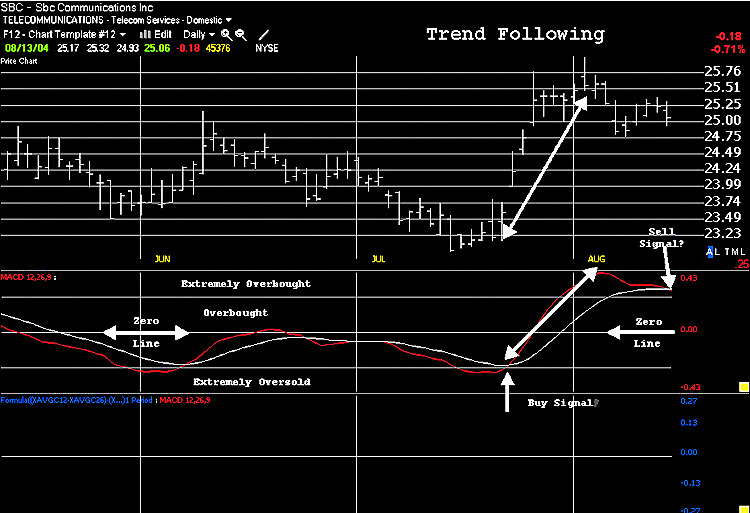
MACD as Trend Following Indicator
* Buy Signal? PCF: ((XAVGC12.1-XAVGC26.1)<(XAVG(XAVGC12.1,9)-XAVG(XAVGC26.1,9)))
AND ((XAVGC12-XAVGC26)>(XAVG(XAVGC12,9)-XAVG(XAVGC26,9))) In English: yesterday’s MACD line was below its Signal line AND today’s MACD line has crossed above its Signal line

* Sell Signal? PCF: ((XAVGC12.1-XAVGC26.1)>(XAVG(XAVGC12.1,9)-XAVG(XAVGC26.1,9)))
AND((XAVGC12-XAVGC26)<(XAVG(XAVGC12,9)-XAVG(XAVGC26,9))) In English: yesterday’s MACD line was above its Signal line AND today’s MACD line has crossed below its Signal line
MACD as an Oscillator Note: The MACD and Signal lines ‘oscillate’ around the zero line.
“ The best buy signals are given when the two lines are below the zero line (oversold) and the best sell signals when the two lines are above the zero line (overbought).
” The Visual Investor by John J Murphy, page 120.
* Buy Signal? PCF: (XAVGC12-XAVGC26)<0 AND(XAVG(XAVGC12,9)-XAVG(XAVGC26,9))<0 AND((XAVGC12.1-XAVGC26.1)<(XAVG(XAVGC12.1,9)-XAVG(XAVGC26.1,9))) AND((XAVGC12-XAVGC26)>(XAVG(XAVGC12,9)-XAVG(XAVGC26,9))) In English: today’s MACD line is oversold (below the zero line) AND today’s Signal line is oversold (below the zero line) AND yesterday’s MACD line was below its Signal line AND today’s MACD line has crossed above its Signal line
* Sell Signal? PCF: (XAVGC12-XAVGC26)>0 AND(XAVG(XAVGC12,9)-XAVG(XAVGC26,9))>0 AND((XAVGC12.1-XAVGC26.1)>(XAVG(XAVGC12.1,9)-XAVG(XAVGC26.1,9))) AND((XAVGC12-XAVGC26)<(XAVG(XAVGC12,9)-XAVG(XAVGC26,9))) In English: today’s MACD line is overbought (above the zero line) AND today’s Signal line is overbought (above the zero line) AND yesterday’s MACD line was above its Signal line AND today’s MACD line has crossed below its Signal line
Suggestion: Adjust the Middle Window . MACD – Short:12 Long:26 Period:9 – Exponential
_ _ _ MACD Color: Red
_ _ _ Avg Color: Grey
_ _ _ Uncheck: Plot MACD as Histogram
_ _ _ Check: Visible . Stochastics – Any settings
_ _ _ SK Draw Color: Black
_ _ _ SD Draw Color: Black
_ _ _ Uncheck: Visible As an approximation, MACD and Signal lines below the Stochastics lower horizontal line are EXTREMELY oversold; MACD and Signal lines above the Stochastics upper horizontal line are EXTREMELY overbought.

MACD Histogram Edit Chart Template: Bottom Window . MACD – Short:12 Long:26 Period:9 – Exponential
_ _ _ MACD Color: Red
_ _ _ Avg Color: Grey
_ _ _ Check: Plot MACD as Histogram
_ _ _ ** Note: In this Histogram, “Period:9” is zero or mid-line
_ _ _ Check: Visible . Custom Indicator Settings
_ _ _ Draw Color: Blue
_ _ _ Draw Style: Normal
_ _ _ Check: Visible
_ _ _ Check: Center Zero Line
_ _ _ Smoothing Average: 1
_ _ _ Select: Exponential Indicator Formula (XAVGC12-XAVGC26)-(XAVG(XAVGC12,9)-XAVG(XAVGC26,9))

** Note: The Custom MACD Indicator line touches the outermost points on the MACD Histogram. **
After you’ve assured yourself that the Custom Indicator is outlining the MACD histogram, either Uncheck: Visible or Delete the Custom Indicator. = = = = = For additional information: From the TeleChart 2000 Help Topics Index, . MACD . Formula codes
. . Math Operators
. . . Average
… AVG(Simple) or XAVG(Exponential) .
TeleChart 2000 User’s Guide

TSV PCF – TC2000 PCF’s – TradeOn.com

TSV:
Time Segmented Volume (TSV) A proprietary technical indicator developed by Worden Brothers Inc.

From the TeleChart 2000 Help Topics, Time Segmented Volume “TSV essentially measures the amount of money flowing in or out of a particular stock.”

“Example Settings:
Short Term Trading: . . . . . . TSV period between 9 and 12

Intermediate Term Trading: TSV period between 18 and 25

Long Term Trading: . . . . . . TSV period between 35 and 45″

For this example, Chart Editing Indicator Tab#

Middle or Bottom

. . .Time Segmented Volume – 18 bars – Simple (solid red)
. . . . .Moving Average – 10 bars – Simple (dotted yellow)

Volume Charting Stock Example
Time Segmented Volume (TSV)

TSV18
(TSV18)
. . Today’s 18-period TSV value

TSV18 > midline
(TSV18>0)
. . .Today’s 18-period
TSV value is above the chart’s TSV midline

TSV18 < midline
(TSV18<0)
. . .Today’s 18-period
TSV value is below the chart’s TSV midline

TSV18 crossing midline UP
(TSV18>0)AND
. . .Today’s 18-period
TSV value is above the chart’s TSV midline
(TSV18.1<0)
. . .Yesterday’s
18-period TSV value was below the chart’s TSV midline

TSV18 crossing midline DOWN
(TSV18.1>0)AND
. . .Yesterday’s
18-period TSV value was above the chart’s TSV midline
(TSV18<0)
. . .Today’s 18-period
TSV value is below the chart’s TSV midline

TSV18 crossing TSV18.1 UP
(TSV18.1<TSV18.2)AND
. . .Yesterday’s
18-period TSV value was below previous day’s (TSV18.2) value
(TSV18>TSV18.1)
. . .Today’s 18-period
TSV value is above yesterday’s TSV18.1 value

TSV18 crossing TSV18.1 DOWN
(TSV18.1>TSV18.2)AND

. . .Yesterday’s 18-period TSV value was above previous day’s (TSV18.2) value
(TSV18<TSV18.1)

. . .Todays 18-period TSV value is below yesterday’s TSV18.1 value

MAX TSV18.5
(MAX(TSV18,5))

. . .18-period TSV maximum value for the last 5 days.

MIN TSV18.5
(MIN(TSV18,5))

. . .18-period TSV minimum value for the last 5 days.

TSV18 AVG
(AVG(TSV18,5))
…5-day average
of 18-period TSV

TSV18 AVG
(AVG(TSV18.1,5))
…5-day average
of 18-period TSV excluding today

TSV18 > its 10-dma
(TSV18>AVG(TSV18,10))
. . .Today’s 18-period
TSV value is above its 10-day average

TSV18 < its 10-dma
(TSV18<AVG(TSV18,10))
. . .Today’s 18-period
TSV value is below its 10-day average

TSV18 crossing 10-day
moving average UP
(TSV18>AVG(TSV18,10))AND
. . .Today’s 18-period
TSV value is above its 10-dma
(TSV18.1<AVG(TSV18.1,10))
. . .Yesterdays’s
18-period TSV value was below its10-day average

TSV18 crossing 10-day
moving average DOWN
(TSV18<AVG(TSV18,10))AND
. . .Today’s 18-period
TSV value is below its 10-day average
(TSV18.1>AVG(TSV18.1,10))
. . .Yesterdays’s
18-period TSV value was above its 10-day average

TSV DIVERGENCE
“A divergence occurs when the trend of a security’s price doesn’t agree with the trend of an indicator.”

For this example:
Chart Editing Indicator Tab# settings Price – Line Chart; Drawing Color BOP
. . . . Linear Regression – 10 bar period
Time Segmented Volume
. . . Linear Regression – 10 bar period
Positive Divergence
. . .18-period TSV Linear Regression Line trending upward from left to right

. . .Price Linear Regression line trending downward from left to right

TSV PCF Code
(TSV18>=(MAX(TSV18,10)))AND(C<=MINC10)


Negative Divergence

. . .18-period TSV Linear Regression Line trending downward from left to right
. . .Price Linear Regression line trending upward from left to right

TSV, Time Segmented Volume
(TSV18<=(MIN(TSV18,10)))AND(C>=MAXC10)


MACD PCF’s – TC2000 PCF’s – TradeOn.com

MACD PCF’s
MACD in EasyScan (cpratsch)
All you have to do is to remember that MACD is the difference between two defined moving averages 12 and 26 overlaid by a moving average of 9 days (the “trigger”).
So, create a difference of the two moving averages:

(avgc12-avgc26)
. Bingo. Yesterday it was
(avgc12.1 – avgc26.1)
Bingo. And if you want all stocks whose MACD went up since yesterday you just write
(avgc12.1 – avgc26.1) < (avgc12-avgc26)
. Bingo .Just place the individual MACD pieces together in brackets. I do not understand why WORDEN does not make a big success story out of the fact that one can use MACD as Easyscan parameter. They by definition do not give advise on Easyscan parameters in their technical HELP organization. Do you know why?  Also, there seems no way to program the 9-day average (the “trigger”) into the formula. If the MACD line goes up for more than 3-4 days its trigger is below the MACD line. So, you don’t need the trigger. Also, if you are one day late because you miss the trigger message, remember the word of one good old investor: “I give you the first 20% and the last 20% of any price run-up if you leave to me the middle 60%.” In other words, MACD screening in Easyscan is better than nothing even if the trigger is missing in the sorting. I have been very successful with MACD, getting help from Metastock 6.5 where I transfer all my questionable stocks (and massage them) before I make any buy or sell decision. This is easy now with the easy-to-handle TC2000/4.1 data transfer capability.
MACD works quite well in TC2000/4.2, so don’t make the horses shy;

a) check the moving averages 12 and 26 and their crossings and turnovers against the MACD line and establish if you get identical signal days

b) absolute numerical MACD data are of no visible practical value

c) check back and see if you would not have been OK in the market just using MACD (12/26/9).

d) Try other differences of moving averages and see if they help you even better than 12/26/9.

e) One is supposed to use exponential moving averages in MACD, so using simple moving averages from the Easyscan formula list may be somewhat wrong. However, I use the formula
(avgc12-avgc26)
to put complex MACD scan formulas together (like up for 3 days), and they work quite well showing in this case all stocks whose MACD is rising for 3 days.
MACD line crossing over the zero line: In the case of a 12-26-9 MACD, it’s:
(AVGC12 – AVGC26) > 0 AND (AVGC12.1 – AVGC26.1) < 0

MACD Trigger (wellmax2)
The first part is just the difference in two moving averages;
AVGC12-AVGC24
( I know you know this, just bear with me ) but the second part is an average of the averages and this is what Worden doesn’t seem to allow in his easycscan language. When I tried to do
AVG(AVGC12-AVGC24)/9
I kept getting “syntax error”. If, however, you take the averages for each of the preceding eight days, add them, and divide by nine you get a nine day average. Here’s the scan:
AVGC12-AVGC24>((AVGC12-AVG24)+(AVGC12.1-AVGC24.1)+(AVGC12.2-AVGC24.2)+(etc3)+(etc4)+..(AVGC12.8-AVGS24.8))/9
will tell you if the current rolling average difference is above the 9 day rolling average of the differences. It computes on the test and I suppose you would want to do a .1 scan for < and this one for > together to pinpoint the crossing.

MACD trigger formula (wellmax2)
AVGC12.1 – AVGC24.1 < ((AVGC12.1 – AVGC24.1) + (AVGC12.2 – AVGC24.2) + (AVGC12.3 – AVGC24.3) + (AVGC12.4 – AVGC24.4) + (AVGC12.5 – AVGC24.5) + (AVGC12.6 – AVGC24.6) + (AVGC12.7 – AVGC24.7) + (AVGC12.8 – AVGC24.8) + (AVGC12.9 – AVGC24.9)) / 9 AND AVGC12 – AVGC24 >
((AVGC12 – AVGC24) + (AVGC12.1 – AVGC24.1) + (AVGC12.2 – AVGC24.2) + (AVGC12.3 – AVGC24.3) +
(AVGC12.4 – AVGC24.4) + (AVGC12.5 – AVGC24.5) + (AVGC12.6 – AVGC24.6) + (AVGC12.7 – AVGC24.7)
+ (AVGC12.8 – AVGC24.8)) / 9

MACD formula (cpratsch)
I use the formula
(AVGC12 – AVGC26) > (AVGC12.1 – AVGC26.1) and (AVGC12.1 – AVGC26.1) > (AVGC12.2 -AVGC26.2)
…… to look for stocks whose MACD ran up for the last 3 days. You can also set one MACD member against the middle line (> 50) or do anything else you want.

MACD breakthrough (BigTedJones)
I had a breakthrough with TC2000 Personal Criteria and I think it’s valuable enough to share. When you write a Criterion for MACD increasing (like you did in your post CP) you don’t automatically have to make it a YES/NO result. Instead of using >, just subtract the two MACDs and TC2000 will create one of those range selectors that you can adjust in easyscan. Now you can find MACD up, MACD down, top 5% of MACD gainers… whatever.
Example Formula using your previous:
(avgc12-avgc26)-(avgc12.1-avgc26.1) Mike, the same goes for stochastics. A Worden guy showed me this at the Money Show at Disney last week, and I about fell off my chair.
Buy/Sell 5-35 MACD x
((AVGC5.1<AVGC35.1ANDAVGC5>AVGC35)OR(AVGC5.1>AVGC35.1ANDAVGC5<AVGC35)
Buy/Sell 13-34 MACD x
(AVGC13.1<AVGC34.1ANDAVGC13>AVGC34)OR(AVGC13.1>AVGC34.1ANDAVGC13<AVGC34)
Buy/Sell 9-21 MACD x
(AVGC9.1<AVGC21.1ANDAVGC9>AVGC21)OR(AVGC9.1>AVGC21.1ANDAVGC9<AVGC21)

MACD Trigger (zbossmann)
Here it is. Basically I was trying to test for the MACD trigger, a 9-day MA of MACD, below MACD yesterday and above today. Never got to test the formula to see if I have the algorithm right because of errors while updating personal criteria. I thought I might expand this to spread the testing range out over two to four days after I saw what this gives. Also thought I might do something similar for stoc. and/or tsv, and possibly meld them together in some way. The end objective I have in mind is to scan for stocks where tsv, macd, and sto are nearly in phase and coming off bottoms.
(((AVGC12.9 – AVGC26.9+AVGC12.8 – AVGC26.8+AVGC12.7 – AVGC26.7+AVGC12.6 -AVGC26.6+AVGC12.5 – AVGC26.5+AVGC12.4 – AVGC26.4+AVGC12.3 – AVGC26.3+AVGC12.2 -AVGC26.2+AVGC12.1 – AVGC26.1) / 9)<(AVGC12.1 – AVGC26.1))AND(((AVGC12.8 – AVGC26.8+AVGC12.7 – AVGC26.7+AVGC12.6 – AVGC26.6+AVGC12.5 -AVGC26.5+AVGC12.4 – AVGC26.4+AVGC12.3 – AVGC26.3+AVGC12.2 – AVGC26.2+AVGC12.1 -AVGC26.1+AVGC12-AVGC26) / 9)>(AVGC12-AVGC26))

MACD again (cpratsch)
Some look for stocks with a “classical” MACD 12-26-9 where the trigger MA 9 just cuts up through the bottoming MACD curve, that is when the histogram is 0. Others insist buying should wait until the 12 MA cuts upward through the 26 MA, that is when the MACD curve cuts upwards through the center line. I claim it depends on the particular stock which way one takes. Risk dependent. However the second step is safer, because all MAs to at least the 12 day MA are already turning up.
A good scanning formula for this case is:

(AVGC12.2 < AVGC26.2) AND (AVGC12.1 > AVGC26.1) AND (AVGC12 > AVGC26)
If one mixes this with a healthy volume scan and the RSI3.3 set for less than about 65 or not more than one day after the turn-around of RSI3.3, one may have something. Look at LTUS. I do not want to buy it but it shows things that turn up.

Further MACD explanation (jnorfy)
The MACD has two crossovers which one can scan for. One is crossing the zero line (like TSV would) but this doesn’t necessarily translate to the Histogram. The other crossover is when the two MA’s cross and the histogram crosses the zero line. An strong up-trending stock (like AOL) is way above the MACD zero line, but the histogram sometimes crosses back and forth.
The formula for a 12-24-9 histogram crossover is <<histogram today>>
.2 * (((2 / 13) * C1 + (1 – ( 2 / 13)) * (AVGC12.2)) – ((2 / 25) * C1 + (1 – 2 / 25) * (AVGC24.2))) + .8 * (((2 / 13) * C2 + (1 – ( 2 / 13)) * (AVGC12.3)) – ((2 / 25) * C2 + (1 – 2 / 25) * (AVGC24.3))) – (((2 / 13) * C1 + (1 – ( 2 / 13)) * (AVGC12.2)) – ((2 / 25) * C1 + (1 – 2 / 25) * (AVGC24.2)))>0
and<<histogram yesterday>>
.2 * (((2 / 13) * C1 + (1 – ( 2 / 13)) * (AVGC12.2)) – ((2 / 25) * C1 + (1 – 2 / 25) * (AVGC24.2))) + .8 * (((2 / 13) * C2 + (1 – ( 2 / 13)) * (AVGC12.3)) – ((2 / 25) * C2 + (1 – 2 / 25) * (AVGC24.3))) – (((2 / 13) * C1 + (1 – ( 2 / 13)) * (AVGC12.2)) – ((2 / 25) * C1 + (1 – 2 / 25) * (AVGC24.2)))<0
or you could make to separate PCF’s without the </> signs and pick the values on the slider.  Without Wordens exact formula, it is hard to do accurately.  I made some simplifications on the expo MA’s because the calculations got too long and there is not easy way to programs an Expo MA for a PCF. I tested the formula, but the validity of the hits isn’t all that great. Your best bet may be to have Worden incorporate a MACD/Histogram function in a follow on version.

Exponential MACD 12.24 fast line
(Paid my dues)
PCF for exp. MACD12.24 today:
((C * 2 / 13 + C1 * 2 / 13 * (1 – 2 / 13) + C2 * 2 / 13 * (1 – 2 / 13)^2 + C3 * 2 / 13 * (1 – 2 / 13)^3 + C4 * 2 / 13 *
(1 – 2 / 13)^4 + C5 * 2 / 13 * (1 – 2 / 13)^5 + C6 * 2 / 13 * (1 – 2 / 13)^6 + C7 * 2 / 13 * (1 – 2 / 13)^7 + C8 * 2 /
13 * (1 – 2 / 13)^8 + C9 * 2 / 13 * (1 – 2 / 13)^9 + C10 * 2 / 13 * (1 – 2 / 13)^10 + C11 * 2 / 13 * (1 – 2 / 13)^11 + AVGC12.12 * (1 – 2 / 13)^12) – (C * 2 / 25 + C1 * 2 / 25 * (1 – 2 / 25) + C2 * 2 / 25 * (1 – 2 / 25)^2 + C3 * 2 / 25 * (1 – 2 / 25)^3 + C4 * 2 / 25 * (1 – 2 / 25)^4 + C5 * 2 / 25 * (1 – 2 / 25)^5 + C6 * 2 / 25 * (1 – 2 / 25)^6 + C7 * 2 / 25 * (1 – 2 / 25)^7 + C8 * 2 / 25 * (1 – 2 / 25)^8 + C9 * 2 / 25 * (1 – 2 / 25)^9 + C10 * 2 / 25 * (1 – 2 / 25)^10 + C11 * 2 / 25 * (1 – 2 / 25) ^11 + C12 * 2 / 25 * (1 – 2 / 25)^12 + C13 * 2 / 25 * (1 – 2 / 25)^13 + C14 * 2 / 25 * (1 – 2 / 25) ^14 + C15 * 2 / 25 * (1 – 2 / 25)^15 + C16 * 2 / 25 * (1 – 2 / 25)^16 + C17 * 2 / 25 * (1 – 2 / 25)^17 + C18 * 2 / 25 * (1 – 2 / 25)^18 + C19 * 2 / 25 * (1 – 2 / 25)^19 + C20 * 2 / 25 * (1 – 2 / 25)^20 + C21 * 2 / 25 * (1 – 2 / 25)^21 + C22 * 2 / 25 * (1 – 2 / 25)^22 + C23 * 2 / 25 * (1 – 2 / 25)^23 + AVGC24.24 * (1 – 2 / 25)^24))

Exp MACD (jnorfy)
The formula I came up with is
Signal Line :
.2 * (((2 / 13) * C + ((1 – 2 / 13) * (AVGC12.1))) – (((2 / 25) * C) + ((1 – 2 / 25) * (AVGC24.1)))) + .8 * (((2 / 13) * C1 + (1 – ( 2 / 13)) * (AVGC12.2)) – ((2 / 25) * C1 + (1 – 2 / 25) * (AVGC24.2)))
Diff Line:
(((2 / 13) * C + ((1 – 2 / 13) * (AVGC12.1))) – (((2 / 25) * C) + ((1 – 2 / 25) * (AVGC24.1))))
Histogram:
.2 * (((2 / 13) * C + ((1 – 2 / 13) * (AVGC12.1))) – (((2 / 25) * C) + ((1 – 2 / 25) * (AVGC24.1)))) + .8 * (((2 / 13) * C1 + (1 – ( 2 / 13)) * (AVGC12.2)) – ((2 / 25) * C1 + (1 – 2 / 25) * (AVGC24.2))) – (((2 / 13) * C + ((1 – 2 / 13) * (AVGC12.1))) – (((2 / 25) * C) + ((1 – 2 / 25) * (AVGC24.1))))
for today. I too get random hits and erroneous values.  I would need to see the formula that Worden uses to actually be 100% accurate.

MACD histogram Calculation (Carpe9Diem)
SUBRACT THE SIGNAL LINE FROM THE FAST LINE TO OBTAIN NUMBER AND PLOT ON GRAPH.
MACD CALCULATION: 12 EMA – 26EMA = FAST LINE CALCULATE 9 DAY EMA OF FAST LINE = SIGNAL LINE

MACD scan (jnorfy)
((avgc12-avgv26)-(avg(avgc12,9)-avg(avgc26,9)))>0 and ((avgc12.1-avgv26.1)-(avg(avgc12.1,9)-avg(avgc26.1,9)))<=0

MACD Zero-Line Crossover (mark ag)
Here’s a MACD Formula for detecting crossovers above the zero line (26-12-9).
((( AVGC12 – AVGC26) + ( AVGC12.1 – AVGC26.1) + ( AVGC12.2 – AVGC26.2) + ( AVGC12.3 – AVGC26.3)
+ ( AVGC12.4 – AVGC26.4) + ( AVGC12.5 – AVGC26.5) + ( AVGC12.6 – AVGC26.6) + ( AVGC12.7 – AVGC26.7) + ( AVGC12.8 – AVGC26.8)) / 9)<  ( AVGC12 – AVGC26) AND ((( AVGC12.1 – AVGC26.1) + ( AVGC12.2 – AVGC26.2) + ( AVGC12.3 – AVGC26.3) + ( AVGC12.4 – AVGC26.4) + ( AVGC12.5 – AVGC26.5) + ( AVGC12.6 – AVGC26.6) + ( AVGC12.7 – AVGC26.7) + ( AVGC12.8 – AVGC26.8) + (AVGC12.9 – AVGC26.9)) / 9) > ( AVGC12.1 – AVGC26.1) AND  (AVGC12 – AVGC26) > 0

If you remove the “AND” Clause, it will detect all crossovers above and below. I use this to give me a heads-up on stocks whose trend is changing to bullish.