Rolling Stock Strategy – TC2000 PCF’s – TradeOn.com

Rolling Stock

Rolling Stock:(ejr39)

The stocks mentioned in the Rolling Stock Strategy using an RSI Channel are examples only. The RSI Channel as an internal strength index has the advantage of predicting a stock’s future movement. This strategy may appear long and complicated but I assure you that once you get the hang of it, you’ll spend a couple of hours a week tending the WatchList and drawing Trendlines. ? Exploiting Wilder’s RSI as an “Internal Strength Index.”

#01 Wilder’s RSI Channel PCF:( 2- month channel)

((MAX(RSI14.3,42))<70)AND((MIN(RSI14.3,42))>30)

OR (not both)

#01 Wilder’s RSI Channel PCF: (1- month channel)

((MAX(RSI14.3,21))<70)AND((MIN(RSI14.3,21))>30)

Test. Save. Update All Criteria.

Suggested EasyScan:

Rolling Stock / RSI Channel

. . . Optionable (True)

. . . Capitalization
. . . (Value) 150 to Max

. . . #01 Wilder’s
RSI Channel (True)

. . . Price Per Share
H . . . (Value)

. . . Volume 5-Day-
H . . . (Value) 500 to Max

. . . Volume 90-Day
. . . (Rank) 53 to 99 – about 2% higher than Volume 5-Day-H Rank

WatchList to Scan: All stocks

Save. Name. Scan

Each day, save this EasyScan WatchList to a bulleted WatchList. Sort the bulleted WatchList against the #01 Wilder’s RSI Channel PCF; (F)lag, erase trendlines, and remove any stocks from the bulleted WatchList which are no longer within the RSI channel.

Suggested Indicator Tab#:

Top

. . . Prices Open
Bar Chart ? Daily

. . . . (Optional)
Envelope Channel ? Period:21 Width: 10 ? Exponential

. . . . Draw a horizontal
trendline connecting entry points (support).*

. . . . Draw a horizontal
trendline connecting exit points (resistance).*

Middle

. . . Stochastics ?
Period:5 SK:1 SD:3 ? Exponential ? check visible

. . . . . .SK Drawing
Color: Black; SD Drawing Color: Red

. . . Wilder?s RSI:
Period:14, Average: 3 ? Exponential ? Drawing Color: Cyan

. . . . . . Linear
Regression ? 21 bar period ? Drawing Color: Cyan

Bottom

. . .Balance of Power

. . .CMS OR OBV

Analyzing the daily charts:

1) Price Graph: price is within a trading range.

2) Wilder’s RSI: fluctuates BETWEEN the 30%- and 70%-reference lines.

3) RSI’s Linear Regression Line: flat at or near the center of the window.

4) Stochastic SD line: exhibits a ?wave? pattern from below the 20%-reference line to above the 80%-reference line and back below the 20%-reference line.

* See Notes for drawing and interpreting Trendlines.

Give preference to stocks with the following attributes:

1) Balance of Power: accumulation starting

2) CMS (or OBV): turning up

Notes:

The Stochastic SD line reduces ?noise? including whipsaws. Visually find the most recent point at which the RSI crossed into and remained between the 30%- and 70%-reference lines assume this cross as the beginning of the ?rolling cycle?.

Flat channel:

When drawing the horizontal trendlines for support or the entry point, use the highest (price) low since the ?rolling cycle? began; conversely resistance or the exit point is the lowest (price) high since the ?rolling cycle? began. The two trendlines MUST be parallel. Adjust the horizontal trendlines if the most recent (price) low is higher than the support trend-line or the most recent (price) high is lower than the resistance trendline.

Example: ENMD

(Rolling since June; note that Wilders RSI has remained between 30%-
and 70%-reference lines.)

DOWN Trending channel:

Draw the support trendline by connecting those price lows matching the Stochastic SD lows (below
the 30%-reference line). The trendline should touch as many lows as possible.

Draw the resistance trendline by connecting the highest (price) highs matching the Stochastic SD highs (above the 70%-reference line). The trendline should touch as many highs as possible.

The channel: The two trendlines MUST be parallel.

Extreme spikes (breakouts or breakdowns) may signal the end of the strategy; if the stock continues
to ?roll?, ignore the spike when extending the trendlines.

Example: ENE

Support:

09/02/99 Price Swing Low and Stochasic SD low

09/23/99 Price low and Stochasic SD low

10/07/99 Price Swing Low and Stochasic SD low

11/23/99 Price Swing Low and Stochasic SD low

Draw the support trendline from the low of 09/02/99 to 11/23/99; the extended trendline touches most
of the lowest lows during this ?rolling cycle?.

Each ?roll? begins from the lowest (price) low ? one day reversal patterns are an indication that a new ?roll? is beginning.

Resistance:

08/24/99 One of the highest (price) highs at the beginning of the downtrend

09/10/99 Price high and Stochasic SD high

10/01/99 Price high and Stochasic SD high

10/29/99 Price high and Stochasic SD high

Draw the resistance trendline from the high of 08/24/99 to 10/29/99; the extended trendline touches most of the highest highs during this ?rolling cycle?.

Once the trendlines have established the channel, the next entry point is the support trendline.

. . . After entry, place a GTC order to sell at the predetermined exit point.

The predetermined exit point is the price high crossing above the extended resistance trendline.

UP Trending channel:

Draw the support trendline by connecting the lowest (price) lows matching the Stochastic SD lows
(below the 30%-reference line). The trendline should touch as many lows as possible.

Draw the resistance trendline by connecting those price highs matching the Stochastic SD highs
(above the 70%-reference line). The trendline should touch as many highs as possible.

The channel: The two trendlines MUST be parallel.

Extreme spikes (breakouts or breakdowns) may signal the end of the strategy; if the stock continues
to ?roll?, ignore the spikes when extending the trendlines.

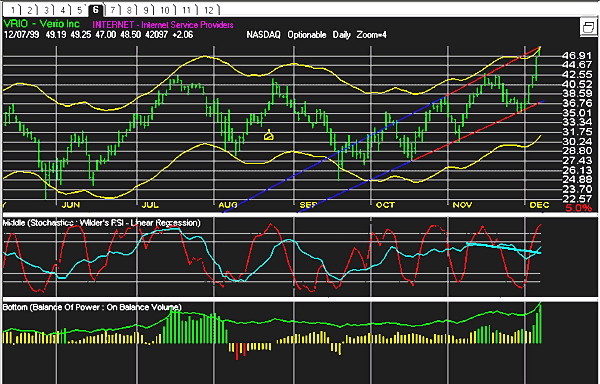
Example: VRIO

Support:

09/20/99 Price Swing Low and Stochasic SD low

10/18/99 Price Swing Low and Stochasic SD low

11/04/99 Price Swing Low and Stochasic SD low

11/29/99 Price Low and Stochasic SD low

Draw the support trendline from the low of 10/18/99 to 11/29/99; the extended trendline touches most
of the lowest lows during this ?rolling cycle?. Each ?roll? begins with the lowest low ? one day reversal patterns are an indication that a new roll? is beginning.

Resistance:

11/15/99 Price high and Stochasic SD high

10/29/99 Price high and Stochasic SD high

10/07/99 Price high and Stochasic SD high

Draw the resistance trendline from the highs of 10/29/99 to 11/15/99; the extended trendline includes most of the highest highs during this ?rolling cycle?. Once the trendlines have established the channel, the next entry point is the support trendline. After entry, place a GTC order to sell at the predetermined exit point. The predetermined exit point is the price high crossing above the extended resistance trendline.

Paper trade, Paper trade, Paper trade until you achieve a 70% success rate.

To reduce the tedium of looking at each chart every day, add the following
PCFs:

#02 Rolling Stock Alert PCF:

(L< ((MAXH21-MINL21)/4)+MINL21))

Today?s Low in Lower Quadrant of 21-day Envelope Channel. From the main chart screen, SORT the bulleted WatchList using the #02 Rolling Stock Alert PCF – stocks which are near the lower Envelope Channel line (support), i.e. a possible early entry point if #03 SD Turning Up PCF becomes True.

#03 SD Turning Up PCF:

(AVG(STOC5.1.1,3)<20)AND(AVG(STOC5.1.1,3))<(AVG(STOC5.1,3))

Stochastics SD line turning up below 20%-reference line. From the main chart screen, SORT the bulleted WatchList using the bulleted WatchList using #03 SD Turning Up PCF. Stochastic SD signaling that uptrend is beginning.

Additional Notes: Wilder?s RSI is associated with the internal strength of a single security. A more appropriate name is “Internal Strength Index.” from Educational Sources:

Wilders RSI

Stochastic RSI

Technical Trading Reading Material

GBS Trading System – TC2000 PCF’s – TradeOn.com

GBS Trading System:
Gary Blake Smith from TheStreet  (for more, see archives for Technician’s
Take. Essential GBS articles are outlined in his 5/3/99 GBS Primer:
Rules:
1. Buy on breakouts from 20 (preferrably 25+) days of congestion, where
the breakout day has a price increase of at least $1 and the volume
surges +50% above the 50-day moving average.

2. Gary prefers the average volume to be at least 50K; he also likes it to be fairly
consistent. He also looks at liquidity, by scanning the prior day’s
transaction log and noting the size of the blocks and size of the
spreads. If he sees large spreads and predominately small lots,
he passes. If you’re trading less than a 1000 shares, you can pick
stocks with a smaller average volume, but avoid stocks that have
days of less than 30K.

3. The minimum price stock Gary looks at used to be $20, but because his equity
and lot size have grown he changed it to $25.

4. Stocks don’t have to be breaking out to new 52 week high.

5. EPS/RS don’t have to be > 80. In fact, he doesn’t use Investor’s Business
Daily anymore.

6. Beware of stocks that break out more than 6% above prior resistance.

7. Put in market order to buy stock before market opens.

8. As soon as you get your fill, put in a sell limit order for a 5% profit. If
the stock starts having problems, change the order to a stop loss
of 6% below the fill price.

9. Generally, the tighter the base the better. Avoid the big V formations. Or,
if you want to take a positive approach, look for the resistance
line to have at least a few tests before the breakout. Watch what
happened in the days right before the trade.

10. To measure how far a breakout can go, look at the number of points within the
current congestion. A good rule of thumb says if resistance is taken
out, then the succeeding rise should move by the same amount of
points.

11. If an acquiring company breaks out it’s OK. The reverse is not OK. Also, Gary tends
to shy away from companies that fall or rise in sympathy with another
company in the news. If it’s just one specific sympathy stock, don’t
trade it. If it’s a whole industry, something is endemically wrong,
and it is OK to trade those.

12. Average hold time is 12 days for longs and 3 days for shorts. Closes the
trade if still open after 20 days.

13. The maximum number of open positions he favors is about 20. He averages 15-20.
His formula for determining lot size =(2*cash)/1000 where cash equals
your net equity in your account.

14. Look for short candidates as well. When shorting, there must be a major downside
break of at least 1 point. This break can be either from an uptrend
of at least a 20 days or a break through clearly defined support
level. The stock does not have to fall below it’s 50 day moving
average. Volume should be +100% or more. Don’t short stocks that
are already in a down trend for the few days or weeks, unless the
break takes out a clearly defined support level. Otherwise, a big
down day after a downtrend might just be a blow-off and a bottom.
The size of the drop isn’t important as long as the stock looks
broken. The same 5% profit, 6% loss applies.

15. If your stock has gone up, but then starts to decline slowly on decreasing
volume, that’s OK, as long as it doesn’t violate its previous support
level. Dipping on heavy volume is bad.

16. When he
buys and holds stocks, for an exit, he’d probably start out using
the 50-day moving average as a stop loss, but then use a 20-day
moving average as the trailing stop.

17. With regard to expected returns, Gary shoots for 100% return, compounded, per
year. In 1996 he got 77%. In 1997 it was 46%. In 1998 86%.

Long:
(C > 20) and (AVGV50 > 500) and (C > MAXC5.1) and (C > C1 + 1) and (V > 1.5 * AVGV50)

Example:(Long)


Shorts:
(C > 20) and (AVGV50 > 500) and (C < MINC5.1) and (C < C1 – 1)
and (V > 1.5 * AVGV50)

Example:(Short)

Message 12829
(Gary B. Smith) scan for longs is:
(C>20)and(AVGV50>500)and(C>MAXC5.1)and(C>C1+1)and(V>1.58*AVGV50)

Rules:

>> 1. Buy on breakouts from 20 (preferrably 25+) days of
congestion,

Resistance: MAXH25.1
Support: MINL25.1
Congestion (20%): (MAXH25.1<(MINL25.1*1.2))

Suggestion:
Other Support and Resistance methods: simple moving averages Fib Retracement

. message 11304

>>
where the breakout day (today)
(C>MAXH25.1)

>>
has a price increase of at least $1
(C>(O+1))

Note:
(C>C1+1) doesn’t account for
a gap with an open to close reversal (O>C)

>>
the volume surges +50% above the 50-day moving average
(V>(AVGV50.1*1.5))

2. Gary prefers the average volume to be at least 50K

“Raise Volume from 50K to 500K”

message 12825 by Goober4_4
“raise the vol to 500K”

>>>
He also looks at liquidity, by scanning the prior day’s transaction
log and noting the size of the blocks and size of the spreads.

** If he sees large spreads and predominately small lots, he passes.
**

3. The minimum price stock Gary looks at used to be $20, but because
his equity and lot size have grown he changed it to $25.

Suggestion: Focus on the stocks that you’ll actually buy, i.e.
(C>20ANDC<40). Each price range is a micro universe with unique movement and rules; most individuals spend too much time analyzing and agonizing over equities that are
outside their price range.

6.
Beware of stocks that break out more than 6% above prior
resistance.

See Rule 1 assuming resistance is MAXH25.1
(C>MAXH25.1)AND(C<(MAXH25.1*1.06))

Suggested
PCFs for GBS Long strategy:

#1 GBS Congestion
(MAXH25.1<(MINL25.1*1.2))

#2 GBS BreakOut
((C>MAXH25.1)AND(C>(O+1)))

#3 GBS Volume
((V>(AVGV50.1*1.5))AND(AVGV50>5000))

= = = = = = = =

Suggestioned
EasyScan for Longs:

[Add condition]s

. Price Per Share – H . . . Value . .
20 to 40 (see suggestion, Rule 3)

. Price vs. 200 Day Moving Average . . . Value
. . 100 to Max

. Price vs. 40 Day Moving Average . . . Value
. . 100 to Max

. #1 GBS Congestion

. #2 GBS BreakOut

. #3 GBS Volume

[Save] Name if new EasyScan [Scan Charts]

Indicator
Tab#

Top

. Price – xxx chart

. . Moving Average – 40 bars – Simple

. . Moving Average – 200 bars – Simple

Middle
or Bottom

. Volume

. . Moving Average – 50 bars – Simple

= =
= = =

Message
12845 – More on GBS Strategy Notes

As
message 12825 points out, “(Gary B Smith) just “knows”
its the right one based on past experience”.

For
more “experience”, review the strategy at
Gary B Smith

Experiential
notes:

4. Stocks don’t have to be breaking out to a new 52 week high.

9. Generally, THE TIGHTER THE BASE THE BETTER. Avoid the big V formations.
Or, if you want to take a positive approach, look for the resistance
line to have at least a few tests before the breakout. Watch what
happened in the days right before the trade.

11. If an acquiring company breaks out it’s OK. The reverse is not OK.
Also, Gary tends to shy away from companies that fall or rise in
sympathy with another company in the news. If it’s just one specific
sympathy stock, don’t trade it. If it’s a whole industry, something
is endemically wrong, and it is OK to trade those.

15. If your stock has gone up, but then starts to decline slowly on
decreasing volume, that’s OK, as long as it doesn’t violate its
previous support level. Dipping on heavy volume is bad.

Entry
Strategy:

7. Put in market order to buy stock before market opens.

Suggestion:

The adage is – Volume precedes Price. What is the stock’s average
hourly volume?

The market is open 6.5 hours per trading day, so divide the stock’s
average 50-day volume by 6.5 or as a PCF: (AVGV50/6.5)

During the first hour after the open, wait until the stock’s
volume is over the average hourly volume, then determine the direction
of the price rather than get caught an ‘amateur hour’
whipsaw. See Rule 15 (above) if the volume appears to be decreasing
or the price is dipping on increased volume.

Stops:

8. As soon as you get your fill, put in a sell limit order for a
5% profit. If the stock starts having problems, change the order
to a stop loss at 6% below the fill price.

16.
When he buys and holds stocks, for an exit he’d probably start out
using the 50-day moving average as a stop loss, but then use a 20-day
moving average as the trailing stop.

Risk / Reward:

10. To measure how far a breakout can go, look at the number of
points within the current congestion. A good rule of thumb says
if resistance is taken out, then the succeeding rise should move
by the same amount of points.

(Gary B Smith’s) formula for determining lot size = (2*cash) / 1000
where cash equals your net equity in your account.

12. Average hold time is 12 days for longs. Close the trade if still
open after 20 days.

Words of Wisdom – TC2000 PCF’s – TradeOn.com

 Words of Wisdom
Dave Evans

For anyone out there who has EVER picked a stock that has gone UP,,,, Guess what?? You have PROVED that YOU CAN DO IT!!!! ALWAYS remember that if you can do it once, YOU CAN DO IT AGAIN! Do not let ANYONE tell you that you can’t!!!

I know for a fact that there are people on these Boards who were in the same position as you AND THEY NOW BELIEVE!! They believe because they are DOING IT NOW!!! It only takes ONE successful trade to show that you CAN do it…

With that said please do not think that Mr. Market is THAT EASY because he is not….What I’m trying to tell you is IT CAN BE DONE!!! Most people who tell you you’re crazy either do not know what they are talking about, have been brought up as failures or are jealous of your Dream…. As you get deeper into TA you will realize that it is not voodoo or magic, just logic, common sense and “PERSONALITY CONTROL”. The system you build is probably the LEAST IMPORTANT piece of your arsenal… The most important piece is YOU!!! That’s why it is so important to BELIEVE YOU CAN DO IT Once you believe you can do it YOU WILL DO IT!

You must learn to live on the BLT of TA… It is your nourishment and fuel to greater profits…. It is your TA LAW… Build your systems, Learn TA, Trust your Indicators… Once you do these three simple steps you are on your way to greater profits.

IS it easy???? Yes and no. It depends on YOU and the type of old baggage you are bringing into the game.. Can it be done??? YES! Yes is the ONLY answer to the question..

Let’s look at the BLT of TA one step at a time and see how easy or hard it really is.

BUILD your system. Well, that can’t be too hard with all the systems floating around on these Boards.. A system can be as simple as a 5-13-40 crossover and as complex as some of the things Richard, Andy, Chan, Jerry, Bill and many of the TA Veterans throw your way. A system can be ONE indicator or a HUNDRED Indicators, it doesn’t matter.

It is what YOU DO EVERY TIME YOU TRADE. This is what we call CONSISTENCY. Once you feel comfortable with it you CAN START MAKING MONEY WITH IT.

LEARN TA.. Yes, the learning is NEVER over.. As you learn more about TA your systems start to evolve. You start adding and subtracting indicators and tools until finally you have it. The perfect system for the perfect trader. Of course this only last for a few weeks because you will ALWAYS find something to change. But, that’s the beauty of TA. It is never stagnant. Each day brings a new story and YOU are the translator. It can be a good story or a bad story and it all depends on YOU! After time you will find yourself going back to many of the things that you started with.. Yes, the things that you discarded in favor of new more exciting things. That to is the nature of TA..

TRUST your Indicators..
This is the MOST IMPORTANT step you will ever take in TA!!!!! You must LEARN to trust your indicators or you will NEVER make CONSISTENT money in the Markets!!! As they say in Bowling, “TRUST IS A MUST!!” This is where the EMOTIONAL BATTLE is fought and it’s fought EVERYDAY YOU TRADE. Yes, you will eventually get to a point where your Intuition will help you BUT that will be well down the road and AFTER you have successfully completed this step!!!.. This is where you SELL when you have lost the 10% you set as your limit BEFORE you bought the stock… This is where you SELL even though the stock looks like it may continue up because YOUR SYSTEM told you to sell.. This is where you sell because YOU KNOW IT IS NOT PERSONAL, IT IS BUSINESS!!! This is where you BECOME A TRADER!!!! When you get to the point where you can look at a trade as nothing more then a business transaction AND NOT some sort of measure of your manhood, you will know that you have made it… Until then, stay with your SYSTEM WITHOUT THINKING.

I always say that it’s not the system that makes money in the Markets, IT’S THE TRADER! Most systems will make money in the Market when they are used right. It is the TRADER that proves to be the difference…

Stochastic PCF’s – TC2000 PCF’s – TradeOn.com

Stochastic PCF’s
Scan for stochastics crossing up through 80
STOC14.7<80 AND STOC14.7.1>= 80
Stochastic indicator: I’ve come up with what I consider fairly reliable indicators using stochastics applied to 4-day and 9-day bars.
Buy indicator: 200.40<30 on the 4-day and 450.90<20 on the 9-day.
Sell indicator: 200.40<65 on the 4-day and 450.90>80 on the 9-day.

Stochastic Crossover Point (babynuke)
Wrote this the other night and although it tested true it wouldn’t show up true even on the stock it tested true. Thought I had done something wrong, but tonight it worked like a champ giving 253 out of 8947 stocks. I call this PCF the “Namvet Buy Point” since it pinpoints the crossover point on your middle window of stochastics 26-9-12. Credit must be given to wellmax2 and his post #1462 for the initial idea behind this approach. Thanks wellmax2!
(STOC26.9.1 < ((STOC26.9.1 + STOC26.9.2 + STOC26.9.3 + STOC26.9.4 + STOC26.9.5 + STOC26.9.6 + STOC26.9.7 + STOC26.9.8 + STOC26.9.9 + STOC26.9.10 + STOC26.9.11 + STOC26.9.12) / 12)) AND (STOC26.9 > ((STOC26.9 + STOC26.9.1 + STOC26.9.2 + STOC26.9.3 + STOC26.9.4 + STOC26.9.5 + STOC26.9.6 + STOC26.9.7 + STOC26.9.8 + STOC26.9.9 + STOC26.9.10 + STOC26.9.11) / 12))

STOC8.3 Scan (DanielExtreme)
Here is a scan that pulled up some nice breakouts. STOC8.3.3<80 AND STOC8.3.2<80 AND STOC8.3.1<80 AND STOC8.3>80 AND V>1000. From these hits I scrolled through and looked for good BOP, TSV and Moneystream.

Weekly Stochastics (babynuke)
Try this: (((STOC45.25 > STOC45.25.1) AND (STOC45.25.1 > STOC45.25.2) AND (STOC45.25.2 > STOC45.25.3)AND (STOC45.25.3 > STOC45.25.4)) AND (((STOC45.25.1) < 30) AND ((STOC45.25) >= 30))) It produces a few aberrations, but overall seems to work pretty good if I understand what you are looking for correctly. Credit to stock_chartist for “calibrating indicators” to fit different time frames.

I m playing with your charts (cpratsch) Two PCFs for EASYSCAN:
1) (STOC 26.9 – STOC26.9.3); this gives stocks whose stochastic curve 26.9 has moved over 3 days. One has to set the amount of change by the sorting process (blue gismo, like 0-maximum) to have them move up.
2) (STOC 8.4 – STOC 8.4.2). The same as above. One can play with the number of days involved. Now one gets some ?1200 stocks and probably likes to reduce their number. One can add some volume formula, or the “Price Growth Rate x years” to get continuously rising stocks, or one can add another scan:
3) (STOC26.4) and sort for stocks whose stochastic curve is not yet too high (?20-55 or so)…I got me watch lists with some 50 stocks that way and will paper trade for a while. These curves all look darned good, surprising at this market lull. All turn up. The question is to guess which ones are the healthiest and will run farthest; not much help to expected here except from volume-including indicators like volume itself, BOP, TSV, Money Stream. These two stochastic curves of you also are great for sell signals, I add BOP and a short RSI like RSI3.3 on one tab to help out for this purpose, plus volume in reverse. I was using stochastics 14 and 4; your 26 and 8, however, are more apart, they much better show the effects of a long time and a short time trend. This is the key here.

Weekly Stochastic (Carpe9Diem)
Here is the PCF for weekly stochastic 26.9: (AVGC.5 – MINL130.5) / (MAXH130.5 – MINL130.5) * 100 I have checked it against other programs and seems to be accurate to +/- 1

Stochastic 8-4-6 SK crossing SD (babynuke)
Here’s the formula: (STOC8.4.1 < ((STOC8.4.1 + STOC8.4.2 + STOC8.4.3 + STOC8.4.4 + STOC8.4.5 + STOC8.4.6) / 6)) AND
(STOC8.4 > ((STOC8.4 + STOC8.4.1 + STOC8.4.2 + STOC8.4.3 + STOC8.4.4 + STOC8.4.5) / 6)) Please note that this is using SIMPLE moving averages while Namvet’s settings use EXPONENTIAL moving averages for the bottom window. If someone knows how to program the formula to use Exponential please let me know! I get zero hits today, will wait to see how it works after Monday’s download.

Fast Stochastics (% D) (ejr39)
Charting Stochatics, both %K and %D, using Tab# Indicator settings is straight forward. For example: the canned Technical Stochastic Short-term-H
. In a Tab# Indicator Editing window
. . .<Add Indicator > <Stochastic>
In the Stochastic window,
. .Period 12
. .SK Period 5
. .SD Period 1, 2, 3 (for this exercise, the number isn’t important)
. .SK Drawing Color Red
. .SD Drawing Color Black
Or, > bigcharts.com defaults for fast stochs (5,5) <
. In a Tab# Indicator Editing window
. . .<Add Indicator > <Stochastic>
In the Stochastic window,
. .Period 5
. .SK Period 5
. .SD Period 1,2,3 (for this exercise, the number isn’t important)
. .SK Drawing Color Red
. .SD Drawing Color Black
Writing a fast Stochastic 5.5 PCF is simple: (Stoc5.5.1 < 20) Stochastic 5.5 yesterday is less than 20% AND (Stoc5.5 > 20) Stochastic 5.5 today is greater than 20% Or Using the Formula Window’s Function List
Stochastics Window
Period 5
SK Period 5
As of yesterday
LOGIC OPERATOR: Less than
Type: 20
LOGIC OPERATOR: AND
Stochastics Window
Period 5
SK Period 5
As of today
LOGIC OPERATORS: Greater than
Type: 20
** The Stochastic PCF’s third number refers to the number of days ago included in the calculation – NOT % D **

Slow Stochastics(% D)(ejr39)
Formulas for Fast Stochastic crossing a % point (Stoc5.5.1 < 20) AND (Stoc5.5 > 20) or a Fast Stochastic turning (Stoc5.5.1 < Stoc5.5.2) AND (Stoc5.5 > Stoc5.5.1) are simple and straight forward.
** Again, the Stochastic PCF’s third number refers to the number of days ago included in the calculation – NOT % D
If your strategy includes a fast stochastic (%K) crossing a slow stochastic (%D), how does one calculate the slow
stochastic using TC2000’s fast PCF formula?
For example, the stochastics from BigDog Bounce: STOC7.3 AND STOC28.3 Using TC2000 version 3, Jerry Gatto (aka BigDog) build a strategy that included the Stochastic Period 7; SK Period 3;
SD Period 10. How did BigDog figure out that the slow stochastic, SD Period 10, could be approximated with the fast
Stoc28.3? Trial and Error? Logic?

STOC 7.3.10 (yhfeb57)
For STOC 7.3.10, %K=STOC7,3 %D=AVG(STOC7.3,10) As an example, a PCF to show STOC crossing 50%
: STOC7.3.1 < 50% and STOC7.3 > 50%
For a PCF to show %K crossing %D
: (STOC7.3.1) < (AVG(STOC7.3.1,10)) AND (STOC7.3)> (AVG(STOC7.3,10))

%D value/formula (Carpe9Diem)
This is the formula for finding the %D (slow stochastic) value for Stoc26.9: AVG(STOC26.9,12) Notice that there is a “comma” between the 9 and the 12. 12 is the SD value. I have not tested any other stochastics besides stoc26.9 and stoc8.4 but it seems to be accurate within a +/- 1. just replace stoc26.9 with what ever stochastic you like to use.

Stochastic (yhfeb57)
Please refer to the TC2000 formula examples. Their example for a stochastic of period 12 and MA of 5 is (STOC12.5). This is %K. The 3rd number showing exclusion of today’s value is shown as (STOC12.5.1). Finding %D requires finding a MA of the %K. Hence in my formula the average for a period of 7 and a MA3(%K) and MA10(%D) is (AVG(STOC7.3,10)). The same calculation excluding today’s value is (AVG(STOC7.3.1,10).

For more information on Stochastics look at the:
” Supplemental Users Guide”.

Hit and Run Trading System – TC2000 PCFs

Hit and Run Trading System
Books By Jeff Coopers
Trading books by Jeff Cooper – THE MUST READS!

Hit and Run Trading:(ejr39)
From Hit and Run Trading . . . The Short-Term Stock Traders’ Bible by Jeff Cooper.

Jeff Cooper is a momentum DAY-TRADER; he has a daily ‘column’ at tradehard.com.
The PCFs which I presented are reproduced from Jeff Cooper’s original
“Hit and Run Trading, The Short-Term Stock Trader’ Bible”.

Study the 180 (Long) rules – Reversal –

Stock’s price closed in the bottom 25% of yesterday’s range AND closed
in the upper 25% of today’s range. Trend – up as price is above both 10-
and 50-day moving averages.

Safety-net – the buy and stop rules.

Apply the 180 (Long) to stocks with a price greater than $40, an average
volume over 200,000, an average 5-day spread greater than $2, and today’s
spread greater than $2. Increase the profits by “trading stocks that have
multiple set-ups all pointing in the same direction. For example, a 180
combined with an Expansion Breakout is a powerful signal.” “Stay out!”
of any stock with conflicting signals. As for a chart picture, the rules
and the PCFs are self-explanatory. (Invariably, after I’ve posted EXAMPLES,
I receive an e-mail berating me because the misguided soul assumed the
example was a recommendation.) paper trade! Paper Trade! PAPER TRADE! Paper trade successfully before
investing the
green stuff.
Add realism, join an investing challenge (game) that allows the ‘investor’
(player) to set buy and sell limits.

PCFs followed by an asterisk (*) are translated from Windows On Wall Street
(WOW) formula

. .As Mr. Cooper is primarily a day-trader and likes higher
priced stocks (above $40),

. . . . you may wish to tailor the stops for lower priced stocks.

Notes: The following Hit and Run Trading PCFs are presented as Alerts.
Remove all spaces from PCFs before Testing and < Updating All Criteria >.

1-2-3-4 STRATEGY:
– Developed by Larry Connors

– Strategy is used to identify when to enter into a runaway or an extremely,
strong trending stock.

– Substitute highest VHF values for ADX.

1-2-3-4 Strategy (Long):
Rules:

1) ADX must be more than 30 and the +DI more than the -DI OR IBD Relative
Strength Value >= 95.

2) Three consecutive lower lows or any combination of 2 lower lows and
an inside day.

3) For the buy: tomorrow only, buy 1/8 above today’s high.

4) Initial stop: near today’s low.

5) Thereafter, use a trailing stop.

1-2-3-4 Long Alert PCF*
((L<L1)AND(L1<L2)AND(L2<L3))OR((L<L1)AND(L1<L2)AND(L2>L3)AND(H2<H3))OR((L<L1)AND

(L2<L3)AND(L1>L2)AND(H1<H2))OR((L1<L2)AND(L2<L3)AND(L>L1)AND(H<H1))
For
the 1-2-3-4 Strategy Long add the 1-2-3-4 Long Alert PCF to an EasyScan
which includes either the VHF PCF and the +DI PCF OR the QP2 Relative
Strength Value PCF. Adjust the values. At the main chart screen, Sort
with -DI PCF.

1-2-3-4 Strategy (Short):
Rules:

1) ADX must be more than 30 and the -DI more than the +DI.

2) Three consecutive higher highs or any combination of 2 higher highs
and an inside day.

3) Tomorrow only, sell short 1/8 below today’s low.

4) Initial stop: near today’s high.

5) Thereafter, use a trailing stop.

Updated: 06-05-01
1-2-3-4 Short Alert PCF*
((H>H1)AND(H1>H2)AND(H2>H3))OR((H>H1)AND(H1>H2)AND(L2>L3)AND(H2<H3))OR

((H>H1)AND(H2>H3)AND(L1>L2)AND(H1<H2))OR((H1>H2)AND(H2>H3)AND(L>L1)AND(H<H1))
For the 1-2-3-4 Strategy Short add the 1-2-3-4 Short Alert PCF to an EasyScan
which includes the VHF PCF and the -DI PCF. Adjust the values. At the
main chart screen, Sort with +DI PCF.

180’s:
– one-day trend reversal; then resumes the trend

180’s (Long):
Rules:

1) Yesterday’s close must be in the bottom 25% of the daily range. (C1<=(((H1-L1)*.25)+L1))

2) Today’s close must be in the top 25% of the daily range. (C>=(((H-L)*.75)+L))

3) Today, stock must close above both its 10-day and 50-day moving averages.

. . . . (C>AVGC10) AND (C>AVGC50)

4) For the buy: Tomorrow, buy 1/8 point above today’s high. (H+.125)

5) Initial stop: 1 point under entry price.

180’s Long Alert PCF*
((C1<=(((H1-L1)*.25)+L1))AND(C>=(((H-L)*.75)+L))AND(C>AVGC10)AND(C>AVGC50))

180’s (Short):
Rules:

1) Yesterday’s close must be in the top 25% of the daily range. (C1>=(((H-L)*.75)+L1))

2) Today’s close must be in the bottom 25% of the daily range. (C<=(((H-L)*.25)+L))

3) Today, stock must close below both its 10-day and 50-day moving averages.

. . . . (C<AVGC10) AND (C<AVGC50)

4) Sell short: Tomorrow, sell short 1/8 point under today’s low. (L-.125)5)

Initial stop: 1 point above entry price.
180’s Short Alert PCF*
((C1>=(((H1-L1)*.75)+L1))AND(C<=(((H-L)*.25)+L))AND(C<AVGC10)AND(C<AVGC50))

BOOMERS:
– Substitute high VHF values for ADX

Boomer (Long):
Rules:

1) ADX must be more than 30 and the +DI more than the -DI OR IBD Relative
Strength Value >= 95.

2) Yesterday’s high must be less than or equal to its previous day’s high
and yesterday’s low must be greater than or equal to its previous day’s
low. ((H1<=H2) AND (L1>=L2))

3) Today’s high must be less than or equal to yesterday’s high and today’s
low must be greater than or equal to yesterday’s low. ((H<=H1)
AND (L>=L1))

4) Tomorrow only, buy 1/8 above today’s high. (H+.125)

>For a Boomer Long, add the Boomer Alert PCF to an EasyScan that includes
either the VHF PCF and the +DI PCF OR the QP2 Relative Strength Value
PCF. Adjust the values.

Boomer (Short):
Rules:

1) ADX must be more than 30 and the -DI more than the +DI.

2) Yesterday’s high must be less than or equal to its previous day’s high
and yesterday’s low must be greater than or equal to its previous day’s
low. ((H1<=H2) AND (L1>=L2))

3) Today’s high must be less than or equal to yesterday’s high and today’s
low must be greater than or equal to yesterday’s low. ((H<=H1)
AND (L>=L1))

4) Tomorrow only, sell short 1/8 below today’s low. (L-.125)

For a Boomer Short, add the Boomer Alert PCF to an EasyScan that includes
the VHF PCF and the -DI PCF. Adjust the values.

Boomer Alert PCF:
((H1<=H2)AND(L1>=L2)AND(H<=H1)AND(L>=L1))

EXPANSION BREAKOUTS:
Expansion BREAKOUT (Long):
Rules:

1) Today’s high is a 2-month (trading calendar) high. (H=MAXH42)

2) Today’s range (H-L) must be equal to or larger than the largest daily
range of the past 9 days.

3) For the buy: Tomorrow only, buy 1/8 point above today’s high. (H+.125)

4) Initial stop: 1 point under yesterday’s close. (C1-1)

Expansion Breakout Alert PCF*
(H=MAXH42) AND ((H-L)>=(H1-L1))
AND ((H-L)>=(H2-L2)) AND ((H-L)>=(H3-L3)) AND ((H-L)>=(H4-L4))
AND

((H-L)>=(H5-L5)) AND ((H-L)>=(H6-L6)) AND ((H-L)>=(H7-L7)) AND
((H-L)>=(H8-L8)) AND ((H-L)>=(H9-L9))

Expansion BREAKDOWN (Short):
Rules:

1) Today’s low is a 2-month (trading calendar) low. (L=MINL42)

2) Today’s range (H-L) must be equal to or larger than the largest daily
range of the past 9 days.

3) Sell short: Tomorrow only, 1/8 point under today’s low. (L-.125)

4) Initial stop: 1 point above yesterday’s close. (C1+1)

Expansion Breakdown Alert PCF*
(L=MINL42) AND ((H-L)>=(H1-L1))
AND ((H-L)>=(H2-L2)) AND ((H-L)>=(H3-L3)) AND ((H-L)>=(H4-L4))
AND

((H-L)>=(H5-L5)) AND ((H-L)>=(H6-L6)) AND ((H-L)>=(H7-L7)) AND
((H-L)>=(H8-L8)) AND ((H-L)>=(H9-L9))

EXPANSION PIVOTS:
UPDATED: 02-16-01

Expansion Pivot (Long):
Rules:

1) Today’s Range (H-L) is GREATER THAN the daily range of the past nine
trading days.

2) Either yesterday or today the stock is trading at or below the 50-day
moving average and explodes higher

. . . . ((H1<AVGC50)OR(L<AVGC50))AND(C>AVGC50)

3) Tomorrow, place a buy 1/8 above the explosion day high. (H+.125)

4) Initial stop: 1 point below the explosion (today’s) close.

Expansion Pivot Long Alert PCF:
((H1<AVGC50) OR (L<AVGC50))
AND (C>AVGC50) AND

(((H-L)>(H1-L1)) AND ((H-L)>(H2-L2)) AND

((H-L)>(H3-L3)) AND ((H-L)>(H4-L4)) AND

((H-L)>(H5-L5)) AND ((H-L)>(H6-L6)) AND

((H-L)>(H7-L7)) AND ((H-L)>(H8-L8)) AND

((H-L)>(H9-L9)))

Expansion Pivot (Short):
Rules:

1) Today’s range (H-L) is GREATER THAN the daily range of the past nine
trading days.

2) Either yesterday or today the stock is trading at or above the 50-day
moving average and explodes lower.

. . . . ((L1>AVGC50)OR(H>AVGC50))AND(C<AVGC50)

3) Tomorrow, sell short 1/8 below the explosion day low. (L-.125)

4) Initial stop: 1 point above the explosion (today’s) close.

Expansion Pivot Short Alert PCF:

((L1>AVGC50) OR (H>AVGC50)) AND (C<AVGC50) AND (((H-L)>(H1-L1))
AND

((H-L)>(H2-L2)) AND((H-L)>(H3-L3)) AND ((H-L)>(H4-L4)) AND ((H-L)>(H5-L5))
AND

((H-L)>(H6-L6)) AND ((H-L)>(H7-L7)) AND ((H-L)>(H8-L8)) AND((H-L)>(H9-L9)))

GILLIGAN’S ISLAND:
– reversal pattern

– Candlestick patterns: possible Dark Cloud Cover (Short) or possible
Piercing Pattern (Long)

Gilligan’s Island (Long):
Rules:

1) Stock must gap open to a new 2-month low. (O<L1)
AND (O<MINL42.1)

2) Stock must close at or in the top 50% of its daily range and equal
to or above the open.

. . . . (C>=(((H-L)*.5)+L))AND(C>=O)

3) Tomorrow, buy 1/8 above today’s high. (H+.125)

4) Initial stop: 1 point below entry price. . . . . . Hold overnight if
the stock closes UP strongly

Gilligan’s Island Long Alert PCF:
((O<L1)AND(O<MINL42.1)AND(C>=(((H-L)*.5)+L))AND(C>=O))

Gilligan’s Island (Short):
Rules:

1) Stock must gap open to a new 2 month high. (O>H1)
AND (O>MAXH42.1)

2) Stock must close at or in the lower 50% of its daily range and equal
to or under the open.

. . . . (C<=(((H-L)*.5)+L))AND(C<=O)

3) Tomorrow, sell short 1/8 under today’s low. (L-.125)

4) Initial stop: 1 point above entry price. . . . . Hold overnight if
the stock collapses.

Gilligan’s Island Short Alert PCF:
((O>H1)AND(O>MAXH42.1)AND(C<=(((H-L)*.5)+L))AND(C<=O))

LIZARDS:
– Reversal pattern, strictly for day trading

– Hammer candlestick patterns

Lizards (Long):
Rules:

1) Today’s open and close must be in the top 25% of the daily range.

. . . . (O>=(((H-L)*.75)+L)) AND (C>=(((H-L)*.75)+L))

2) Today’s low must be a 10-day trading low. (L=MINL10)

3) For the buy: Tomorrow only, buy 1/8 point above today’s high. (H+.125)

4) Initial stop: 1 point under entry price. . . . . . Sell the position
at the close if not stopped out.

Lizard Long Alert PCF*
(O>=(((H-L)*.75)+L))AND(C>=(((H-L)*.75)+L))AND(L=MINL10)

Lizards (Short):
Rules:

1) Today’s open and close must be in the bottom 25% of the daily range.

. . . . (O<=(((H-L)*.25)+L)) AND (C<=(((H-L)*.25)+L))

2) Today’s high must be a 10-day trading high. (H=MAXH10)

4) Initial stop: 1 point above entry price.

. . . . . Cover the short position at the close if not stopped out.

Lizard Short Alert PCF*
(O<=(((H-L)*.25)+L))AND(C<=(((H-L)*.25)+L))AND(H=
MAXH10)


SLINGSHOTS:

takes advantage false breakouts.

UPDATED: 02-16-01

Slingshot (Long):
Rules:

1) Yesterday, stock makes a 2-month high. (H1=MAXH42.1)

2) Today’s low is at least 1/8 lower than yesterdays low. (L<(L1-.125))

3) For the buy: either today or tomorrow when the stock trades 1/8 above
yesterday’s high.

4) Initial stop: 2 points under entry price.

Slingshot Long Alert PCF:
((H1=MAXH42.1)AND(L<(L1-.125))
AND(C>(H1+.125)))

Slingshot (Short):
Rules:

1) Yesterday, stock makes a 2-month low. (L1=MINL42.1)

2) Today’s high is at least 1/8 higher than yesterdays high.
(H<(H1+.125))

3) For the buy: either today or tomorrow when the stock trades 1/8 below
yesterday’s low.

4) Initial stop: 2 points under entry price.

Slingshot Short Alert PCF:
((L1=MINL42.1)AND(H>(H1+.125))AND(C<(L1-.125)))

Slingshot Long Alert PCF:
((L1=MINL42.1)AND(H>(H1+.125))AND(C<(L1-.125)))

WHOOPS (SHORT ONLY):
Rules:

1) Stock must be trading under its 10-day AND 50-day moving averages.
(C<AVGC10) AND (C<AVGC50)

2) Yesterday’s close must be below the open. (C1<O1)

3) Tomorrow’s open must be at least 1/4 point above today’s close. (tomorrow’s
O>(today’s C+.25))

4) Tomorrow, sell short 1/8 point below today’s close. (C1-.125)

5) Initial stop: 1 point above entry price. . . . . .If the stock moves
down strongly,

move the stop 1/8 point below entry price – a stock that snaps back to
being positive, may be staging a reversal.

Whoops Alert PCF:
((C<AVGC10)AND(C<AVGC50)AND(C1<O1))

For additional information:

ADX and VHF:

. . . Mark Boucher’s Trading Watch Lists

. . . Traders Dictionary

. . . . . Average Directional Movement Index (ADX)

. . . Traders Learning Section

. . . . . Capturing Trends with the ADX

. . . . . . – Excellent explanation and illustrations
verthoriz filter
technical analysis Indicators
. . Vertical Horizontal Filter

Directional Movement (DI):


DMI clone – VHF – message 7003 by BigJDawson:
(( (C – C1) – .001 ) / ( ABS
( (C – C1) – .001) ) )) + (((C1 – C2) – .001 ) / ( ABS ((C1 – C2) – .001))))
+

(((C2 – C3) – .001 ) / ( ABS ((C2 – C3) – .001)))) + (((C3 – C4) – .001
) / ( ABS ((C3 – C4) – .001)))) +

(((C4 – C5) – .001 ) / ( ABS ((C4 – C5) – .001)))) + (((C5 – C6) – .001
) / ( ABS ((C5 – C6) – .001)))) +

(((C6 – C7) – .001 ) / ( ABS ((C6 – C7) – .001)))) + (((C7 – C8) – .001
) / ( ABS ((C7 – C8) – .001)))) +

(((C8 – C9) – .001 ) / ( ABS ((C8 – C9) – .001)))) + (((C9 – C10) – .001
) / ( ABS ((C9 – C10) – .001)))) +

(((C10 – C11) – .001) / (ABS((C10 – C11) – .001)))) + (((C11 – C12) –
.001) / (ABS((C11 – C12) – .001)))) +

(((C12 – C13) – .001) / (ABS((C12 – C13) – .001)))) + (((C13 – C14) –
.001) / (ABS((C13 – C14) – .001)))) +

(((C14 – C15) – .001) / (ABS((C14 – C15) – .001)))) + (((C15 – C16) –
.001) / (ABS((C15 – C16) – .001)))) +

(((C16 – C17) – .001) / (ABS((C16 – C17) – .001)))) + (((C17 – C18) –
.001) / (ABS((C17 – C18) – .001)))) +

(((C18 – C19) – .001) / (ABS((C18 – C19) – .001))))

Improved Directional Movement (DM) PCFs – messages 7957,
7958:

+DM (14-period) PCF:
((((H>H1ANDL>L1)OR(H>H1ANDL<L1ANDH-H1>L1-L))AND(H-H1))+(((H1>H2ANDL1>L2)OR

(H1>H2ANDL1<L2ANDH1-H2>L2-L1))AND(H1-H2))+(((H2>H3ANDL2>L3)OR

(H2>H3ANDL2<L3ANDH2-H3>L3-L2))AND(H2-H3))+ (((H3>H4ANDL3>L4)OR

(H3>H4ANDL3<L4ANDH3-H4>L4-L3))AND(H3-H4))+(((H4>H5ANDL4>L5)OR

(H4>H5ANDL4<L5ANDH4-H5>L5-L4))AND(H4-H5))+(((H5>H6ANDL5>L6)OR

(H5>H6ANDL5<L6ANDH5-H6>L6-L5))AND(H5-H6))+ (((H6>H7ANDL6>L7)OR

(H6>H7ANDL6<L7ANDH6-H7>L7-L6))AND(H6-H7))+(((H7>H8ANDL7>L8)OR

(H7>H8ANDL7<L8ANDH7-H8>L8-L7))AND(H7-H8))+(((H8>H9ANDL8>L9)OR

(H8>H9ANDL8<L9ANDH8-H9>L9-L8))AND(H8-H9))+(((H9>H10ANDL9>L10)OR

(H9>H10ANDL9<L10ANDH9-H10>L10-L9))AND(H9-H10))+ (((H10>H11ANDL10>L11)OR

(H10>H11ANDL10<L11ANDH10-H11>L11-L10))AND(H10-H11))+ (((H11>H12ANDL11>L12)OR

(H11>H12ANDL11<L12ANDH11-H12>L12-L11))AND(H11-H12))+ (((H12>H13ANDL12>L13)OR

(H12>H13ANDL12<L13ANDH12-H13>L13-L12))AND(H12-H13))+ (((H13>H14ANDL13>L14)OR

(H13>H14ANDL13<L14ANDH13-H14>L14-L13))AND(H13-H14)))

-DM (14-period) PCF:
((((L<L1ANDH<H1)OR(H>H1ANDL<L1ANDH-H1<L1-L))AND(L1-L))+(((L1<L2ANDH1<H2)OR

(H1>H2ANDL1<L2ANDH1-H2<L2-L1))AND(L2-L1))+(((L2<L3ANDH2<H3)OR

(H2>H3ANDL2<L3ANDH2-H3<L3-L2))AND(L3-L2))+ (((L3<L4ANDH3<H4)OR

(H3>H4ANDL3<L4ANDH3-H4<L4-L3))AND(L4-L3))+(((L4<L5ANDH4<H5)OR

(H4>H5ANDL4<L5ANDH4-H5<L5-L4))AND(L5-L4))+(((L5<L6ANDH5<H6)OR

(H5>H6ANDL5<L6ANDH5-H6<L6-L5))AND(L6-L5))+(((L6<L7ANDH6<H7)OR

(H6>H7ANDL6<L7ANDH6-H7<L7-L6))AND(L7-L6))+(((L7<L8ANDH7<H8)OR

(H7>H8ANDL7<L8ANDH7-H8<L8>L7))AND(L8-L7))+(((L8<L9ANDH8<H9)OR

(H8>H9ANDL8<L9ANDH8-H9<L9-L8))AND(L9-L8))+(((L9<L10ANDH9<H10)OR

(H9>H10ANDL9<L10ANDH9-H10<L10-L9))AND(L10-L9))+ (((L10<L11ANDH10<H11)OR

(H10>H11ANDL10<L11ANDH10-H11<L11-L10))AND(L11-L10))+ (((L11<L12ANDH11<H12)OR

(H11>H12ANDL11<L12ANDH11-H12<L12-L11))AND(L12-L11))+ (((L12<L13ANDH12<H13)OR

(H12>H13ANDL12<L13ANDH12-H13<L13-L12))AND(L13-L12))+ (((L13<L14ANDH13<H14)OR

(H13>H14ANDL13<L14ANDH13-H14<L14-L13))AND(L14-L13)))

. . . dynamic movement system

Moving Average (ma):
Moving Averages
. . . IBD – QP2 Relative Strength Value

Create a Trending Watch List:


Creating Trend WatchLists – message 7782:
To Create Uptrend WatchLists (reverse for
Downtrend)

DNS – 6 pt:
(AVGC5>AVGC13)AND(AVGC13>AVGC34)AND(AVGC8-AVGC17)>(AVG(AVGC8,9)-AVG(AVGC17,9))AND

(AVGC55-AVGC55.15>0)AND(C-C12>0)AND(V>AVGV120)
http://www.tradeon.com/wp-content/uploads/emember/downloads/tc2000/index.html
. . . DNS (Dave’s New System)

IBD or QP2 Relative Strength Value:
(((C/(.001+C62))*.04)+((C63/(.001+C125))*.02)+((C126/(.001+C188))*.02)+((C189/(.001+C251))*.02))*100
http://www.tradeon.com/wp-content/uploads/emember/downloads/tc2000/index.html
. . . IBD

From tradehard.com:
Mark Boucher’s Top RS list includes “3
technical and fundamental criteria.

They are:”

? Technical: Ranked in the top 15%-20% of Relative Strength

? Technical: Making new highs

? Fundamental: Ranked in the top 15%-20% of Earnings.

Tradehard.com Relative Strength
EasyScan:

<Personal Criteria>

. . .QP2 Relative Strength Value . . . Range Selector (Rank%) 80 to 85-99

<Technicals>

. . .Price as Percent of 52 Week High-H . . Range Selector (Rank%) 98-99

><Media General Fundaments>

, , ,EPS Percent Change Latest Yr . . . Range Selector (Rank%) 80 to 85-99

<Save> <Scan>

tradehard.com

. . . Mark Boucher’s Trading Watch Lists

UpTrend: Strength – message
7783:

Both ADX and VHF measure the STRENGTH of the
trend – NOT the direction of the trend

…Traders Dictionary

. . . Average Directional Movement Index (ADX)


00 VHF(14):
UPDATED:
02-02-01

(MAXC14-MINC14)/(.001+ABS(C-C1)+ABS(C1-C2)+ABS(C2-C3)+ABS(C3-C4)+ABS(C4-C5)+ABS(C5-C6)

+ABS(C6-C7)+ABS(C7-C8)+ABS(C8-C9)+ABS(C9-C10)+ABS(C10-C11)+ABS(C11-C12)+ABS(C12-C13)+ABS(C13-C14))
EasyScan:

< Personal Criteria>

. . . < 00 VHF (14) > . . . adjust Range Selector (Rank %) . . 70
to 80-99

. . . . . (Adjust Range Selector (Rank %) higher for fewer selections
or a stronger 14-day trend.)

Improved Directional Movement (DM) PCFs – messages 7957, 7958:
See +DM and -DM above.

UpTrend: Reading the Charts
– message 7785, correction 7786:

EasyScan for identifying UP trending stocks:

< Personal Criteria>

. . . < 00 VHF (14) > . . . adjust Range Selector (Rank %) . . 80-99

. . . < 00 DMI (14) Clone > . . . adjust Range Selector (Value)
. . . 0.01 to Max

. . . < QP2 Relative Strength Value > . . . Range Selector (Rank%)
80 to 85-99

. < Technicals >

. . . < Volume 5-Day-H > . . adjust Range Selector (Value)* . .
.500 to Max

. . . < Volume 90-Day > . . . adjust Range Selector (Rank %)* .
. .64 to 99

. . . .(Volume 90-Day Range Selector Rank % adjusted 2% higher than Volume
5-Day-H Range Selector)

. < Media General Fundamentals >

. . . Capitalization . . . adjust Range Selector (Value)* . . . 150 to
Max

WatchList to Scan: All stocks or a bulleted DNS WatchList

< Save > < Scan >

Save the daily EasyScan WatchList to a bulleted TREND FOCUS WatchList
for further evaluation. *

The user is encouraged to adjust the EasyScan’s general, fundamental and
technical criteria to fit

her / his requirements. Reading the chart – Visually confirming the UP
TREND!

Editing a chart Indicator Tab#:

Top

. Prices

. . Linear Regression – 52 bar period (Long-term trend) – 1 year

. . Linear Regression – 26 bar period (Intermediate-term trend) – 6 months

. . Linear Regression – 13 bar period (Intermediate-term trend) – 3 months

.. . Linear Regression – 3 bar period (Short-term trend being identified
by VHF, DI clone) – 15 days

On a WEEKLY chart (using the daily EasyScan WatchList or the TREND FOCUS
WatchList):

1) Is the long-term trend up, down, or flat?

2) Are the intermediate-term trends up, down, or flat?

3) Is the short-term rising Linear Regression line part of an existing
up-trend? (Continuation?)

4) Is the short-term Linear Regression line rising from a flat long-term
line or flat intermediate-term line? (Break Out from consolidation?)

5) Is the short-term Linear Regression line rising from a down-sloping
long-term line or down-sloping intermediate-term lines? (Reversal?)

The PCFs and the EasyScan allow the chart reader to focus on the characteristics
of the uptrend;

the reader isn’t distracted by indecisive direction. OR inadequate media
general, fundamental, and / or technical criteria.


Updated:11-17-01

Message 10937

Extended
Level Boomers Strategy

TC2000 Version 4.3.0019 – 07/23/00

Assumptions:

Day one is 2 days ago

60-days = 42-trading days

A “tick”

. the minimum price increment of a stock

. stock’s trade in minimum increments of 1/16th of a point or $.0625

. a move of 1/16 up or down is one-tick

Suggested
Solution:

1. Day one makes a 60-day high.
(H2>MAXH42.3)

2. The next
two days and beyond, the stock trades

under or equal to the Day one high and above or equal

to the Day one low .
Boomer: ((H1<=H2)AND(L1>=L2)AND(H<=H2)AND(L>=L2))

3. Following
the two days that the stock trades INSIDE

the Day one high, place a buy order (good till

canceled) one tick above the Day one high.
Buy: (H2 +.0625)

4. If the
stock trades under the Day one low before it

trades above the day-one high, cancel the order.

5. When filled,
risk 1 point and use a trailing stop

to lock in profits.

Open protective Stop: Entry Price – $1

Extended Level
Boomers (long) Alert

Add Rules 1 and 2 to an Extended Level Boomers EasyScan

If you wish to continue following the stock BEYOND (Rule 2), copy the
Extended Level Boomers EasyScan

WatchList to a bulleted WatchList.

Remove the stocks that fail (Rule 4) from the bulleted WatchList.


Updated:
11-17-01

Message 9718

Jeff Cooper’s Jack-In-The-Box
Jack-In-The-Box
is a variation of the Three Inside Up candlestick pattern.

If you wish
to trade stock’s over $30.00 per share:
(C>30)

1. A stock
must make a 9-day expansion breakout: this means it must make a 60 day
high (or 42 trading-day high?)
H1>(MAXH42.2)

and its range
must be the largest of the previous nine trading sessions.
((H1-L1)>(H2-L2)AND

(H1-L1)>(H3-L3)AND

(H1-L1)>(H4-L4)AND

(H1-L1)>(H5-L5)AND

(H1-L1)>(H6-L6)AND

(H1-L1)>(H7-L7)AND

(H1-L1)>(H8-L8)AND

(H1-L1)>(H9-L9)AND

(H1-L1)>(H10-L10))

2. The day
after the 9-day expansion breakout, i.e. today. The market must CONTRACT
and trade INSIDE the breakout day’s bar.

Inside day:
(H<H1)AND(L1<L)

3. Buy the
day after the inside day, 1/16 above the breakout day’s high and risk
one point.


Updated:
11-17-01

Message 9681

Jeff Cooper’s Reversal New Highs Method

From tradingmarkets.com
q and a: “… It is actually a continuation pattern and not a
“trend” reversal. The

reversal (for buys) refers to a stock selling off intraday to trade under
the previous day’s low, then reversing to shoot to new highs …
”

PCF suggestions:

For Buys (white
candlestick):
(C>O)

Stock above
$30, the higher the better.
(C>30)

or EasyScan Technical Criterion Library – Price Per Share – H (Value:
29.99-Max)

or

main chart screen Sort Value above 29.99

OutSide Day:

… The stock must trade under yesterday’s low (L<L1)

… It must then trade above yesterday’s high (H>H1)

(An Outside
Day can also be: (L<=L1)AND(H>=H1)
IF the outside day’s spread is LARGER than the previous

spreads in the series).

5-day Range
Expansion: today’s range must be the LARGEST range of the past five days
((H-L)>(H1-L1)AND

(H-L)>(H2-L2)AND

(H-L)>(H3-L3)AND

(H-L)>(H4-L4)AND

(H-L)>(H5-L5))

Today the
stock must make a new 60 day high.

. . . In the examples, does Cooper’s 60 days = 42 trading days?

If today is
a new high,

. . . H must be greater than or EQUAL to MAXH i.e.
(H>=MAXH42)

or

. . . H must be greater than MAXH starting yesterday

i.e. (H>MAXH42.1)


Updated:
11-17-01

Message 10938

V-thrust Strategy

TC2000 Version 4.3.0019 – 07/24/00

Assumptions:

“Yesterday” is today’s TC2000 market close;

“Today” is the trading day following the TC2000 market close.

60-days = 42-trading days

Suggested
solution:

1. The stock must have made a 60-day high within the past seven trading
sessions.
MAXH7>MAXH42.8

2. A sharp
three- to six-day sell-off must then ensue. 20% Retracement:

C1<(MAXH7-(MINL7*.2))

3. Yesterday,
the stock must have risen above the previous days high, giving us the
beginning of a

V-formation Modified Swing Low Pattern 1:
((H2>H1)AND(C>H1)AND(L2>L1)AND(L>L1))

See message 7981.

4. Today only,
buy 1/16 above yesterdays high and risk 1 point.
BUY: H +.0625
RISK or Open Protective Stop: Entry price – $1

5. Exit
on the close.

If the stock closes near the top of its range, you may want to hold one-half
overnight.

V-Thrust
(Long) Alert

#1 42-trading
day high within the past seven trading sessions PCF
(MAXH7>MAXH42.8)

#2 20% Retracement
PCF
(C1<(MAXH7-(MINL7*.2)))

#3 Modified
Swing Low Pattern 1 (V-formation) PCF
((H2>H1)AND(C>H1)AND(L2>L1)AND(L>L1))

Either customize
a WatchList sort tab or add the PCFs to an EasyScan The PCFs are best
applied to a strongly uptrending WatchList i.e. BEI Range Riders.

See the following
messages to Create a Trending Watch List

. . . Creating Trend WatchLists – message 7782

. . . . . UpTrend: Strength – message 7783

. . . . . Improved Directional Movement (DM) PCFs – messages 7957,
7958

. . . . . UpTrend: Reading the Charts – message 7785, correction
7786


TSV PCF – TC2000 PCF’s – TradeOn.com

TSV PCF’s

TSV on top of price (jnorfy)

I wanted to find TSV’s in the upper 15% of the trading range on Zoom 5 (100 days or so) daily charts. but you can’t say (tsvmaxh100) or anything to that effect. so i settled for tsv’s above zero, and increasing. i wanted this to be significantly above price, but not a hammered stock. hmmm, what to do? so i searched for stocks trading in the 30-50 percentile of their 100d range. the formula looked like this:

(TSV1 > 0) AND (TSV5 > 0) AND (TSV18 > 0) AND (TSV18 > 1.5 * TSV18.35) AND (C < (((MAXH100 -MINL100) / 2) + MINL100)) AND (C > ((.3 * (MAXH100 – MINL100) / 2)) + MINL100))

I get a lot of tsv’s at about 0 and stocks in th 48-50% so not good finds, but some interesting picks. ones to watch for a month or 2 see what they do. If anyone can make a better formula, or streamline that one, please, help is appreciated.

TSV’s (JIM P64)

A certain part of the trading range, create a PCF which contains (TSV18) which gives you “TSV18 today”. Then set up a scan using the PCF, and crank the rank scale up to whatever level you want. A rank of 99 out of 99 will give you TSV’s in the top quarter of any chart, but you can use whatever rank values suit the circumstances. You can scan for negative divergences using a PCF that says “TSV18 _ days ago was greater than TSV18 today and PMA _ days ago was less than PMA today”, or reverse them for positive divergences. I’m not sure if this is what you were looking for or not, but I hope it helps. Jim

TSV18 crossing its 13 day ma (Paid my dues)

To the upside:
(TSV18.1 < AVG(TSV18.1,13)) AND (TSV18 > AVG(TSV18,13))

To the downside:
(TSV18.1 > AVG(TSV18.1,13)) AND (TSV18 < AVG(TSV18,13))

Add in a slope setting (write this formula in personal scan and adjust the value in easyscan):
((TSV18/TSV18.1)-1)*100

TSV18 crossing above 10 dma of TSV18 (Paid my dues)

(TSV18.1<AVG(TSV18.1,10))AND(TSV18>AVG(TSV18,10))

TSV18 up 5% & crossing 13 day MA (mcsteiny)

Thanks very much for this scan. I took a stab at putting another touch on it today. So, I wrote this:

((TSV18>(TSV18.1*1.05)) AND (TSV18.1<AVG(TSV18.1,13)) AND (TSV18>AVG(TSV18,13))

I won’t know how it worked from Fridays data, until I run it later. I’m not sure if that is a fair test, after what the DOW did. After going through a few of them, I’m not sure how much the the scan for 5% up had. It didn’t look earth shattering! Their were about 3-4 out of 14 that looked like they might have a chance. The rest had a flat money flow in Tab-2 bottom, or the BOP was headed downhill, and in the red. A MACD turn-around might help, along with something to catch the BOP just turning green. Anyway, you have given me something good to work with… and I’m doing the best I can. Thanks again…

Paid My Dues; st al (mcsteiny)

I’ve been busy trying the PCF’s you wrote for the TSV18 series. I have tried a few new things, and I am seeing some good results. Now, my scans are giving me something on each side of 7 picks. Out of those, 3-4 look good enough
to start researching. My little theory about the TSV ‘0’ line, on Tab-3, middle is bearing some fruit. One thing I tried, was adjusting the scales on TSV18, and BOP today, to value, and; 20 low, and 32 high. This creates a range, and it seems to work for me pretty well. It helps filter the stocks I’m looking for. It seems to work better with the BOP. As I posted before, I rewrote your “TSV18 crossing its 13day MA,” and added; “TSV18 up 5% crossing its 13day MA.” Here is what I have in that scan:

a) TSV18 Up
5% and crossing its 13day MA

b) 15 day
minimum Volume (set at 70k)

c) MA upward
and crossing

d) BOP today
set for value and range of 20-32

e) Price per
share set for value $7-18

I first got 21 picks, and after setting the BOP today for range, it went down to 4, two looked good, and one good enough to trade (If no bad news, and good fundamentals). I felt that the 5% percent up I used was just a tad too much. I re-wrote the PCF for A 3% increase:

((TSV18>(TSV18.1*1.03)) AND (TSV18.1<AVG(TSV18.1,13)) AND (TSV18>AVG(TSV18,13))

This scan looked even better! I ended up with 7 picks, with two good enough to trade (without bad news, and good fundamentals). I’m still experimenting with your PCF; TSV18 zero crossover. I have tried it on a couple of other scans, and it seems to help, but not dramatically. I have to use it some more before I can report anything. What I have been seeing with the TSV seems to be true. If you bring that in at, or just above the zero line, and scan it for a sharp turn up, with the BOP set for range, everything else seems to pull in with it, in most cases.

Myron, try this (JIM P64)

TSV18>(TSV18.1*1.03)ANDTSV18.1<AVG(TSV18.1,13)ANDTSV18>AVG(TSV18,13).

I think this will give you what you want. I see in your posted formula that there are 7 of these ( and only 6 of these ) which is why you are getting the syntax error. Hope this helps……jim

TSV Crossover (mark ag)

I also use this in conjunction with the MACD Crossover to confirm the trend: –TSV Positive Zero Crossover of 3-day MA

((TSV14.1 + TSV14.2 + TSV14.3)/3) < 0 AND((TSV14 + TSV14.1 + TSV14.2)/3) > 0

TSV 43 bars>0 (DanielExtreme)

Here is a partial answer to my own question. I have been able to set up a scan that illustrates the TSV 43 bar breaking above zero on a 1 day chart as follows with 13 week volume at least 25000:

((TSV43.1,4) < 0) AND ((TSV43,4) > 0) AND (AVGV63) > 250

In addition, I added Stoc7.3 crossing 10 as follows:

(STOC7.3.1) < (AVG(STOC7.3.1,10)) AND (STOC7.3) > (AVG(STOC7.3,10))

Finally, I added Antonio’s WBMF as follows and combined all three in an Easy Scan:

((C – C1) > .5) AND (((V / (AVGV50.1 + 1)) – 1) * 100 > 39)

I got some nice results, the most interesting ones being PH, IENT, CBSI, ASYT, CNQR, AND WG280, THE COMMUNICATION LONG DISTANCE INDUSTRY GROUP. All of them appear to be safe entries. I am still looking for input on the scan for a Four Day chart if it is possible. Myron

More Info: Go to the “Supplemental User Guide” and Look under “TSV”.

Trader Girl Tab Settings – TC2000 PCF’s – TradeOn.com

TAB settings (tradegirl99)

I haven’t been online recently but wanted to thank namvet34 for his early post with settings for tab 12. (K.I.S.S). I use this daily along with the settings I have on my tab 11 which I’ll explain. Thanks also to cpratsch for your reply to my post with help on writing scans. I’m still working on this. I read the post from gesges asking if anyone has made money from using tc2000. I’m a firm believer in TA. The market could be soaring or ving, but a stock always seems to follow its chart pattern. I keep my tab 11 set as follows.

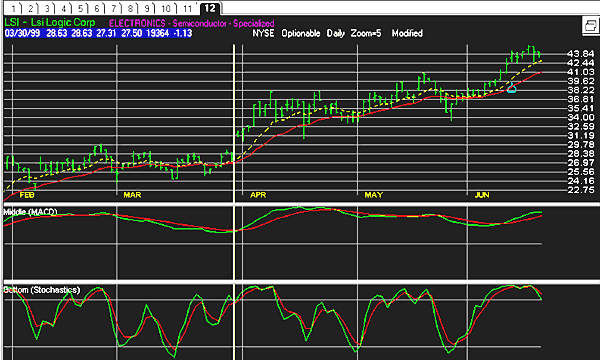
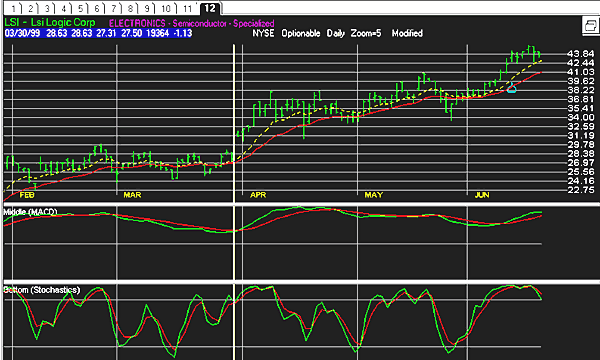
The stoch setting follows George Lane. I review his video weekly and this is his setting. I scan my watchlists for charts with stoch crossing up and if macd confirms the move I check the weekly view. Sometimes I’ll scan the weekly views first to see what is just turning up and then usually buy the stock if the daily view is good. The best time to get in is if both views show a stock beaten down to the 20% line and daily and weekly are now crossing up. The second best time is if the stoch is crossing up and approaching the 75% area and the macd is crossing up and at or above the center line on the macd screen. This is the time for a pop in price. A most recent example is LSI.

I owned this at around 16 using my initial scans of macd and stoch and just added to the position on 3/30 @ 28.25 because it showed the potential for a pop. Within a couple of days the stock jumped 3 points. It’s not foolproof — I toggle between tab 11 and namvet34 tab 12 to confirm my buy signals. I have some trouble with selling signals but just try to sell if the downward crossing of stoch is confirmed by the macd crossing downward. If the weekly view changes to a downward crossing, I always sell. Or sometimes if a stock is really moving up and I have a great profit, I place a mental stop 7% below the highest close during my ownership of the stock. If a stock drops 7% from its highest close, it usually continues to drop, or so it seems with stocks I purchase. I still can’t figure out how to write a scan for my signals, though. As it is, I scan different watchlists I have set up and just keep trading. Happy trading. L.

Swing Trading TC2000 PCF’s – TradeOn.com

Swing Trading:

(idea of Sputnick55)  Someone who holds a stock for its ‘natural’ up cycle (3-6 days), then sells and moves on to the next stock.

Here is an example of a scan I use to find my 3-day wonders; (the 3-day pause before they run).
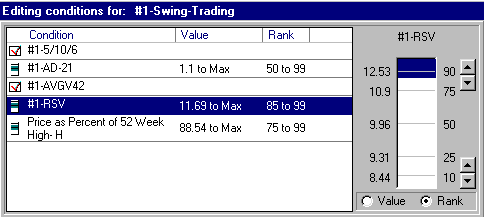
Ad 21 (greater than 50) (“Rank”)
AVG(BOP,21)
. .
. Just set it to greater then 50rank it’s on the bop . Looking for accumulation
Average >15
AVGV42.1 >= 1000 AND C >= 15
. .
. That’s a check off, nothing to adjust for volume and price (You can adjust the value of “C” if you like)
RSV (set for >85)
(“Rank”)
(((C / (.001 + C62)) * .04) + ((C63 / (.001 + C125)) * .02) + ((C126 / (.001 + C188)) * .02) + ((C189 / (.001 +C251)) * .02)) * 100
. .
. That’s not wilders rsi it’s the IBD Relative strength. Look in the Canslim part of the user board. (just have it up there)
52 week high 89-max
(Technicals-Price as Percent of 52 Week High-H “Value”)

5/10/6 (the scan to find the pauses)
(AVGC5 – AVGC10) – (AVG(AVGC5,6) – AVG(AVGC10,6)) < 0
. .
. Nothing to adjust here just add it to the scan criteria. It’s just helps find a slight pause in the heavy moving stocks. Not the end all scan, just a useful tool. I do formations on the chart.

Do some basic charting and watch your volume on them and you have a nice short-term list.

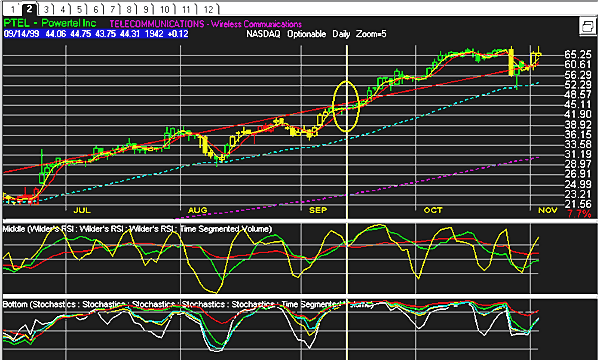
The trick is you need simple real-time monitoring on how I play this bad boy (you could put a limit order in I guess but I don’t do that) The best stocks to look for are stocks that broke out after a bit of a base, this should catch the slight pause. I use a MACD histogram on these. The MORE positive the histogram is (the stochastic does not usually dip down to much, maybe to 60 range never to 20) and the MACD histogram is positive. It indicates a great short-term stock. You do not get a stock every day that meets all my criteria, but I get a few a weeks usually. The scan produces 50-80 stocks a night. It’s a short-term pause and momentum scan (you will notice the stocks are not dropping, they look flat so it’s a go/no go thing). I like it. A good example of what I look for is PTEL about September 14th. This is a GREAT example but not typical of the final results. A trick is the 12/26 MACD histogram. I keep a list of 10 or so stocks that are poised to break out just wait for a nice break above the most recent high (on a good volume) and we are off to the races. Also one thing I would like you all to try for 2 months is run this scan every day (you can omit the 5/10/6 part or not) and save the stocks to a watch list every day. The ones that don’t run will be a great stock in 2-3 weeks. They die off (low volume) and then come back (high volume). Set your favorite indicators to try to pick them up. I think you will be amazed at what you will see in a few weeks. Keep me posted of your progress. You need at least 3 weeks to see.


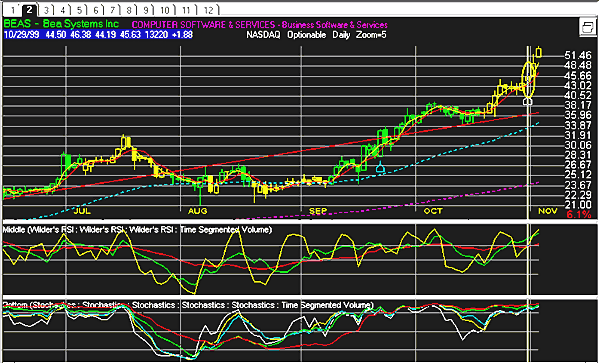
Example: (Found with EasyScan)

Example: (Found with EasySacan)

Books on Swing Trading


Tripple Cross-over – TC2000 PCF’s – TradeOn.com

Tripple Cross-over
Tripple Cross-over (mcsteiny)

If anyone is interested, this is what I have done: I wrote a scan called the “Tripple Cross-over.”
1) cpratsch’s STOC41.5 Turn-up
((STOC41.5.3<20)AND(STOC41.5.2>20)AND(STOC41.5.2<STOC41.5.1)AND(STOC41.5.1<STOC41.5))
2) 5 dma crossing 13 dma
((AVGC5.1<AVGC13.1)AND(AVGC5>AVGC13))
3) (Note: DID NOT USE THIS ONE) TSV8 Before crossing zero
((TSV8>(-(TSV8-TSV8.1)/1))AND(TSV8.1<(-(TSV8-TSV8.1))/1))
4) MACD2,22 Before crossing zero
((AVGC2-AVGC22)>(-((AVGC2-AVGC22)-(AVGC2.1-AVGC22.1))/1)AND(AVGC2.1-AVGC22.1)
<(-((AVGC2-AVGC22)-(AVGC2.1-AVGC22.1))/1))
5) Volume increasing last 2 days
((V2<V1)AND(V>V1)

(Note:) I didn’t use the TSV8, because I use a narrower price band, and I got ‘0’ hits, and MACD seems to pull it in anyway. The TSV8 and MACD2 scans are supposed to put you just crossing the last number before zero. I use 2 Tripple cross-over scans. One with the STOC41.5 Turn up, and also a STOC23.4 Turn up, if no hits with the STOC41.
a) I set up a Tab in TC2000 with a DAILY Bar chart, with the zoom at 4, and MA’s of 40,13,5, exponential.
b) The middle window is a TSV8, simple, with 13 dma, simple.
c) The bottom window is a MACD2,22, simple, with a 13 dma, simple.
d) I set up another tab next to it, with RSI’s, with the top one being a RSI13,3, which is used as the short term selling point, when it goes over the top.
Thank’s to cpratsch for the idea.

When the 5 dma crosses up through the 13 dma, and the 13 dma has started to turn up, and TSV8 is crossing zero, and the MACD2,22 is crossing zero, and the volume has increased for 2 days, or a big spike, it is the start of a move upwards for that stock. It doesn’t just happen when big moves in the stock market occur… it happens in smaller moves, all the time in many stocks. Check PPRT and look for the tripple cross-over in about Wednesday. If I would have bought in then, I could have bought for about 9.70. A day and a half later, it went to 11.38, and then by Friday, it backed down to 10.78 as it started going over the top of RSI13,3, and out for a nice little profit. Check it out.
Mimurry: Tripple Cross-over(mcsteiny)
I thought I would try and give you some more information if you are going to try it. I have been busy testing it. I have tried
many different configurations, and have come up with a few conclusions. First… the Tripple Cross-over can probably work very well in a market rally, or a up market. I check each day in ‘SignalWatch,’ for a forecast opinion by Ed Downs, of the Dow that day, and what he thinks will happen the next day, and what to look for as far as levels during the next session. If the market is negative, I would try something else.
Also, I forgot to say in my repost to set the MACD in item 4 to a histogram. It is used as a visual indicator, with the TSV8.
I tried creating several different types of Tripple Cross-over scans. I tried leaving out the “MACD before crossing zero,” and using item #3, “TSV before crossing zero,” with the “TSV slope indicator” PCF, with the slider set at rank. Using the slope indicator, I tried using the top 10%, the middle 30%, and the bottom 25%. It worked, but not great! If you want to experiment with the TSV, for short term trading, use a period between 9 and 12. The TSV is unique because it also indicates accumulation, and distribution, by measuring the amount of money flowing in or out of a stock. That helps visually, and is why I used it in my tab, and still use it. The reason I took out the MACD, is because I discovered that the MACD is a TREND indicator, and TSV, RSI, and STOC, are OSCILLATORS indicators, and are better suited for this purpose. The OSCILLATORS, appear to be driven by price, and the MACD by time. I also tried using RSI as the primary scan PCF, and I have concluded that perhaps they over control the scan, along with even “5dma crossing 13dma, putting the price to far past the “Pop.” I am trying to also catch that Pop, or spike if you will, just before it happens. I am still testing, but it might be enough, just to use:
1) STOC41.5 Turn-up
((STOC41.5.3<20)AND(STOC41.5.2>20)AND(STOC41.5.2<STOC41.5.1)AND(STOC41.5.1<STOC41.5))
2) 5 dma increasing
((AVGC5>AVGC5.1))
3) 13 dma increasing
((AVGC13>AVGC13.1))
4) Volume increasing last 2 days
((V2<V1)AND(V>V1))
or, with minimum volume 70,000 optional;
((V2<V1)AND(V>V1)AND(MINV>700))
5) (In Wordens fundamental criteria)
“EPS Percent Change (Latest Quarter)”
*This should enhance the probability that the stocks will increase in price, rather than tank. No guarantee though! It is the percentage change in earnings per share from the comparable quarter a year before. Timely stocks will usually have strong recent quarterly earnings to validate the annual earnings strength. It reads in percentage.
6) (In Wordens technical criteria) “Price per share” your range.
I use this scan along with the other conventional Tripple Cross-over’s. This one usually narrows down to hits in the teens. Then I copy it over to a bulleted directory, and visually go through them, eliminating some, and tagging the ones I want. I have set up other tabs with RSI, STOC, and MACD’s. Experiment with them, and use all of your indicators on the tabs, they will help. I also do the fundamental things, such as check the news, get a rating in IBD, etc. I have made some money so far… however, I have restrained myself, until I can test this further. I have even been doing intra-day scans on TC2000, trying to catch the Tripple Cross-over, and nail it. I’m still working on that also, so I don’t have a lot to report. I hope I have helped… I hope this scan works for you or anyone else trying it. Change it… improve it… make it work! I would be interested to know how you have done with it. Good luck!

“If you always do… what you always did… you’ll always get… what you always got!”

Also check out the Tripple Screen Trading System

Stochastic RSI: StochRSI – TC2000 PCF’s – TradeOn.com

StochRSI – PCF’s

NeuroCat (ejr39)

Recently, I began reading SI’s TA – Beginner’s thread and realized that most of the DNS could be programmed in TC2000 version 4; so now, for Chandle’s Stochastic RSI: StochRSI = (RSI – RSIL)/(RSIH -RSIL) where RSIL and RSIH are the lowest and highest values of the RSI over a given period. In his book he uses 14 periods.

In TC2000, the translation for StocRSI is: ((RSI14 – MIN(RSI14,14)) / ((MAX(RSI14,14) – MIN(RSI14,14))+.001) * 100)

As you know, Catlady, TC2000 doesn’t have charting capabilities for the StocRSI; the StochRSI > 30 is simple:

((RSI14 – MIN(RSI14,14)) / ((MAX(RSI14,14) – MIN(RSI14,14))+.001) * 100) > 30

But how is the direction of the indicator determined (using only TC2000) – would work?
((RSI14 – MIN(RSI14,8)) / ((MAX(RSI14,8) – MIN(RSI14,8))+.001) * 100) > ((RSI14 – MIN(RSI14,14)) / ((MAX(RSI14,14) – MIN(RSI14,14))+.001) * 100)
StoRSI increasing (NeuroCat01)
Try this for StochRSI today – StochRSI 2 days ago > 0
(((RSI14 – MIN(RSI14,14)) / ((MAX(RSI14,14) – MIN(RSI14,14))+.001) * 100) ) – (((RSI14.2 – MIN(RSI14.2,14)) / ((MAX(RSI14.2,14) – MIN(RSI14.2,14))+.001) * 100)) > 0
Using 2 days difference instead of 1 was a totally arbitrary decision on my part. I charted the same StoRSI indicators in Metastock and the charts look OK to me.
StoRSI today
(RSI(14)-LLV(RSI(14),14))/((HHV(RSI(14),14)-(LLV(RSI(14),14)))+.001)*100 StoRSI 2 days ago

(Ref(RSI(14),-2)-LLV(Ref(RSI(14),-2),14))/((HHV(Ref(RSI(14),-2),14)-(LLV(Ref(RSI(14),-2),14)))+.001)*100
Also, your StoRSI formula agrees with Chande’s but the folks on SI seem to be using a version with an extra Moving Average thrown in for smoothing, like this:
Mov((RSI(14)- LLV(RSI(14),14)) /((HHV(RSI(14),14)-(LLV(RSI(14),14))),14,E)+.001)*100
Now, that would be hardier in TC2K, do we need it?

StochRSI14 (ejr39)
(((RSI14 – MIN(RSI14,14)) / ((MAX(RSI14,14) – MIN(RSI14,14))+.001) * 100)) / (((RSI14.2 – MIN(RSI14.2,14)) /
((MAX(RSI14.2,14) – MIN(RSI14.2,14))+.001) * 100)) > 0

StochRSI14 (ejr39) PCF for StocRSI14
(((RSI14 – MIN(RSI14,14))/((MAX(RSI14,14) – MIN(RSI14,14))+.001) * 100)) – Copy the PCF to your WP8; remove any extra spaces that the Yahoo message editor adds before copying the PCF to
TC2000’s PCFormula Window.
09 Chan’s DNS modification PCF is added to the DNS/Dahl EasyScan. If the modification enhances your personal DNS/Dahl EasyScan than continue to use the modification; otherwise, remove the PCF.

StochRSI and DNS (ejr39)
PCF’s used to screen bulleted WatchLists containing DNS or Dahl only stocks. (Check message 3867 for StochRSI’s purpose.) StochRSI14
((RSI14 – MIN(RSI14,14)) / ((MAX(RSI14,14) – MIN(RSI14,14))+.001) * 100) > 30
StochRSI14.2
((RSI14.2 – MIN(RSI14.2,14)) / ((MAX(RSI14.2,14) – MIN(RSI14.2,14))+.001) * 100) < 30
StochRSI8.5
((RSI8 – MIN(RSI8,5)) / ((MAX(RSI8,5) – MIN(RSI8,5))+.001) * 100) > 20
StochRSI(14) should be crossing UP THROUGH 30

StochRSI(8.5) should be crossing UP THROUGH 20 and may even be crossing up through 80

StochRSI explained (ejr39)

StochRSI = (RSI – RSI “lowest RSI during period”) / (RSI “highest RSI during period” – RSI “lowest RSI during period).

“As an RSI user, you may have been frustrated when the RSI did not reach an extreme value (above 80 or below 20) for months at a time. Perhaps you wanted an entry point into an ongoing trend, and were looking for a price extreme, but couldn’t find one using RSI. The solution to your problem is the Stochastic RSI (StochRSI).” “The StochRSI combines the two popular ideas behind the RSI and the Stochastic oscillator. The Stochastic oscillator measures the location of closing prices within the recent high to low range. Similarly, StochRSI measures the location of RSI within its recent range, showing short-term momentum extremes. It can be used as an anti trend or a trend-following tool.”

“The sensitivity of the StochRSI overcomes the disadvantages of using a fixed number of days in its calculation and the tendency of the built-in RSI smoothing to mask short-lived price extremes while showing swing failures in RSI. The ability to spot short-term extremes in RSI (and momentum) is its principal advantage. The StochRSI is a more consistent indicator of overbought and oversold conditions simply because we are measuring its position within the most recent range.”

The above explanation of StochRSI was taken from “The New Technical Trader” by Tushar S. Chande and Stanley Kroll