Big Dog Bounce:
Up trending stocks that take a dip
PCFs:
1)
#25-Stoch7.3.10
(STOC7.3.2>STOC7.3.1) AND (STOC7.3>STOC7.3.1)
2) #26-RSI3.3 (RSI3.3.2>RSI3.3.1)
AND (RSI3.3>RSI3.3.1)
3) #6-Big-Dog-Bounce (MAXH5.1>C*1.1)
AND (STOC7.3<50) AND (STOC28.3>50) AND (C>AVGC21)
4) #24-Risk-Reward % ((MAXC21-AVGC21)/AVGC21)*100
EasyScan:
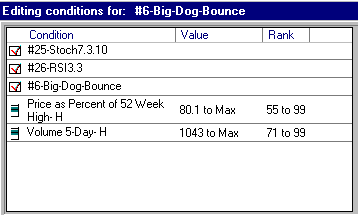
Tab: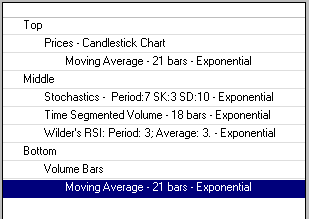
Rules:
1) Big Dog Bounce
sort value is “TRUE”
2) The Stochastic
%K line below the midline – below 20 for the best risk/reward.
3) The Stochastic
%K line must have a hook turning up.
4) The Stochastic
%D line above the midline.
5) Wilder’s RSI hooking
up which confirms the direction of the Stochastic %K.
6) Volume drying on
way down, resuming on pivot.
7) At least 10 – 20%
between lowest close and previous high during the last 7 – 10 bars.
8) If after the pivot
the stock stays flat or goes down, get out. You want big strength going
to new highs.Usually this happens within 3 to 7 bars. This will provide
very short term candidates, the expiration date is usually when prices
meet the previous high. Stay nimble. This scan produces leads NOT buy
triggers.
Philosophy:
1) The first pullback
(dip) from a new high is USUALLY buyable.
2) Strong stocks tend
to pull back (dip) to the 21 day moving average before rebounding.
3) A 21 day cycle
USUALLY indicates institutional buying.
4) Remember: RESISTANCE
is the highest CLOSE during the past 21 days. SUPPORT is the 21 dma.
5) If the stock price
drops more than 20% below resistance or if the stock price drops below
the 21 dma, avoid the trade.
6) Is the trade worth
the trouble? Use PCF #24 to find the RISK/REWARD percentage. The higher
the better.
Example:
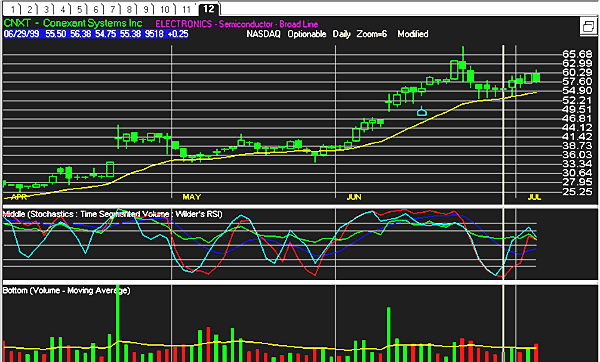
CNXT was picked as the only stock by the above scan on June 26, 1999.